
Dănești
The House of Dănești: Dynastic Legitimacy, Princely Rivalry, and the Struggle for Wallachia
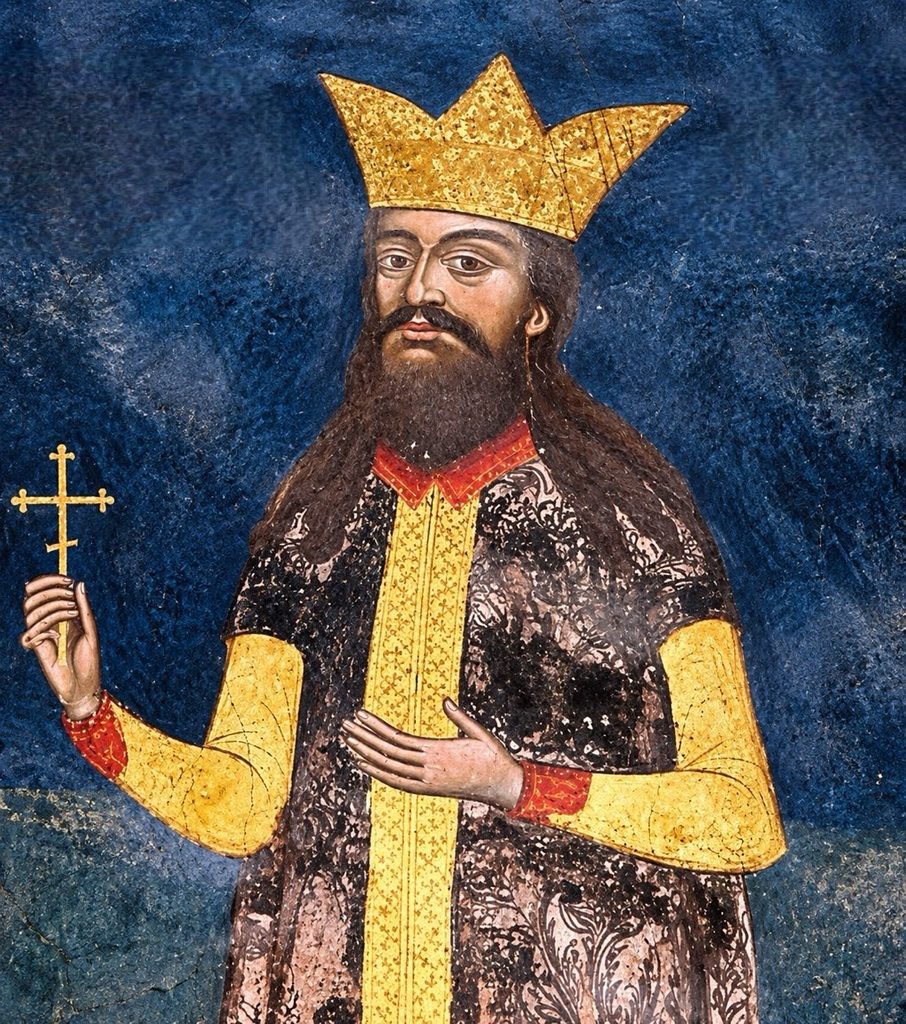
Fresco depicting Basarab III Laiotă cel Bătrân, Horezu Monastery.
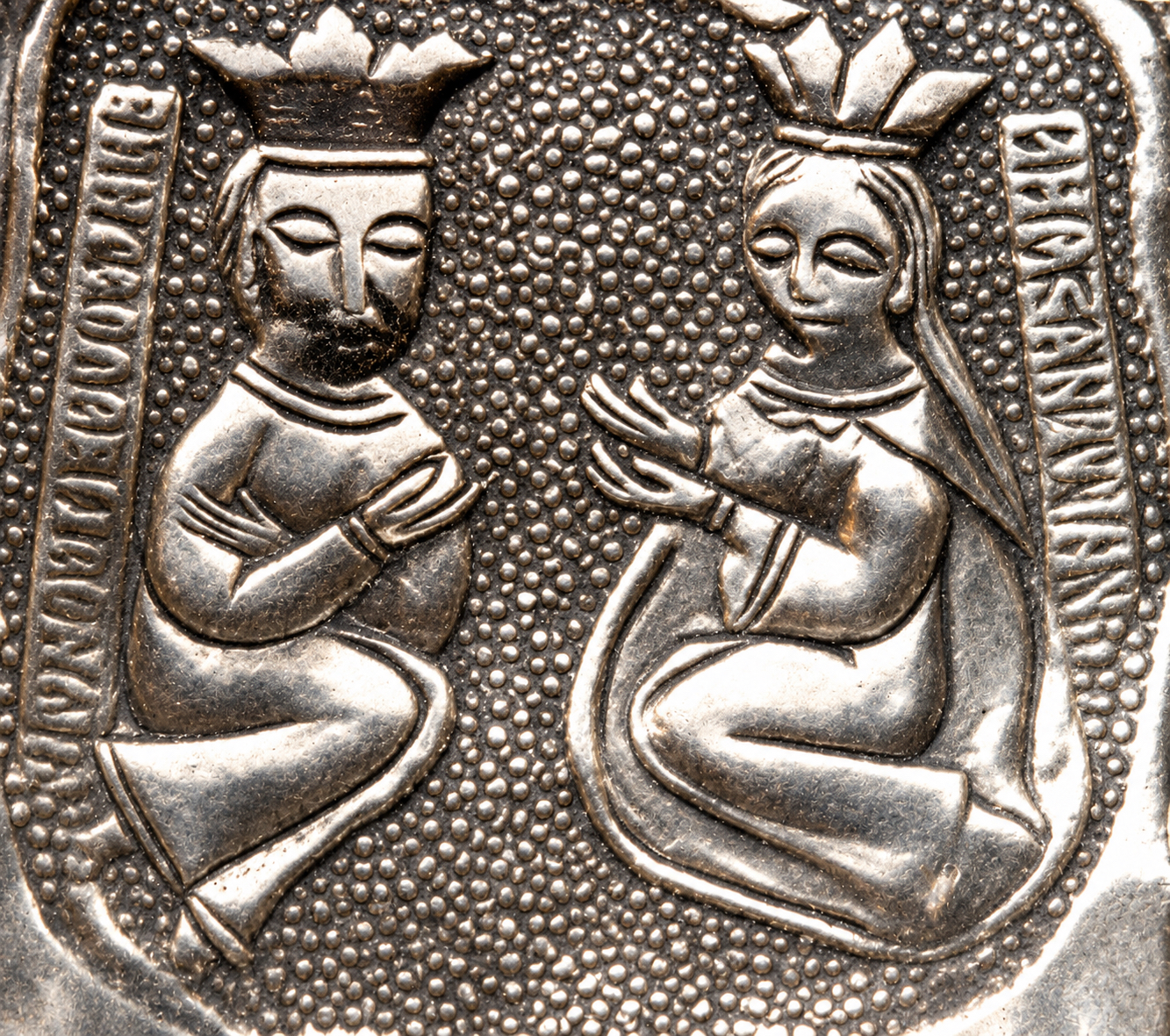
Vladislav II. and Doamna Neacșa depicted on a 15th-century silver reliquary at the Monastery of St. Stephen (Meteora). Digital restoration and preparation by Basarab Heritage.
I. Origins and Dynastic Identity
The House of Dănești occupies an important place in the political history of medieval Wallachia. Traditionally regarded as one of the principal branches of the House of Basarab, the Dănești produced several princes who ruled the principality during the late fourteenth and fifteenth centuries. Their history illustrates how dynastic descent shaped claims to princely authority in a political environment marked by competing family lines, shifting alliances, and the involvement of powerful neighbouring states.
The name Dănești derives from Dan I, conventionally identified as a son of Radu I and a brother of Mircea cel Bătrân. Dan I is traditionally regarded as the founder of the branch. Although this genealogical framework forms part of the established account of the Basarab dynasty, the precise chronology and relationships of some early rulers remain subjects of historical discussion. The origins of the Dănești should therefore be understood within the broader development of medieval Wallachia, while individual genealogical claims are assessed according to the available evidence.
The emergence of distinct branches within the ruling house was a significant feature of Wallachian political life. Dynastic descent could provide a credible foundation for a claim to the throne, but it did not establish an automatic or uninterrupted succession. Several members of the same ruling family could advance competing claims, and the outcome of a succession dispute often depended on political support, military strength, and the ability to secure recognition from influential domestic and foreign actors.
The Dănești became particularly prominent through the repeated interventions of their members in the struggle for Wallachia’s princely office. Dan II, for example, occupied the throne on several occasions during the early fifteenth century, despite repeated challenges from his rival Radu II. His career demonstrates that a dynastic claim could survive the loss of power and be renewed when political and military circumstances changed.
During the fifteenth century, the Dănești’s most prominent dynastic rivals were the Drăculești, the branch associated with Vlad II Dracul and his descendants. The two lines advanced competing claims to the same princely inheritance, and their rivalry contributed to repeated changes of ruler. Yet the Dănești should not be understood merely as opponents of the Drăculești. They represented a distinct branch of the wider Basarab tradition, with their own rulers, political interests, and strategies for obtaining and maintaining authority.
The history of the Dănești consequently offers an important perspective on the House of Basarab as a whole. It reveals how a shared dynastic inheritance could become the basis for competing claims to power, while the fortunes of individual branches depended on their ability to translate lineage into effective political authority.
II. Dynastic Legitimacy and the Contest for the Throne
In medieval Wallachia, princely succession was shaped by dynastic descent, political alliances, the support of influential boyar families, and the intervention of neighbouring powers. Membership in the ruling house could establish a credible claim to authority, but it did not guarantee accession to the throne or the uninterrupted possession of princely power. A claimant also needed the military and political means to overcome rivals and maintain a functioning government.
The career of Dan II provides a particularly clear illustration of this situation. During the first decades of the fifteenth century, his rule was interrupted repeatedly by the competing claims of Radu II. Dan II regained the throne on several occasions, demonstrating both the persistence of his dynastic claim and the importance of political and military capacity. His repeated returns also reveal the instability of succession in Wallachia, where possession of the princely office could remain contested even after a ruler had established himself.
These conflicts were not simply private disputes between members of an extended ruling family. They affected the principality’s political orientation and its relationships with neighbouring powers. Dan II maintained important connections with Sigismund of Luxembourg, King of Hungary, and participated in efforts to resist Ottoman expansion. His rivalry with Radu II, who received Ottoman support at different points in the struggle, illustrates how domestic succession disputes became intertwined with the wider strategic competition between Hungary and the Ottoman Empire.
The involvement of neighbouring powers could strengthen a claimant’s position, but it also introduced additional pressures. Hungarian or Ottoman support did not necessarily reflect an enduring commitment to a particular dynastic branch.
Rather, external powers pursued their own strategic interests, and their relationships with Wallachian princes could change as circumstances evolved. A claimant’s ability to obtain assistance therefore depended not only on descent but also on diplomacy, military prospects, and the interests of potential allies.
The rivalry continued into the middle and later fifteenth century. Vladislav II, traditionally identified as a son of Dan II, became one of the most prominent Dănești rulers. His struggle with Vlad III Drăculea brought the competition between the two branches into particularly sharp focus. Vladislav’s periods of rule and the repeated challenges to his authority illustrate how dynastic legitimacy, military intervention, and external support could determine the outcome of a succession dispute.
A similar pattern can be observed in the career of Basarab III Laiotă cel Bătrân, another ruler traditionally associated with the Dănești. His repeated accessions during the 1470s took place amid the continuing struggle with Radu cel Frumos of the Drăculești line and other claimants to the throne. His career demonstrates that the rivalry was not resolved through a single decisive confrontation. Instead, control of Wallachia continued to shift as rulers gained or lost the support necessary to maintain their position.
The relationship between the Dănești and the Drăculești should not, however, be portrayed as a confrontation between two permanently unified factions. Dynastic affiliation mattered, but political alignments were shaped by changing circumstances, personal interests, and the involvement of domestic and foreign actors. Individual rulers must therefore be considered within the particular conditions of their reigns rather than treated as representatives of an unchanging dynastic policy.
For the Dănești, the struggle for the throne was both a question of inheritance and a test of political capacity. Their history demonstrates that dynastic legitimacy provided an important foundation for princely authority, while the exercise of that authority depended on the continuing ability to secure support, manage rival interests, and maintain control in a contested political landscape.
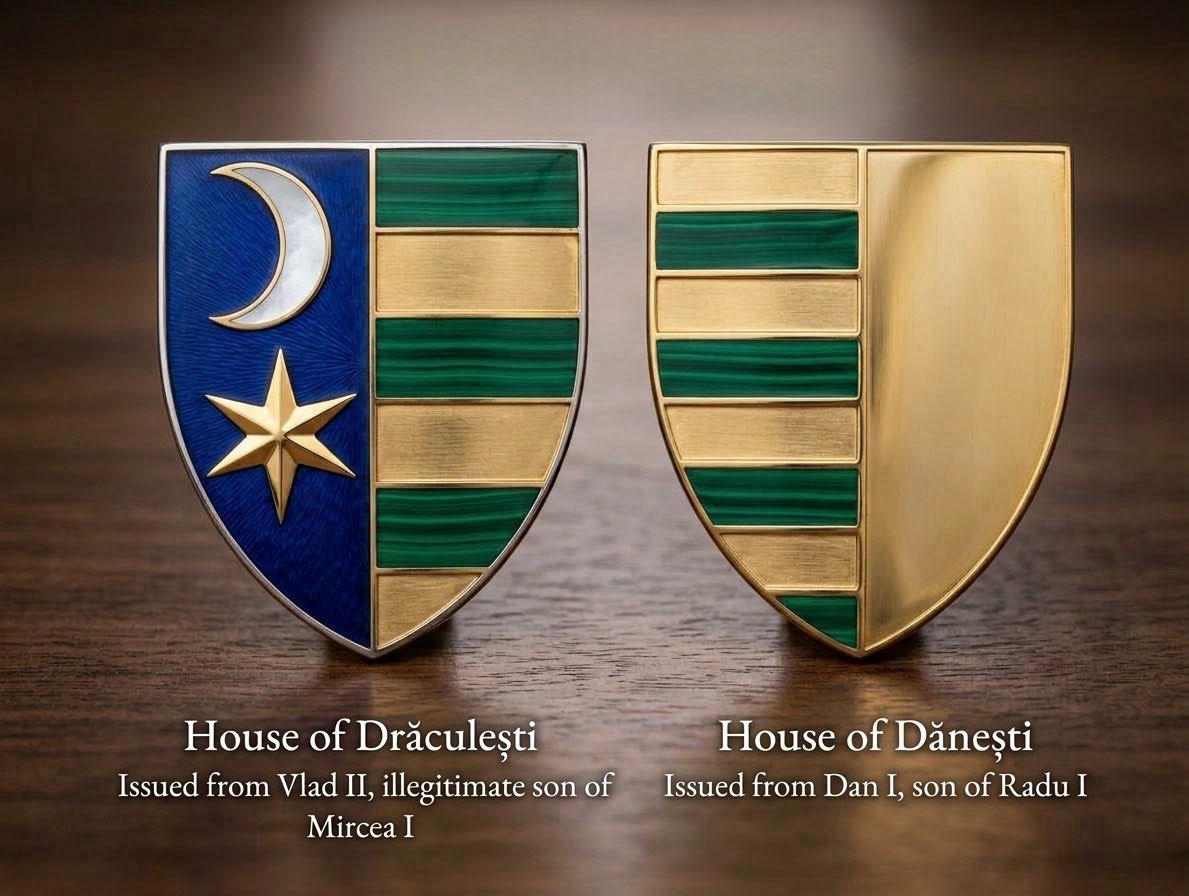
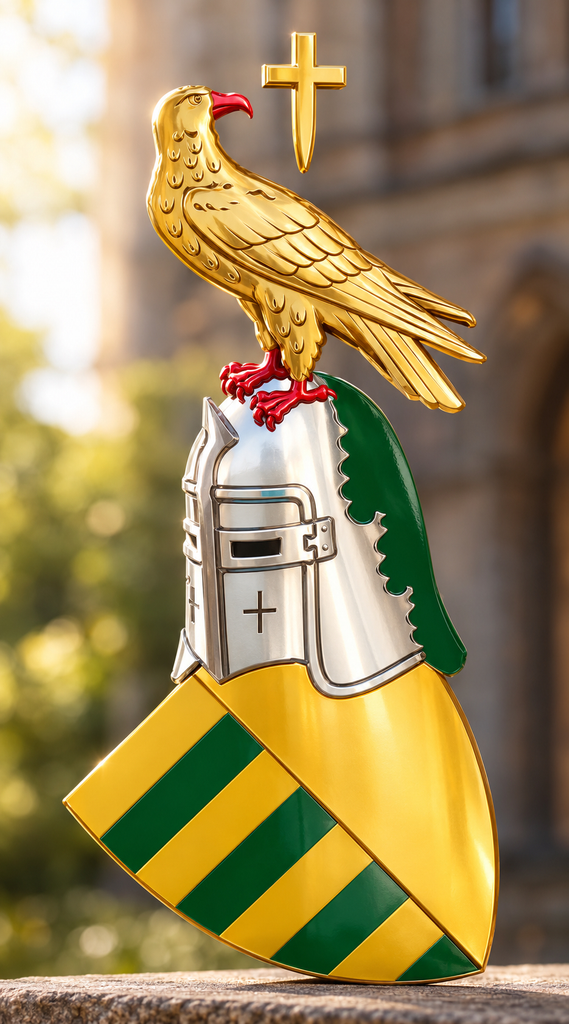
Heraldic emblem of the House of Basarab – digital asset curated by Basarab Heritage.
III. Princely Government, Diplomacy, and Wallachia’s Political Autonomy
The Dănești pursued their political ambitions within a region of considerable strategic importance. Wallachia lay between the Carpathians and the lower Danube, connecting Central and Southeastern Europe while bordering territories influenced by the Kingdom of Hungary and the expanding Ottoman Empire. Its rulers had to navigate the interests of powerful neighbours while preserving the institutions and resources through which the principality was governed.
Princely rule required more than a legitimate claim to the throne. A ruler had to maintain relations with the boyar elite, administer the affairs of the principality, secure revenues and military resources, and sustain the political relationships on which effective government depended. The princely court served as a centre of administration and diplomacy, while cooperation with influential local groups remained essential to the exercise of authority.
The reign of Dan II offers a concrete example of the relationship between government and diplomacy. His connections with Sigismund of Luxembourg formed part of a broader effort to maintain Wallachia’s position amid growing Ottoman pressure. Surviving documentary evidence, including records relating to his political and economic connections with the Transylvanian Saxons of Brașov, also provides insight into the networks that supported Wallachian rule. Such evidence helps move the history of the Dănești beyond the succession struggle alone and toward the practical relationships through which a prince exercised authority.
Dan II’s repeated returns to power further illustrate the importance of military capacity. His political position depended not simply on his place within the Basarab dynasty, but on his ability to assemble support and respond to changing circumstances. His career should not be taken as evidence that all Dănești rulers followed the same diplomatic or military policy. Rather, it shows how one prince used the resources and alliances available to him in a particular period.
Diplomacy remained an essential instrument of Wallachian government throughout the fifteenth century.
Political agreements, negotiations, alliances, and military cooperation could strengthen a prince’s position, but their effectiveness depended on circumstances often beyond his control. A change in regional priorities or the emergence of a rival supported by another power could quickly alter the balance. The fortunes of Vladislav II and Basarab III Laiotă cel Bătrân must be understood within this environment of competing claims and shifting support.
Relations with the Ottoman Empire became increasingly consequential as Ottoman power expanded in Southeastern Europe. Wallachian rulers had to negotiate the conditions under which they could preserve their authority while responding to Ottoman demands. At the same time, relationships with the Kingdom of Hungary could offer diplomatic or military support, although they too involved strategic interests that did not always coincide with those of Wallachia.
The principality’s position should not be reduced to a simple choice between complete independence and uninterrupted foreign control. Wallachia retained its own princely institutions and internal political structures, even as its rulers faced pressure from more powerful neighbours. The extent of their practical freedom varied according to military strength, diplomatic circumstances, and the wider balance of power.
The Dănești formed part of this broader history of princely government. Their individual policies and political circumstances were not identical, and their actions should be assessed in relation to the challenges of each reign. Their significance lies not in a single, consistent foreign policy, but in the ways their rulers sought to secure the throne, maintain political relationships, and exercise authority within a demanding regional environment.
Their history therefore extends beyond dynastic rivalry. It also illuminates the practical challenges of governing medieval Wallachia, where princely authority depended on the interaction of local institutions, aristocratic support, military resources, and diplomacy.
IV. Orthodox Christianity and the Cultural Context of Princely Rule
Orthodox Christianity occupied a central place in the religious and cultural life of medieval Wallachia. Churches and monasteries served as places of worship and prayer, but they also contributed to the preservation of written culture, the production of religious art, and the continuity of spiritual traditions across generations. Religious institutions formed an important part of the society in which the Dănești and other branches of the Basarab dynasty exercised authority.
Princely patronage was one expression of this relationship between political power and religious life. Rulers and members of the aristocracy could support ecclesiastical institutions through foundations, donations, commissions, and other acts of benefaction. Such support could express religious commitment, strengthen relationships with ecclesiastical communities, and preserve the memory of patrons. The significance of these activities, however, varied according to the circumstances and resources of individual benefactors.
The wider religious landscape of Wallachia provides an important context for understanding the Dănești. The Great Princely Church at Târgoviște, for example, illustrates the close relationship between Orthodox worship, princely representation, and the visual expression of authority in the principality. Its architectural and artistic heritage belongs to the broader history of Wallachian princely patronage. It should not, however, be presented as a specific achievement of the Dănești without evidence establishing a direct connection to an individual ruler of that branch.
This distinction is important because the religious heritage of medieval Wallachia developed across generations. A church might be founded under one ruler, supported by another, and subsequently enlarged, restored, or redecorated. The surviving appearance of a monument may therefore reflect several different periods of patronage. The date of a building, the date of its surviving paintings, and the identity of its patrons must be distinguished when interpreting its historical significance.
Wallachia’s religious and cultural connections also extended beyond its political borders. The wider Orthodox world provided a framework for spiritual exchange, ecclesiastical relationships, and the movement of religious objects, texts, and artistic traditions. These connections formed part of the cultural environment in which Wallachian rulers and communities participated, although particular relationships or acts of patronage must be established through evidence specific to the individuals concerned.
The Dănești belonged to a ruling tradition in which Orthodox Christianity provided an important framework for religious life and cultural identity. Their history can therefore be situated within the wider ecclesiastical culture of Wallachia without attributing unsupported foundations or donations to the branch. Where a particular act of patronage can be securely associated with an individual ruler, it can illuminate that ruler’s religious commitments and political relationships. Where the evidence does not support such an attribution, the broader cultural context remains relevant in its own right.
The study of the Dănești thus reaches beyond the political contests for which the branch is chiefly remembered. It offers an opportunity to consider the religious and cultural environment of medieval Wallachia and the ways in which faith, princely authority, and historical memory interacted within the wider Basarab tradition.
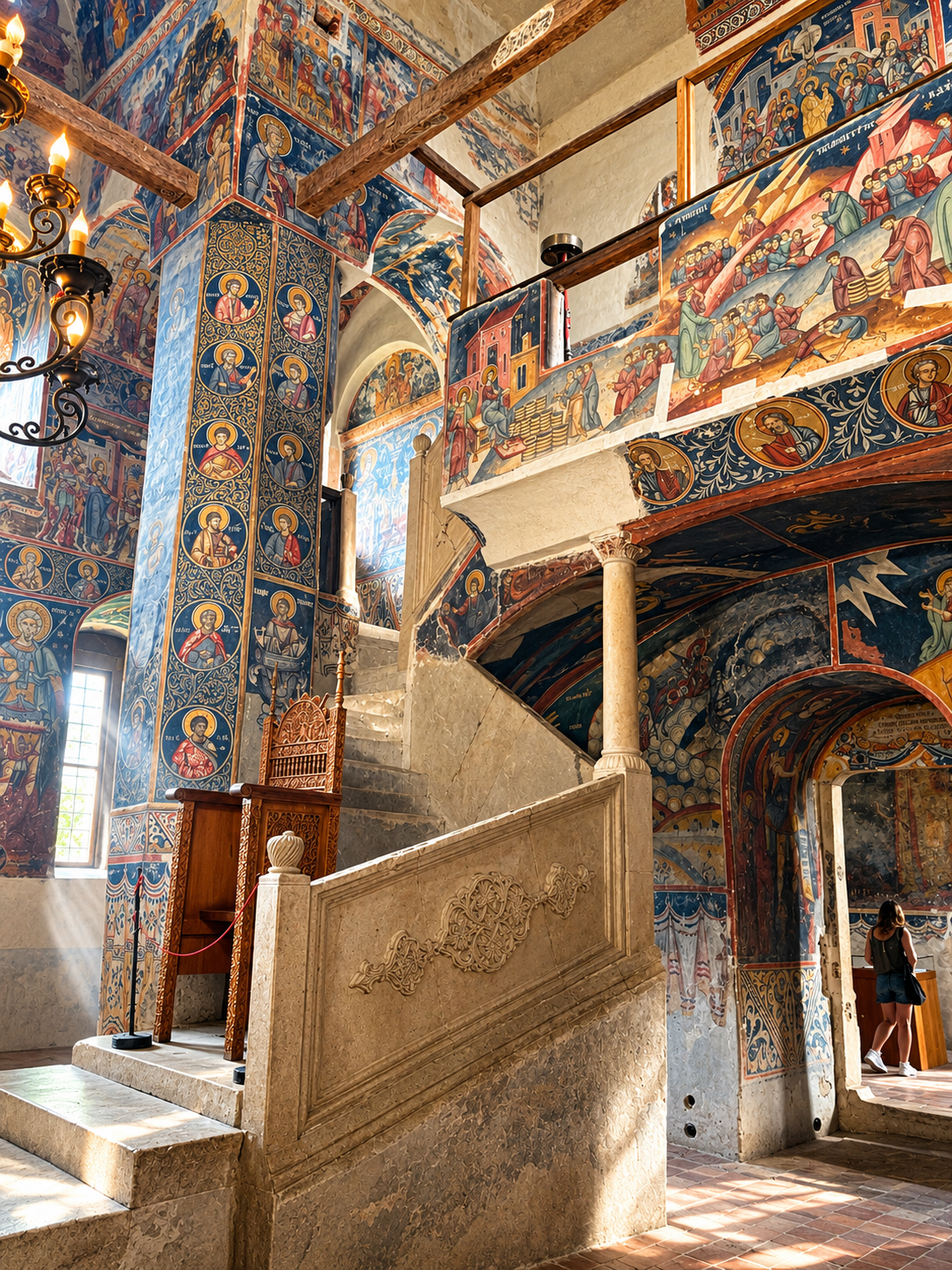
Interior of the Great Princely Church (Biserica Mare Domnească) at the Princely Court of Târgoviște, showcasing the princely throne and post-Byzantine fresco cycles that reflect the religious patronage of Wallachia’s rulers.
V. Historical Legacy and the Dănești within the Basarab Dynasty
The historical significance of the Dănești extends beyond their rivalry with the Drăculești. Their place within the House of Basarab reveals how dynastic descent shaped political legitimacy in medieval Wallachia and how competing claims to a shared inheritance could influence the government of the principality.
The careers of Dan II, Vladislav II, and Basarab III Laiotă cel Bătrân illustrate different aspects of this history. Dan II’s repeated returns to the throne demonstrate the persistence of a dynastic claim in the face of political and military challenges. Vladislav II’s struggles with Vlad III Drăculea reveal the intensity of the competition between the two branches during the mid-fifteenth century. Basarab III Laiotă’s repeated accessions in the 1470s show that the rivalry remained unresolved through successive changes of ruler.
Taken together, these examples demonstrate that the history of the Dănești cannot be understood simply as a sequence of successful and unsuccessful claimants. Their political fortunes were shaped by the interaction of lineage, military capacity, domestic alliances, and the interests of neighbouring powers. A claim to princely authority could endure even when its holder lost the throne, while a successful accession did not guarantee a stable or lasting reign.
The relationship between the Dănești and the Drăculești was therefore both a family rivalry and a struggle over the exercise of princely authority. Both branches belonged to the wider Basarab tradition, yet their competing claims contributed to repeated changes of ruler during a period of considerable political uncertainty. Their shared dynastic background did not prevent conflict; it provided the basis on which rival claims to legitimacy could be advanced.
The history of the Dănești also highlights the importance of distinguishing political prominence from genealogical continuity. The decline of a branch as a significant source of princely claimants does not, by itself, establish the extinction of every possible family connection or collateral line. Any claim about the complete end of a lineage must be supported by genealogical evidence rather than inferred solely from the loss of political influence.
Nor should the history of the Dănești be separated from the wider development of Wallachia. Their rulers operated within institutions and political relationships that continued to evolve, while the principality remained exposed to the competing interests of its neighbours. The succession struggles in which they participated formed part of a broader history of political adaptation, in which dynastic inheritance, aristocratic support, diplomacy, and military power all shaped the possibilities of princely government.
The Dănești represent an essential chapter in the history of the House of Basarab. Their experience reveals how a medieval ruling dynasty could contain competing branches, each seeking to turn inherited legitimacy into effective authority. It also demonstrates why the political history of Wallachia cannot be understood through a single line of rulers alone.
To study the Dănești is to examine the contested nature of dynastic power in medieval Wallachia. Their legacy lies not only in the individual princes who held the throne, but also in what their careers reveal about succession, political allegiance, and the challenges of governing a principality situated between powerful regional neighbours. Through their history, the wider Basarab tradition emerges not as a simple succession of rulers, but as a complex political inheritance shaped by rivalry, negotiation, and changing circumstances.
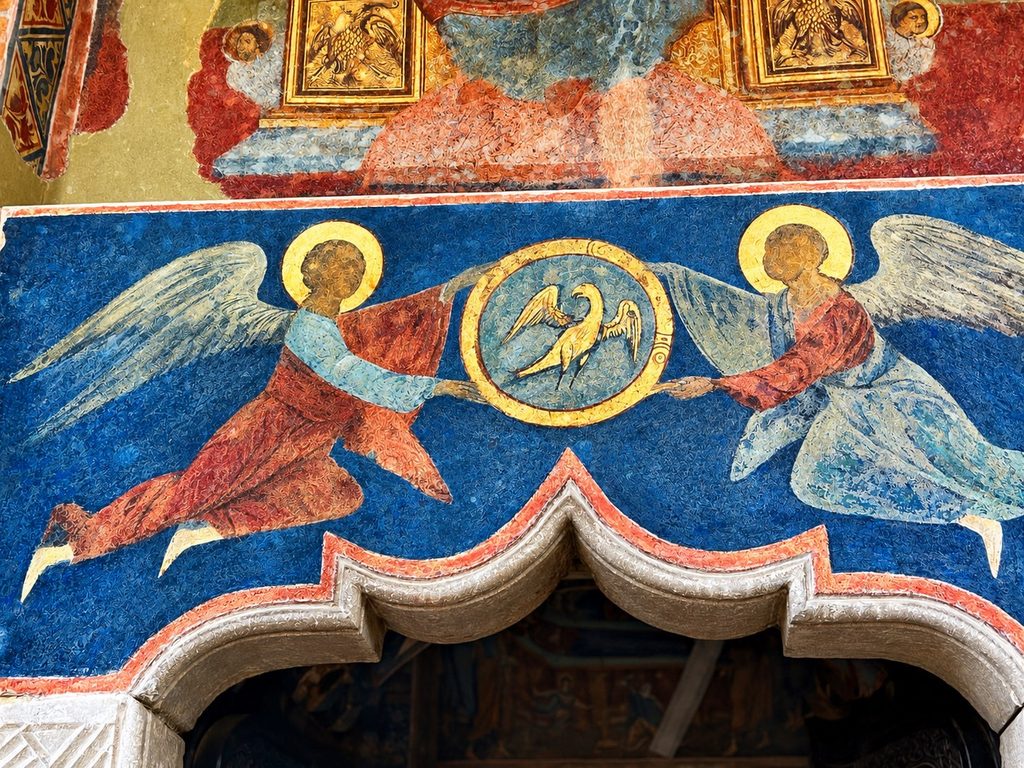
Ecclesiastical wall painting from the Princely Court of Târgoviște, illustrating the intertwining of divine sanction and dynastic authority in medieval Wallachia.
Chronology of the Dănești Princes of Wallachia
The House of Dănești was one of the principal branches of the Basarab dynasty, whose members repeatedly contested or occupied the princely throne of Wallachia between the late fourteenth and early sixteenth centuries. Their history reflects the complex nature of medieval succession, in which dynastic descent, political alliances, military strength, and the support of neighbouring powers all influenced the exercise of princely authority.
The chronology below follows the commonly used identification of the principal Dănești rulers. Some early genealogical relationships and regnal dates remain disputed, particularly those concerning the princes named Dan in the late fourteenth and early fifteenth centuries. These uncertainties are noted where they materially affect the historical interpretation.
Dan I
- Prince of Wallachia: 1383-1386
- Dan I is traditionally regarded as the founder of the Dănești branch of the Basarab dynasty. Commonly identified as a son of Radu I, he ruled Wallachia from 1383 until his death in 1386. His descendants formed a distinct branch of the ruling family, whose members continued to advance claims to the princely throne during the following generations.
Dan I’s place in the Basarab genealogy is central to the traditional understanding of the Dănești. The precise relationships among some early members of the dynasty, however, have been reconsidered by modern historians.
Vlad I Uzurpatorul
- Prince of Wallachia: approximately 1394-1397
- Vlad I, traditionally identified as a son of Dan I, challenged the authority of Mircea cel Bătrân and briefly occupied the Wallachian throne during the 1390s. His accession illustrates the contested character of princely succession, in which members of the ruling dynasty could advance competing claims to authority.
The epithet Uzurpatorul, meaning “the Usurper”, reflects the traditional interpretation of his challenge to Mircea’s rule. It should be understood as a historiographical designation rather than as a neutral contemporary title.
The precise chronology of Vlad I’s reign has been debated, and some modern reconstructions place the beginning of his rule in 1396 rather than 1394.

Portrait of Dan II, Voivode of Wallachia (House of Dănești), based on a 19th-century rendering. Digital restoration and preparation by Basarab Heritage.

Portrait of Vladislav II, Voivode of Wallachia (House of Dănești), based on a 19th-century rendering. Digital restoration and preparation by Basarab Heritage.
Dan II
- Prince of Wallachia: 1422-1426 and 1427-1431, according to the conventional chronology
- Dan II is traditionally regarded as one of the most prominent Dănești princes of the early fifteenth century. His repeated returns to the throne during the succession struggle with Radu II illustrate the instability of Wallachian politics during this period.
His career was closely connected with the wider competition between the Kingdom of Hungary and the Ottoman Empire. Dan’s political position depended on military support, diplomacy, and the shifting interests of neighbouring powers. His repeated accessions demonstrate that a dynastic claim could survive the loss of the throne and be renewed when political circumstances changed.
The identification and chronology of Dan II require particular caution. Some historians have argued that the traditional account combines the careers of more than one ruler named Dan. Andrei Pippidi’s revised reconstruction distinguishes Dan III, a son of Mircea cel Bătrân, from Dan IV, a son of Dan I. The distinction is explained in the note on Dan III below.
Basarab II
- Prince of Wallachia: 1442-1443
- Basarab II, traditionally identified as a son of Dan II, briefly occupied the Wallachian throne in 1442-1443. His reign took place amid the continuing rivalry between the Dănești and Drăculești branches and the growing involvement of the Kingdom of Hungary in Wallachian affairs.
His short period of rule ended when Vlad II Dracul regained the throne. Basarab II’s career illustrates the continuing importance of dynastic descent while also demonstrating that princely authority depended on the ability to maintain political and military support.
Vladislav II
- Prince of Wallachia: 1447-1456, with an interruption in 1448
- Vladislav II, traditionally identified as a son of Dan II, was one of the most significant Dănești rulers of the fifteenth century. He came to power in 1447 following the overthrow and death of Vlad II Dracul.
His reign was closely connected with the political and military interests of John Hunyadi, the leading Hungarian military commander and regent. In October 1448, Vlad III Țepeș briefly displaced Vladislav, but Vladislav soon regained the throne and continued to rule until 1456.
His prolonged conflict with Vlad III illustrates the intensity of the rivalry between the Dănești and Drăculești branches. It also demonstrates how Wallachian succession disputes were shaped by both domestic political divisions and intervention from neighbouring powers.
Basarab III Laiotă cel Bătrân
- Prince of Wallachia: 1473-1477, during several separate reigns
- Basarab III Laiotă cel Bătrân was a recurring claimant and ruler during the succession struggles of the 1470s. His first accession occurred in November 1473, and he subsequently regained the throne on several occasions after being displaced by Radu cel Frumos and other rivals.
His periods of rule took place amid continuing competition between the Dănești and Drăculești branches, with external support playing an important role in determining who controlled the principality. The frequent changes of ruler demonstrate that the conflict was not resolved by a single decisive confrontation.
Basarab III’s genealogical position is traditionally associated with the Dănești, although precise family relationships should be distinguished from assumptions based solely on political affiliation.
Basarab IV Țepeluș cel Tânăr
- Prince of Wallachia: 1477-1482, during several separate reigns
- Basarab IV Țepeluș cel Tânăr, commonly associated with the Dănești branch and traditionally identified as a son of Basarab II, became prince during the continuing succession conflicts of the late fifteenth century.
His rule was interrupted by rival claimants, including Mircea, who briefly occupied the throne in 1480, and Vlad Călugărul in 1481. Basarab subsequently regained power and remained prince until 1482.
His repeated accessions demonstrate the persistence of Dănești claims into the final decades of the fifteenth century. They also reveal the limits of dynastic legitimacy when a ruler could not maintain sufficient military and political support.

Portrait of Moise, Voivode of Wallachia (traditionally associated with the House of Dănești), based on a 19th-century rendering. Digital restoration and preparation by Basarab Heritage.
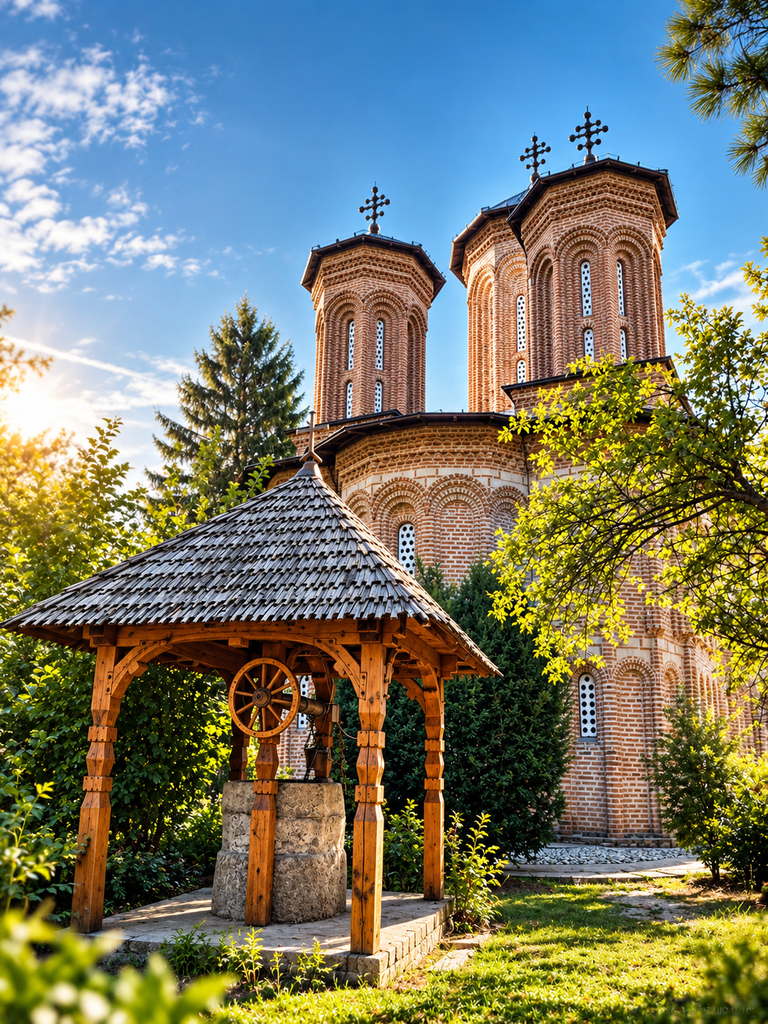
Snagov Monastery, historically fortified and heavily patronized by Vladislav II in the mid-15th century. While the present church reflects 16th-century reconstructions, the site stands as an important monastic center linked to Dănești patronage.
Vladislav III
- Prince of Wallachia: 1523, 1524, and 1525, during three separate reigns
- Vladislav III was a later claimant to the Wallachian throne, traditionally associated with the Dănești. He occupied the throne during three separate periods in the 1520s, challenging the position of Radu de la Afumați.
His first reign began in April 1523 and ended in October of that year. He returned to power in March 1524 and again in April 1525, but neither restoration established lasting control over the principality.
Vladislav III’s repeated accessions demonstrate that claims associated with the Dănești continued to influence Wallachian politics into the sixteenth century. His precise genealogical relationship to the earlier Dănești rulers should nevertheless be treated cautiously, as the surviving evidence does not establish every connection with equal certainty.
Moise
- Prince of Wallachia: 1529-1530
- Moise ruled Wallachia from March 1529 until June 1530. His reign took place during a period of continuing political competition and instability.
He lost the throne in 1530, bringing this phase of Dănești-associated princely rule to an end. His precise genealogical relationship to the earlier Dănești rulers is uncertain, and his inclusion in the wider dynastic tradition should not be taken as proof of an entirely documented line of descent.
Moise is therefore best treated as a later ruler traditionally associated with the Dănești rather than as the conclusively established final member of every genealogical line descending from the branch.
Dan III
A Note on the Disputed Chronology
Dan III requires separate treatment because his identity and dynastic affiliation are connected to an important historiographical debate.
In the conventional presentation of Wallachian history, the succession struggles of the early fifteenth century are often described through the career of Dan II, traditionally identified as a son of Dan I and a member of the Dănești branch.
In his study “Dan Voievod: A Revised Chronology and Genealogy” (2013), historian Andrei Pippidi proposed a different reconstruction. He argued that the traditional account had conflated distinct rulers named Dan. In his interpretation, Dan III was a son of Mircea cel Bătrân, while Dan IV was a son of Dan I. Pippidi also proposed a brief reign for another Dan, Mircea’s brother, in 1393.
This reconstruction changes the interpretation of the early dynastic rivalry. Under Pippidi’s model, Dan III belongs to Mircea’s line rather than to the Dănești branch, while Dan IV is the relevant Dănești figure in the succession struggles of the 1420s and early 1430s.
Because this interpretation differs from the conventional chronology, Dan III should not be presented as an additional, undisputed Dănești prince. His case is best included as a separate historiographical note, allowing readers to understand why published genealogies and regnal lists may differ.