
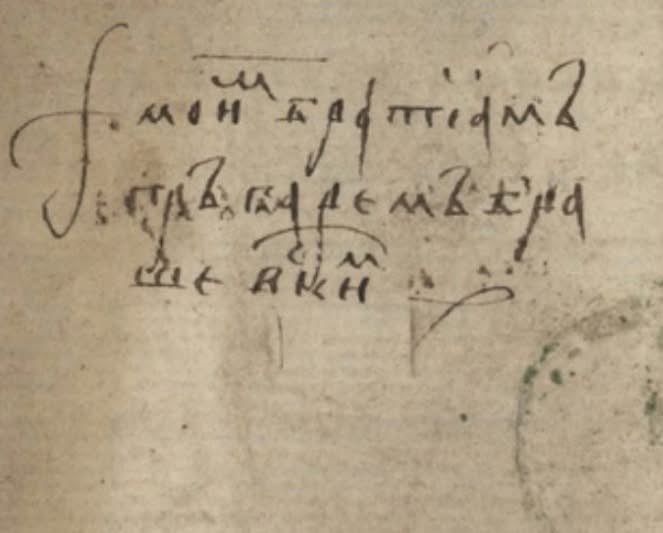
An archival document from the early fifteenth century, preserving a personal appeal by a Wallachian dignitary and offering a glimpse into the political relationships surrounding Vlad Dracul before his accession.
A Letter from a Time of Uncertainty
Among the documents preserving the historical relations between Wallachia and the Transylvanian town of Brașov, known in German as Kronstadt, there are occasional letters whose significance lies not in the scale of the events they describe, but in the personal circumstances they reveal.
One such document is a letter from Jupan Voico, a Wallachian dignitary bearing the title of vornic, addressed to the councillors of Brașov. Preserved in the town’s archival collections, it is recorded in the scholarly edition Documenta Romaniae Historica, volume I, and in the earlier documentary collection published by Ioan Bogdan in 1905.
The letter is assigned to 1431, although the published references do not establish a precise day or month. Its contents are direct and unusually personal: Voico asks the councillors to help him obtain a garment made of cloth and associated with fur. He promises to repay them two or three times the value once his lord, Vlad Dracul, has obtained the throne.
The request is modest in material terms, yet its historical context gives it wider significance. Voico is not addressing the councillors as a stranger. He invokes an established relationship, recalls his friendship with them during the time of an earlier voivode named Dan, and asks that their former bond endure despite his present difficulties.
The document thus preserves a moment in which personal friendship, political allegiance and material assistance intersected.
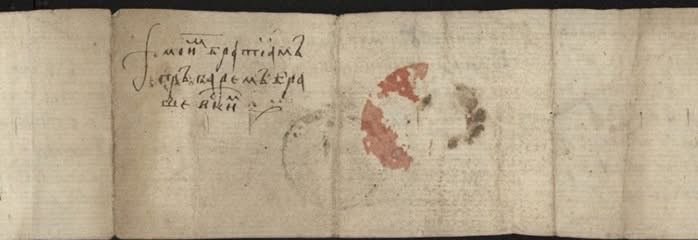
Between an Earlier Lord and a Future Voivode
Voico begins by addressing the councillors as his dear brothers. He reminds them that he had been their friend during the time of his former lord, Voivode Dan, and assures them that he intends to remain so.
His appeal rests upon the continuity of this relationship. He acknowledges that circumstances have become difficult, then asks for assistance with a particular garment. In return, he promises repayment at a later date, offering to pay two or three times the amount.
The language is neither that of a formal diplomatic treaty nor that of a simple commercial order. It is the language of a personal appeal made within an existing network of political and social connections.
The reference to Dan is itself worthy of attention. The published summary identifies the earlier ruler by that name but does not, on its own, settle every question concerning Voico’s service or the precise circumstances of their relationship. Such details must be considered alongside other contemporary documents.
What the letter does establish is that Voico regarded his earlier friendship with the councillors of Brașov as sufficiently important to invoke it when asking for assistance.
Vlad Dracul Before His Accession
The central historical detail lies in Voico’s reference to Vlad Dracul’s anticipated accession.
In 1431, Vlad was not securely established as the reigning voivode of Wallachia. He was pursuing his political claim, and the circumstances of his early attempts to obtain the throne require careful chronological distinction. His later, well-established reign must not simply be projected backwards onto this letter.
Voico’s promise is conditional: when God helps his lord Vlad to obtain the throne, he will once again be the councillors’ brother and friend, as before, and even more so. The repayment of the garment is thus linked directly to a future political outcome.
The document offers a small but revealing glimpse into the relationships surrounding Vlad Dracul during this uncertain period. It suggests that the personal networks of his followers extended across the political boundaries separating Wallachia and Transylvania, and that such relationships could be maintained in anticipation of a change in power.
The title voievod associated with Vlad in the transmitted text must be read in this context. A title or form of address does not, by itself, prove that its bearer had already secured the throne. The chronology of Vlad’s early political career is more complex than a single date of accession can convey.
A Material Request and Its Historical Limits
The garment requested by Voico is described in the Romanian documentary literature as a subă de postav. The precise form of the garment and the historical meaning of the original expression deserve careful philological treatment. For this reason, the English translation below uses the cautious wording “a fur garment made of cloth.”
The letter records a request for assistance and a promise of repayment. It does not, however, specify the full extent of Voico’s financial circumstances or establish the income available to Vlad Dracul.
Some modern commentary has connected the request with the revenues of a mint and with the payments made to Vlad for frontier service under King Sigismund of Luxembourg. Those interpretations cannot be demonstrated from this letter alone. They require independent documentary evidence and should not be presented as direct conclusions from Voico’s words.
The value of the document lies in what it actually preserves: the appeal to an established friendship, the description of difficult circumstances, the request for a specific item of clothing and the promise of a greater repayment when political circumstances improved.
These details are sufficient to make the letter historically significant without attributing to it conclusions that it does not itself support.
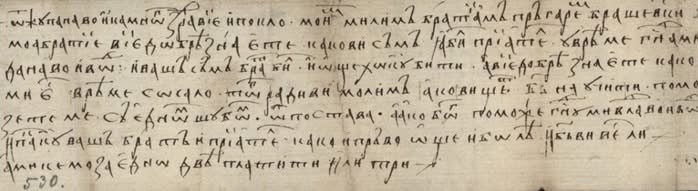
The Original Text
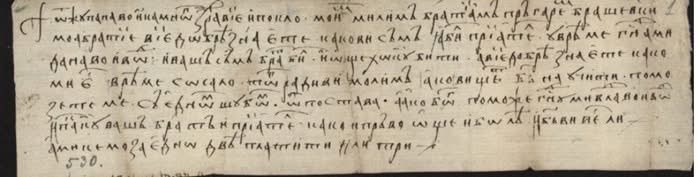
The following Cyrillic transcription is reproduced from the text supplied for this article. Its spelling and editorial conventions have not yet been independently collated, character by character, with the archival original. It should therefore be understood as a transcription supplied for presentation, rather than as a newly verified diplomatic edition.
† ωт жупана Воика миωгω здравїє и покло[нєнїє] моим милимъ братїамъ, пръгсєм Брашєвски[м].
Моа братїє, вїє дωбрђ знаєтє како ви съмъ я бил прїатєа у врђмє господина ми Дана воивωвод, и вашъ съмъ брат бил и ωщє χωку бити. А вїє добрђ знаєтє, како ми єст врђмє сωсало; тωгω ради ви молимъ, ако ви щєт богь научити, помозєтє мє съ єднωм шубωм ωт постава, а ако бωг[ъ] поможє господину ми Влад воивωвод, и пак ку вашъ братъ и прїатєа, како и пръво, ωщє и бωлђ. И вогь ви вєсєли. А ми кємо ζа єднω двђ платити или три.
† Моим братїамъ, пръгарємъ Брашєвским.
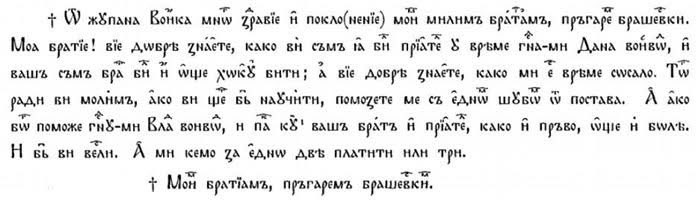
English Translation
The following English translation is based on the Romanian rendering supplied with the transcription. It is intended as a readable translation and has not been established through a new critical translation directly from the archival original.
† From Jupan Voico, greetings and salutations to my dear brothers, the councillors of Brașov.
My brothers, you know well that I was your friend in the time of my lord, Voivode Dan, and that I have been your brother and shall continue to be so. But you know well what difficult times have come upon me. Therefore I ask you, if God should so inspire you, to help me with a fur garment made of cloth. And if God helps my lord Vlad, the voivode, then I shall again be your brother and friend, as before, and even more so. May God grant you joy. And for one, I shall then pay two or three.
† To my brothers, the councillors of Brașov.
The expression “for one, I shall then pay two or three” follows the supplied Romanian translation. Its precise commercial meaning would benefit from examination of the original text and the conventions of contemporary correspondence.
A Small Document, a Wider Historical World
The history of Wallachia in the fifteenth century is often recounted through changes of ruler, dynastic rivalries, military campaigns and diplomatic agreements. Yet the political world of the period was also sustained by personal relationships, mutual obligations and the movement of people and goods between neighbouring territories.
Voico’s letter preserves one such moment. A Wallachian dignitary turns to the councillors of Brașov, recalls an earlier friendship and seeks assistance while awaiting the outcome of his lord’s political ambitions.
The requested garment may seem modest beside the struggles for a throne. Yet precisely this ordinary material need allows us to approach the period from another perspective: through the people who served rulers, maintained connections across political boundaries and sought to preserve relationships during uncertain times.
The document does not tell the whole story of Voico, Vlad Dracul or their relations with Brașov. It does, however, preserve a distinct and valuable fragment of that history.
Basarab Heritage presents this letter as a reminder that the careful study of historical evidence does not depend solely upon grand events or monumental records. Sometimes, a brief personal appeal can illuminate the human relationships through which the wider history of Wallachia and Transylvania unfolded.
Basarab Heritage
— A.C.
⸻
Sources and Further Reading
- Bogdan, Ioan, Documente privitoare la relațiile Țării Românești cu Brașovul și cu Țara Ungurească în secolele XV și XVI. Texte slave cu traduceri, adnotațiuni istorice și o introducere asupra diplomei vechi românești. Bucharest: Institutul de Arte Grafice Carol Göbl, 1905, document CCVII, p. 248. The introductory catalogue identifies the letter as a 1431 appeal by Voico, vornic of Vlad Dracul, requesting a cloth garment and promising to repay double or triple its value after Vlad obtained the throne.
- Documenta Romaniae Historica, D. Relații între Țările Române, vol. I (1222–1456). Bucharest: Editura Academiei Republicii Socialiste România, 1977, document 178. The published summary likewise identifies Voico’s request and its connection with Vlad Dracul’s anticipated accession.
- Suciu, Ștefan; Nussbächer, Gernot; Cincu, Monica, Relațiile Țării Românești și Moldovei cu Brașovul, 1369-1803: Inventar arhivistic. Bucharest: Direcția Generală a Arhivelor Statului, 1986. The archival inventory records the Brașov document under no. 530.
- Simon, Alexandru, “Before and After Sigismund: Vlad II Dracul and the Question of Church Union (1436-1440).” Croatica Christiana periodica 49, no. 96 (2025): 51-67. This study provides additional scholarly context for Vlad Dracul’s political position before and during his later rule.
The document is catalogued in the Brașov archival collections under document no. 530. The published dating places it in 1431; the precise day and month have not been established in the references cited above.
The Cyrillic text and English translation presented here should be collated against the relevant printed edition or archival image before being described as a verified transcription and translation of the original.