
An original fifteenth-century document reveals the intersection of princely authority, commercial disputes, and political rivalry in Wallachia.
A Princely Letter from a Time of Conflict
Among the documentary sources illuminating the reign of Vlad II Dracul, a letter addressed to the civic authorities of Brașov offers a revealing glimpse into the political and economic tensions of fifteenth-century Southeastern Europe.
Written in the name of Vlad Dracul, Voivode of Wallachia, the letter addresses the judge and council members of Brașov. The prince asks them not to obstruct a servant whom he has authorised to seize Moldavians and confiscate the goods they carry.
His justification is explicit. According to the letter, another of his servants had previously been captured in Moldavia, bound, and handed over to Alexandru Aldea, a rival claimant to the Wallachian throne, and his associate Albul. Vlad Dracul further states that the merchandise he had in Moldavia had been confiscated and that Aldea and Albul were demanding more than a thousand gold florins for the servant’s release.
In response, Vlad had authorised his servant Vlad to seize Moldavians and take their possessions. He now demanded that the authorities of Brașov allow this retaliatory action to proceed without interference.
The letter therefore documents more than a personal grievance. It reveals how political rivalry could become entangled with commercial interests, the seizure of property, the capture of individuals, and the responsibilities of neighbouring urban authorities.
Wallachia, Moldavia, and Brașov
During the fifteenth century, relations between Wallachia and Brașov were shaped by commerce as well as by political and military considerations. Located in Transylvania, Brașov was an important trading centre whose commercial networks connected the markets north and south of the Carpathians.
Correspondence between Wallachian rulers and the authorities of Brașov provides valuable evidence of these relationships. Such letters concerned the movement of merchants, the recovery of property, commercial disputes, and the treatment of individuals travelling across political boundaries.
Vlad Dracul’s letter reveals the confrontational side of this interconnected world. The prince invokes his authority to justify the actions of his servant and expects the magistrate of Brașov to respect his instructions. At the same time, the document demonstrates that disputes originating in Moldavia could have consequences for relations with a Transylvanian trading city.
The letter also names Alexandru Aldea and Albul, who appear here as Vlad Dracul’s adversaries. Their involvement places the dispute within the wider struggle for power in Wallachia during the early 1430s.
Alexandru Aldea was not merely an external political rival: he was himself a Wallachian ruler whose position conflicted with Vlad Dracul’s dynastic ambitions. The letter thus offers a glimpse of how internal competition for the principality could intersect with relations between neighbouring lands.
Trade, Captivity, and Retaliation
One of the most striking aspects of the document is its account of the confiscation of merchandise.
Vlad Dracul claims that his goods in Moldavia had been taken and that his servant had been handed over to Aldea and Albul. The ransom demanded for the servant – more than a thousand gold florins, according to the letter – was presented as justification for the prince’s retaliatory measures.
The proposed response was collective: Moldavians encountered by Vlad’s servant were to be seized, and the goods they carried were to be taken.
The letter should not be read as a neutral account of the original dispute. It presents the events from the perspective of Vlad Dracul, whose purpose was to persuade the authorities of Brașov to permit his actions. Nevertheless, it offers valuable evidence of the ways in which rulers described commercial grievances and asserted their authority beyond their immediate territories.
The document also illustrates the precarious position of merchants and travellers in a period when political rivalries could disrupt trade and expose individuals and their property to seizure.
The Seal of Vlad Dracul
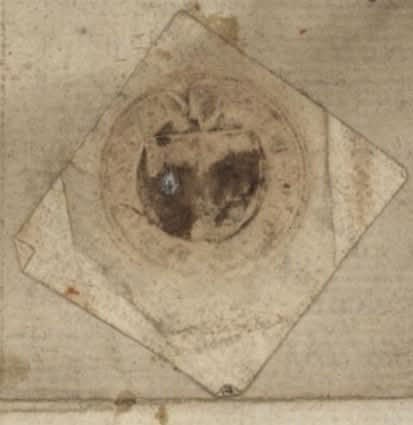
The accompanying description identifies a seal impressed in red wax on the reverse of the letter. Its design is described as depicting two figures facing one another, separated by a lily, within a triangular shield.
The Gothic inscription is transcribed as:
S. IOANI † WLAD † WAYVODA.
The seal is reported to be poorly preserved on this particular document, although the design is said to be more clearly visible on other letters. The monogram is described as having been written in red ink.
Seals were important instruments of medieval documentary practice. Alongside the written text, they helped identify the issuer and authenticate a communication. Their inscriptions and imagery can also contribute to the study of princely titles, political symbolism, and the administration of Wallachia.
The description presented here follows the accompanying source material; the seal’s dimensions and finer details should be checked against the original document or an authoritative archival reproduction before being stated more precisely.
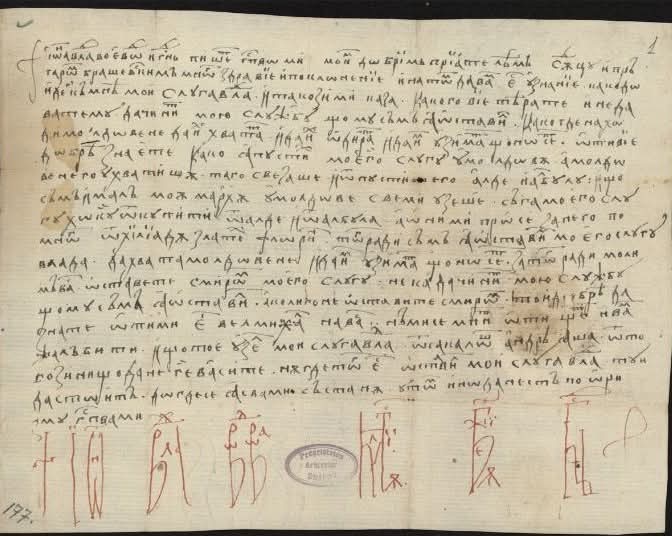
The Original Text in Slavonic
The following transcription reproduces the Slavonic text supplied by Mihai Dobre in his publication in the Facebook group Valahia în Documente și Cronici. The spelling and letter forms are retained as provided; the transcription has not been independently collated against the original archival document.
† Іωaн Влад воєвод[а] и господинъ, пишєт господствω ми моим дωбрїмь прїатєлђмь, сюдцу и пръгарωм Брашовскимъ, мнωгω здравїє и поклωнєнїє. И на тωм да вам єст у знанїє, како дωидє къ миђ мои слуга Влад и такози ми каза, како го вїє тђратє и нє даватє му да чинит мою службу, що му съмъ я ωставил, како гдє наχωди Молдωвєнє, да иχ χватат и да иχ ωдират и да им узимат що нωсєт. ωти вїє дωбрђ знаєтє, како я пустиχ моєго слугу у Молдωвю, а Молдωвєнє го уχватишю та го свєзашє и ωтпустишє го Алдє и Албулу, и що съмъ ималъ мою марχю у Молдωвє, свє ми узєшє. Съга моєго слугу χωку ωткупити ωт Алдє и ωт Албула, а ωни ми прωсє за нєго помиωгω ωт χїлїдю злтєχ флωрин. Тωгω ради съмъ я ωтавил моєго слугу Влада, да χвата Молдωвєнє и да им узимат що нωсєт. За тωгω ради молимъ вас, ωставєтє с мирωм моєго слугу, нєка да чинит мою службу, що му съмъ я ωставил. Ако ли го нє ωставитє с мирωм, то и дωбрђ да знатє, ωти ми єст вєлми жал на вас, нъ м и сє мнит, ωти щєт и вам жалъ бити. И щото є узєл мои слуга Влад ωт Сакалωш Андђяша, ωт тогози нищо да нє гєваситє, ню гдє тωгω єст ωставил мои слуга Влад, туи да стωитъ, дω гдє сє я с вами състаню. У тωм инω да нєстъ, по ωризму господствa ми.
† Іωн Влад вωєвωда, милостїя божїєя господинь.
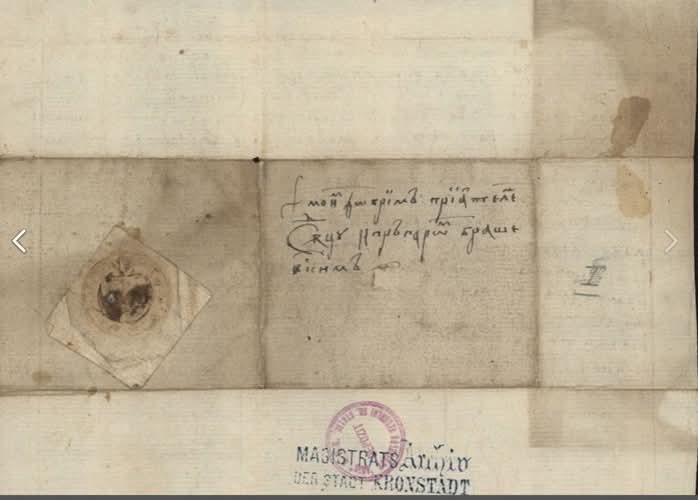
Address on the Reverse
† Моим ъдобримъ прїатєлєм сядчу ни пръгарωм Брашєвскимиъ.
English Translation
The following English translation is based on the Romanian translation supplied by Mihai Dobre. It is intended as a readable rendering of the text rather than a new critical translation from the original Slavonic.
† Ioan Vlad, Voivode and Lord, writes to my good friends, the judge and council members of Brașov, sending them many greetings and salutations.
We hereby inform you that my servant Vlad has come to me and told me that you are obstructing him and will not allow him to carry out the service I entrusted to him. His instructions were that wherever he encountered Moldavians, he was to seize them, plunder them, and take whatever they carried.
You know well that I sent one of my servants to Moldavia, where the Moldavians captured him, bound him, and handed him over to Aldea and Albul. They also took all the merchandise I had in Moldavia.
Now I wish to ransom my servant from Aldea and Albul, but they are demanding more than a thousand gold florins for his release. For this reason, I have authorised my servant Vlad to seize Moldavians and take whatever they carry.
Therefore, I ask you to leave my servant in peace and allow him to perform the service I entrusted to him. If you do not leave him in peace, know well that I shall have serious cause for grievance against you, and I believe that you too will have cause for regret.
As for the goods my servant Vlad took from Săcaloș Andrieș, do not interfere with them or take anything from them. Let them remain where my servant Vlad left them until I meet with you.
Let nothing be done otherwise, but according to my princely command.
† Ioan Vlad, Voivode and Lord, by the grace of God.
Address on the Reverse – English Translation
† To my good friends, the judge and council members of Brașov.
Dating and Historical Context
The precise date of this letter requires a source-critical approach.
In his edition of 1902, the Romanian Slavist Ioan Bogdan assigned the document to 1431–1432. His dating was based on his interpretation of the political circumstances described in the letter, particularly the hostility between Vlad Dracul and Alexandru Aldea and the conflict involving Moldavia.
A later archival inventory, Relațiile Țării Românești și Moldovei cu Brașovul (1369–1803): inventar, assigns the document a broader date range: after 31 May 1433 and before 1 July 1435.
These datings should not be silently conflated. They represent different chronological assessments of the same document. Until the question has been examined further against the wider documentary record, the later archival dating provides a useful working range, while Bogdan’s earlier proposal remains an important part of the historiography.
The letter is catalogued as archival document no. 177 and is identified as an original Slavonic document bearing a monogram, watermark, and attached seal.
Historical Significance
This letter offers a rare glimpse into the practical exercise of princely authority during a period of political tension.
Vlad Dracul invokes his position as ruler to justify retaliatory action, while appealing to the civic authorities of Brașov not to interfere with his instructions. His account connects the confiscation of merchandise, the capture of a servant, a ransom demand, and the seizure of goods carried by Moldavians.
The document also reveals the overlapping political and commercial networks of Wallachia, Moldavia, and Transylvania. Although the prince’s account is necessarily partisan, it remains valuable evidence of the disputes and pressures that could shape relations between neighbouring territories.
For the history of the Basarab dynasty, the letter is particularly significant because it places Vlad Dracul’s political rivalry with Alexandru Aldea within a broader regional context. It shows how the struggle for power in Wallachia could extend into commercial relations and diplomatic correspondence with neighbouring authorities.
Preserved in the documentary record of Brașov, the letter remains an important source for studying the political, economic, and diplomatic history of fifteenth-century Wallachia.
Basarab Heritage
— A.C.
⸻
Sources and Acknowledgements
Transcription and Romanian translation: Mihai Dobre, contributor to the Facebook group Valahia în Documente și Cronici. The Slavonic transcription and Romanian translation reproduced here are attributed to his published contribution.
Archival reference: Brașov Archive, document no. 177, original in Slavonic, with monogram, watermark, and attached seal.
Archival inventory: Relațiile Țării Românești și Moldovei cu Brașovul (1369–1803): inventar (1986), entry 42. This inventory dates the letter to after 31 May 1433 and before 1 July 1435.
Earlier scholarly edition: Ioan Bogdan, Documente și regeste privitoare la relațiile Țării Românești cu Brașovul și Ungaria în secolul XV și XVI (Bucharest: Socec, 1902), document XXXII, pp. 87–88. Bogdan dated the letter to 1431–1432.
Additional edition: Ioan Bogdan, Documente privitoare la relațiile Țării Românești cu Brașovul și cu Țara Ungurească în sec. XV și XVI, vol. I: 1413–1508 (Bucharest, 1905), document no. 37, pp. 59–61.
Modern documentary edition: Documenta Romaniae Historica, series D, Relații între Țările Române, vol. I: 1222–1456, document no. 187, pp. 287–288.
The text and translation are presented for historical and educational purposes. The transcription, translation, seal description, and chronology should be understood in light of their respective sources and the differing scholarly assessments noted above.