“God Is With Us”
There are words whose meaning reaches far beyond the moment in which they were first spoken. They arise in times of uncertainty, when the future seems unsettled and the strength of human beings appears insufficient to meet the trials before them. Yet they endure because they express a conviction that transcends any particular age: that even in darkness, suffering and upheaval, humanity is not abandoned.
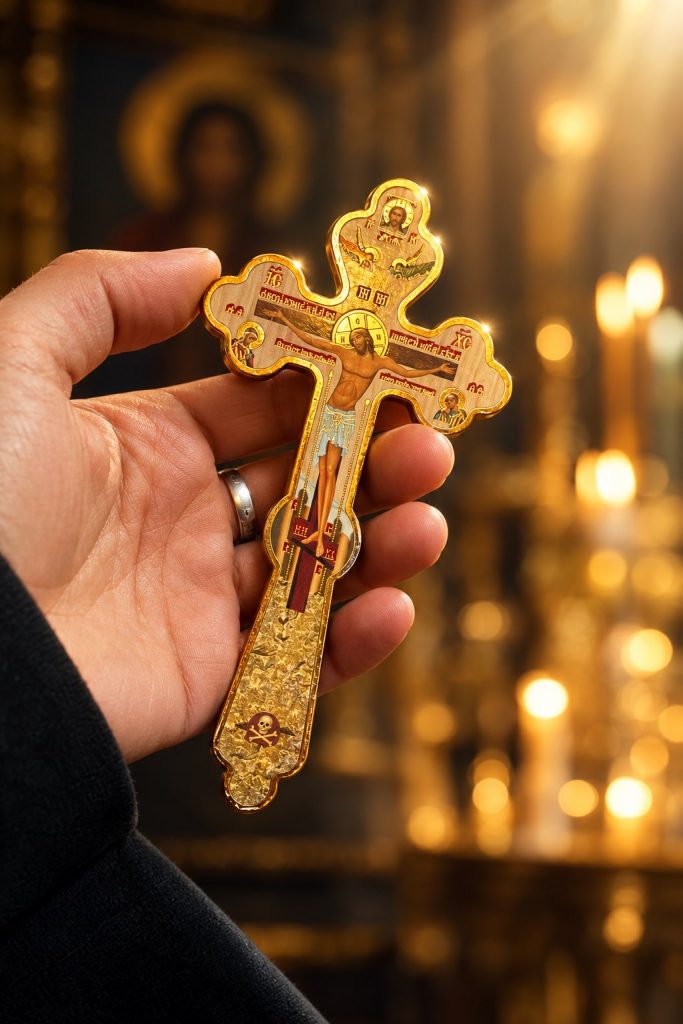
Μεθ’ ἡμῶν ὁ Θεός – “God is with us” – is such a declaration.
The words have deep roots in the biblical tradition. They are associated above all with the Book of Isaiah and, through centuries of Christian worship, have become familiar in the liturgical life of the Eastern Orthodox Church. The present composition draws upon this inheritance. Its language evokes the scriptural assurance of divine presence, the steadfastness of faith in adversity and the praise of the Holy Trinity.
The title is presented here in the simplified Latin spelling “Met’ hymon ho Theos” for practical reasons: it is easier to enter into search fields and to find on digital music and streaming platforms. A more precise scholarly transliteration of the Greek is “Meth’ Hēmōn ho Theos.” The original Greek title, Μεθ’ ἡμῶν ὁ Θεός, remains unchanged.
The Biblical Setting: Isaiah and the Crisis of Judah
The historical roots of the central phrase lie in the eighth century BC, during the prophetic ministry of Isaiah son of Amoz.
At that time, the small kingdom of Judah was caught between competing regional powers. King Ahaz faced pressure from Rezin, king of Aram-Damascus, and Pekah, king of Israel, also known as Ephraim. Their alliance threatened Jerusalem and sought to compel Judah to join their resistance to the expanding power of Assyria.
The political crisis forms the background to Isaiah chapters 7 and 8. Isaiah called upon the king and the people of Judah to place their trust in the Lord rather than allow fear to determine their course. The prophet’s message was not a denial of the dangers confronting the kingdom. It was an insistence that political and military power did not constitute the ultimate authority over history.
In Isaiah 8:8-10, the imagery becomes particularly forceful. The advancing threat is compared to a flood, yet the plans of the nations are declared incapable of overturning the divine purpose. The passage culminates in the words of the Greek Septuagint:
ὅτι μεθ’ ἡμῶν Κύριος ὁ Θεός.
“For God is with us.”
The familiar liturgical expression Μεθ’ ἡμῶν ὁ Θεός draws upon this biblical wording. It should therefore be understood first in its original prophetic setting: a declaration of trust in God amid the political and military uncertainty confronting Judah in the eighth century BC. It was not originally a reference to the fall of Constantinople, the Ottoman conquest or any later historical conflict.
This distinction matters. The enduring significance of the phrase lies precisely in the fact that it was not confined to one historical crisis. Its meaning could be received anew by later generations without erasing the circumstances in which it first appeared.
From the Prophet Isaiah to Christian Tradition
The Christian understanding of divine presence developed through the reception of the Old Testament within the New Testament.
In the Gospel according to Matthew, the birth of Jesus is interpreted in relation to the prophecy of Isaiah 7:14. Matthew 1:22-23 quotes the passage and gives the name Emmanuel, explaining its meaning as “God with us.” In Christian theology, this becomes a central expression of the mystery of the Incarnation: God’s presence among humanity in the person of Jesus Christ.
Isaiah 7 and Isaiah 8 belong to the same broader prophetic context, but their passages should not be confused. The prophecy quoted by Matthew is Isaiah 7:14; the wording “God is with us” appears explicitly in Isaiah 8:10 in the Septuagint. Christian interpretation brings these texts into a wider theological relationship, but they are not the same verse.
Over the centuries, the phrase became deeply established in the worship and devotional language of Eastern Christianity. Its resonance is particularly evident in the Orthodox service of Great Compline, known in Greek as the Μέγα Ἀπόδειπνον.
During Great Lent, Great Compline is traditionally celebrated in Orthodox monasteries and parishes from Monday to Thursday. Within this service, the hymn commonly known as “God Is With Us” draws upon a series of passages from Isaiah, especially chapters 8 and 9. Its recurring proclamation is a confession of trust in God in the face of the powers and anxieties of the world.
The hymn has been preserved and developed in different musical traditions. Orthodox composers have set it in a variety of arrangements, drawing upon older chant traditions as well as later choral forms.
The present composition belongs to this wider spiritual and musical inheritance, but it is not presented as a transcription of the traditional Great Compline hymn. It is a contemporary work inspired by its central biblical declaration and by the language of Orthodox prayer.
The Scriptural Imagery of the Song
The lyrics bring together several themes familiar from the Psalms and the prophetic books.
The image of mountains being shaken and the foundations of the earth disturbed recalls Psalm 45 in the Septuagint, corresponding to Psalm 46 in the numbering commonly used in many modern Western Bibles. That psalm begins with the assurance that God is humanity’s refuge and strength, and declares that there is no need to fear even if the earth is moved and the mountains are carried into the sea.
The song does not quote the psalm word for word. Rather, it reshapes its imagery into a personal confession: even when the foundations of the familiar world seem to tremble, hope remains directed towards the Lord.
The words concerning shelter beneath God’s wings belong to another recurring biblical image. In the Psalms, the wings of God represent protection, refuge and the security of those who seek His care. The song draws upon this language to express peace not as the absence of hardship, but as the assurance of divine protection within it.
Other expressions – consolation in affliction, patience in suffering, expectation in the night and prayer in the heart – continue this movement from uncertainty towards confidence. They are not presented as quotations from a single biblical passage, but as a poetic summary of themes that run throughout the scriptural tradition.
Five Movements: From Presence to Glory
The composition unfolds in five movements. Together, they form a progression from the recognition of God’s presence to the final confession of faith and praise.
I. Ἡ Παρουσία – Presence
The opening movement begins in darkness and silence. Against this setting, the voice of the Lord is heard, and His light remains unextinguished.
The solo voice introduces the central conviction of the composition: fear and turmoil need not have the final word, because God is with His people.
II. Ἡ Πίστις – Faith
The choir takes up the declaration and broadens it into a communal confession.
God is present in heaven and on earth, in joy and in sorrow. The language of abandonment and refuge gives this movement its emotional centre. The image of shelter beneath God’s wings expresses the peace sought by those who place their trust in Him.
III. Ἡ Δοκιμασία – Trial
The third movement returns to the instability of the world. Mountains may be shaken and the foundations of the earth disturbed, yet hope remains fixed upon the Lord.
The short, carefully balanced phrases that follow – consolation in affliction, patience in suffering, expectation in the night, prayer in the heart – express the spiritual discipline through which faith endures adversity.
IV. Ἡ Ὁμολογία – Confession
The fourth movement brings the central declaration to the foreground.
The choir proclaims with increasing strength that God is with us and that the Lord is with us. The language is no longer merely an inward assurance; it becomes an open confession of faith.
Darkness and temptation are acknowledged, but they do not displace the light and hope that come from God.
V. Ἡ Δόξα – Glory
The final movement turns from the trials of the individual and the community towards the praise of the Holy Trinity.
Father, Son and Holy Spirit are named together, and the composition closes with the enduring language of Orthodox worship:
Εἰς τοὺς αἰῶνας τῶν αἰώνων. Ἀμήν.
“Unto the ages of ages. Amen.”
The final return of the central phrase gives the composition its sense of completion. What began as a voice heard in the darkness ends as a communal proclamation of faith.
Songtext
The following is the complete Greek text of Met’ hymon ho Theos, preserving the five-part structure and the wording supplied for the composition. The translation seeks to preserve the meaning, imagery and solemn character of the Greek original. It is not intended as a strict word-for-word rendering, but as a faithful English version that can be read and understood independently.
Μεθ’ ἡμῶν ὁ Θεός – God Is With Us
Ι. Ἡ Παρουσία
Ἐν τῷ σκότει τῆς νυκτός,
ἐν τῇ σιγῇ τῶν καιρῶν,
ἡ φωνὴ Κυρίου ἀκούεται,
καὶ τὸ φῶς αὐτοῦ οὐ σβέννυται.
Οὐ φοβηθησόμεθα,
οὐ ταραχθησόμεθα,
ὅτι σὺ μεθ’ ἡμῶν εἶ,
Κύριε ὁ Θεὸς ἡμῶν.
ΙΙ. Ἡ Πίστις
Μεθ’ ἡμῶν ὁ Θεός,
ἐν οὐρανῷ καὶ ἐπὶ γῆς.
Μεθ’ ἡμῶν ὁ Θεός,
ἐν χαρᾷ καὶ ἐν θλίψει.
Οὐκ ἐγκαταλείψεις ἡμᾶς,
οὐκ ἀποστρέψεις τὸ πρόσωπόν σου.
Ἐν τῇ σκέπῃ τῶν πτερύγων σου
εὑρίσκομεν τὴν εἰρήνην.
ΙΙΙ. Ἡ Δοκιμασία
Ἐὰν σαλευθῶσι τὰ ὄρη,
καὶ τὰ θεμέλια τῆς γῆς,
ἡμεῖς ἐπὶ σοὶ ἐλπιοῦμεν,
ὅτι σὺ εἶ ὁ Κύριος.
Ἐν τῇ θλίψει παράκλησις,
ἐν τῷ πόνῳ ὑπομονή,
ἐν τῇ νυκτὶ προσδοκία,
ἐν τῇ καρδίᾳ προσευχή.
IV. Ἡ Ὁμολογία
Μεθ’ ἡμῶν ὁ Θεός!
Μεθ’ ἡμῶν ὁ Κύριος!
Οὐ φοβούμεθα τὸ σκότος,
οὐ κλονιζόμεθα ἐν τοῖς πειρασμοῖς.
Μεθ’ ἡμῶν ὁ Θεός!
Μεθ’ ἡμῶν ὁ Κύριος!
Σὺ εἶ τὸ φῶς τῶν ὀφθαλμῶν,
σὺ εἶ ἡ ἐλπὶς τῶν καρδιῶν.
V. Ἡ Δόξα
Πᾶσα ἡ δόξα σοι πρέπει,
Πάτερ, Υἱὲ καὶ Πνεῦμα Ἅγιον.
Νῦν καὶ ἀεὶ καὶ εἰς τοὺς αἰῶνας,
ἡ βασιλεία σου μένει.
Μεθ’ ἡμῶν ὁ Θεός,
Μεθ’ ἡμῶν ὁ Θεός.
Εἰς τοὺς αἰῶνας τῶν αἰώνων.
Ἀμήν.
I. Presence
In the darkness of the night,
in the silence of the ages,
the voice of the Lord is heard,
and His light is not extinguished.
We shall not fear,
we shall not be troubled,
for You are with us,
O Lord our God.
II. Faith
God is with us,
in heaven and upon the earth.
God is with us,
in joy and in sorrow.
You will not abandon us,
You will not turn Your face away.
Under the shelter of Your wings
we find peace.
III. Trial
Even if the mountains should be shaken,
and the foundations of the earth,
we shall place our hope in You,
for You are the Lord.
Consolation in affliction,
patience in suffering,
expectation in the night,
prayer in the heart.
IV. Confession
God is with us!
The Lord is with us!
We do not fear the darkness,
we are not shaken by trials.
God is with us!
The Lord is with us!
You are the light of our eyes,
You are the hope of our hearts.
V. Glory
All glory is due to You,
Father, Son and Holy Spirit.
Now and always and unto the ages,
Your kingdom endures.
God is with us,
God is with us.
Unto the ages of ages.
Amin.
Listen to the Song
A Living Biblical and Liturgical Heritage
The strength of Met’ Hēmōn ho Theos lies in the way it brings together different layers of the Christian tradition without confusing their historical origins.
Its central declaration comes from the prophetic language of Isaiah, spoken in a time of political danger in the ancient kingdom of Judah. Its imagery recalls the Psalms, whose words of refuge, steadfastness and trust have accompanied generations of worshippers. Its final doxology belongs to the enduring language of Christian prayer, while its central refrain has a particularly familiar place in the liturgical life of the Orthodox Church.
The composition is therefore best understood as a contemporary musical meditation on an ancient biblical promise. It does not claim to reproduce a medieval chant or a historical liturgical text in its entirety. Rather, it receives the words and images of Scripture and gives them a new musical expression.
Across centuries, the circumstances of human life have changed, but the question at the heart of the song has remained recognisable: what sustains faith when the world seems uncertain?
Its answer is expressed in the words that return throughout the composition:
Μεθ’ ἡμῶν ὁ Θεός – God is with us.
Basarab Heritage
— A.C.