
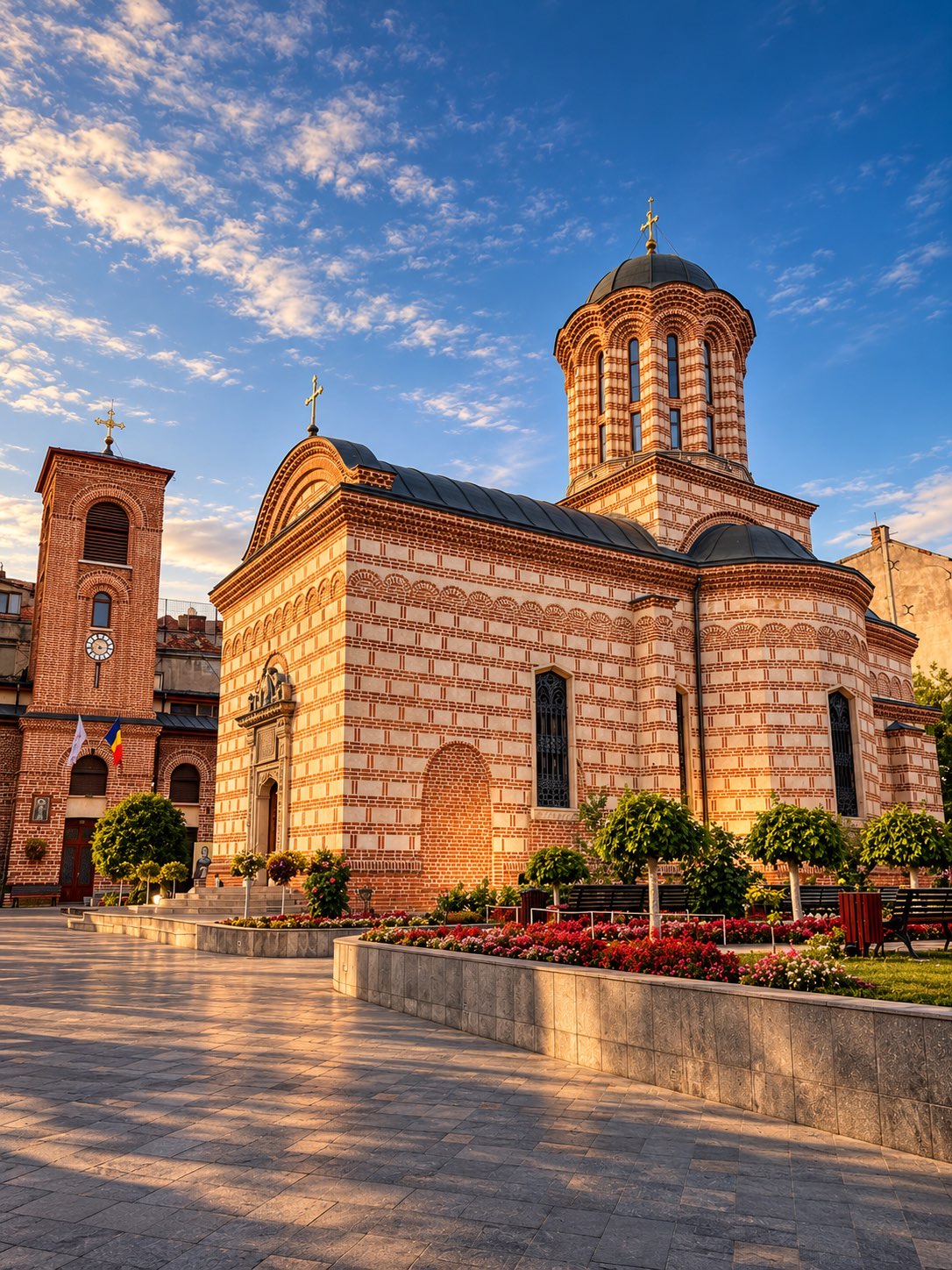
In the historic heart of Bucharest, amid the streets and courtyards of the Old Town, stands a church whose history reaches back to the age of the Wallachian princes. Known today as Biserica Sfântul Anton – Curtea Veche, it is at once a surviving monument of the former princely court, a witness to the development of the capital, and a place of enduring Orthodox devotion.
Its history brings together two distinct foundations. The first belongs to the princely world of the sixteenth century and the reign of Mircea Ciobanul. The second entered the church’s story through an event of destruction: the great fire of Bucharest in 1847, which consumed a neighbouring church dedicated to Saint Anthony the Great. From that lost sanctuary came an icon which would establish a lasting connection between the two places of worship.
A Church at the Heart of the Princely Court
The church stands on Strada Franceză, beside the remains of the Old Princely Court, once the political centre of Wallachian government in Bucharest. The court developed over several centuries and served as a residence and administrative seat for the voivodes who governed the principality. Its presence gave the surrounding area particular significance: this was not simply a neighbourhood of merchants and craftsmen, but a setting in which princely authority, religious life and urban activity converged.
The church now known as Sfântul Anton was founded by Mircea Ciobanul, ruler of Wallachia during several periods between 1545 and 1559. It was established as the princely church of the court and originally dedicated to the Annunciation of the Mother of God – Buna Vestire.
The chronology of its construction requires some care. The National Archaeological Repertory places the building within the period between 1545 and 1559, on the site of an earlier place of worship, traditionally identified as a wooden church. The church’s foundation inscription, later replaced by one commissioned under Ștefan Cantacuzino, attributes its construction to Mircea Ciobanul. The traditional date of September 1559 is associated with the completion of the princely foundation. A document of 13 May 1563 provides early documentary confirmation of the church’s existence.
The building was subsequently completed and decorated under Mircea’s successor, Petru cel Tânăr, with the involvement of Doamna Chiajna, Mircea’s wife and daughter of Petru Rareș of Moldavia. The church thus belongs to a period in which Bucharest was consolidating its position as an important centre of Wallachian political life. Its foundation was not merely an act of private devotion, but part of the wider princely presence that shaped the court and its surroundings.
Mircea Ciobanul and the Wallachian Princely Tradition
Mircea Ciobanul occupies a distinctive place in the history of sixteenth-century Wallachia. His reigns were marked by the political pressures characteristic of the period, when the principality’s rulers had to maintain their authority amid the competing interests of the Ottoman Empire, neighbouring powers and the local boyar elite.
The foundation of a princely church was an expression of both religious devotion and political legitimacy. Such buildings were closely associated with the ruler’s household and the ceremonial life of the court. They provided a setting for worship and dynastic commemoration, while giving visible form to the relationship between princely authority and the Orthodox Church.
The memory of the founders remains present within the building. The votive painting preserves the portraits of Mircea Ciobanul and Doamna Chiajna, identifying the princely couple with the foundation. Their presence connects the surviving monument not merely with a date or a name in a chronicle, but with the individuals whose patronage gave the church its place in the history of Bucharest.
Mircea Ciobanul was buried in the church after his death in 1569. The date of his burial, traditionally given as 21 September, is recorded in the Wallachian chronicle tradition. The church thus became associated not only with the religious life of the princely court, but also with the memory of its founder.
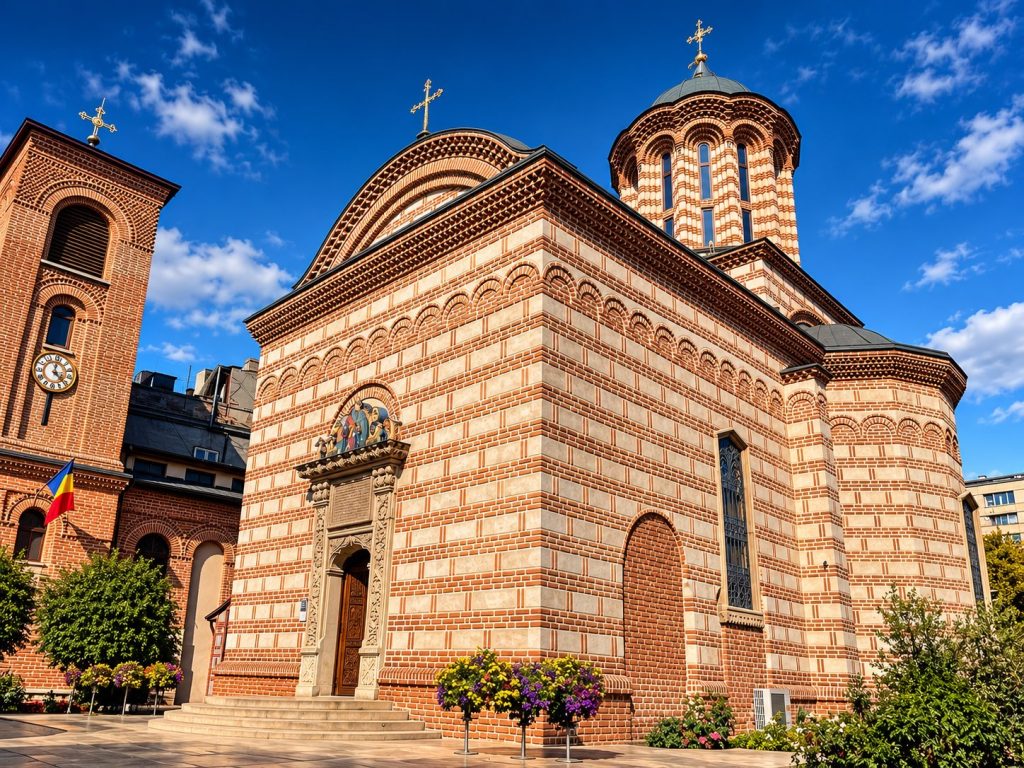
Exterior view of the Biserica Sfântul Anton – Curtea Veche, illustrating the traditional Wallachian ecclesiastical architecture and the 16th-century princely foundation in Bucharest.
Architecture and the Changing Appearance of the Church
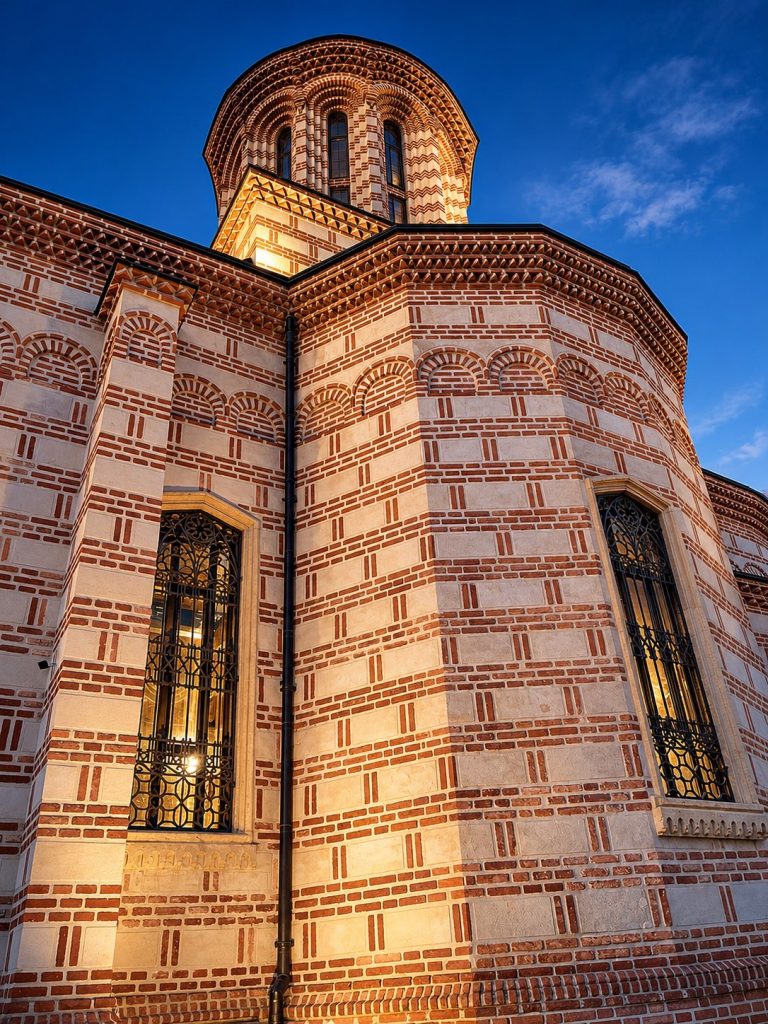
The church belongs to the tradition of Wallachian ecclesiastical architecture, in which a relatively compact building could nevertheless possess considerable ceremonial and symbolic importance. Its plan and proportions reflect the architectural language of Orthodox worship in the principality during the sixteenth century.
The building did not, however, remain unchanged. Like many historic churches in Bucharest, it underwent repairs, additions and alterations over the centuries. During the early eighteenth century, under the reign of Ștefan Cantacuzino, the entrance portal was renewed and the church received further painted decoration. Later modifications also affected the structure. A document dated 20 October 1758 records that Constantin Mavrocordat enlarged the church by adding two side chapels. Their foundations have been identified in the archaeological remains around the building.
The church suffered from periods of neglect and structural deterioration. In the nineteenth century, repairs became increasingly urgent. The great fire of 1847 damaged the building, although it did not destroy it. Subsequent restoration works, coordinated by the ecclesiarch Visarion, transformed its appearance and renewed much of its interior furnishing and decoration. The church was reconsecrated on 22 March 1852, after the completion of these works.
A further major restoration, undertaken between 1928 and 1935 under the Historical Monuments Commission, sought to recover much of the building’s earlier architectural form. The appearance visitors encounter today is therefore the result of both its sixteenth-century foundation and successive campaigns of restoration. It should be understood as a historic monument shaped by several periods, rather than as an untouched survival from the age of Mircea Ciobanul.
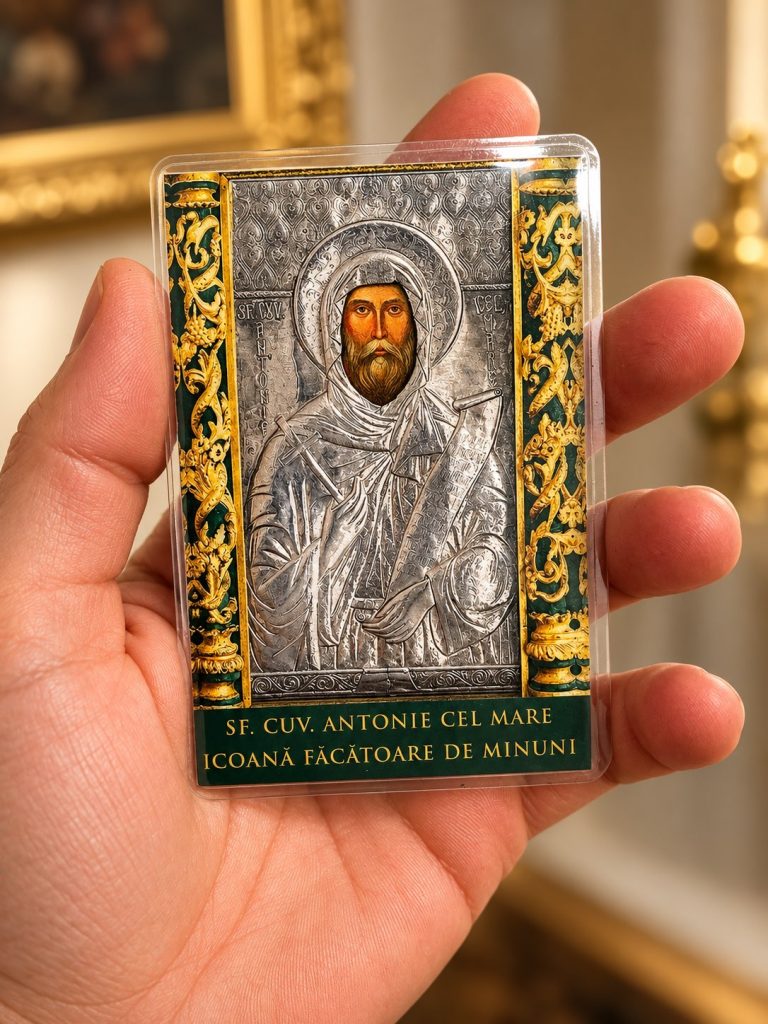
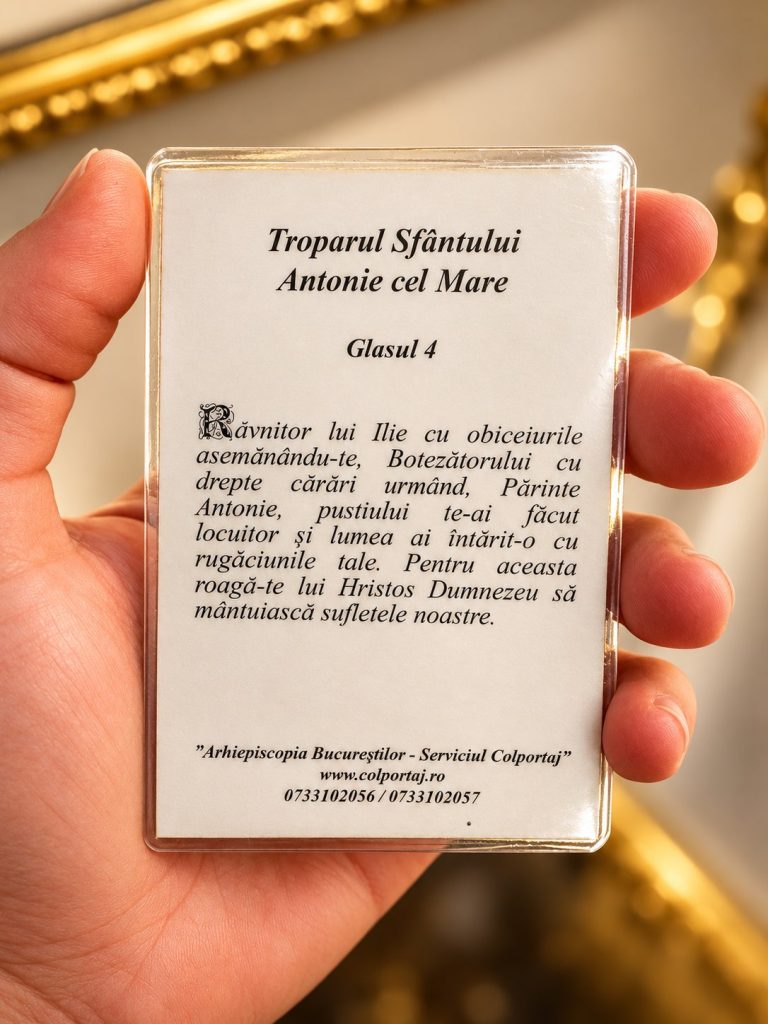
Devotional print displaying the venerated miracle-working icon of Saint Anthony the Great alongside its liturgical troparion, reflecting the living religious practice surrounding the sanctuary’s second patron.
The Fire of 1847 and the Icon of Saint Anthony
The most distinctive element of the church’s later identity is connected with the catastrophic fire that swept through Bucharest on 23 March 1847. The conflagration destroyed a substantial part of the city, including a nearby church dedicated to Saint Anthony the Great, commonly known as Sfântul Anton-Pușcărie.
That destroyed sanctuary must be distinguished from the princely church which survives today. The latter, originally dedicated to the Annunciation, was damaged by the fire but remained standing. The neighbouring Church of Saint Anthony, by contrast, was lost.
According to the ecclesiastical tradition preserved by the Archdiocese of Bucharest and the Romanian Patriarchate, an icon of Saint Anthony was recovered from the ruins of the destroyed church. It was brought to the princely church and placed there for veneration. The transfer created a spiritual and historical link between the two sanctuaries, allowing the memory of the lost church to continue within the surviving building.
The icon became the focus of a growing devotion. Saint Anthony the Great, the Egyptian ascetic of the third and fourth centuries and one of the foundational figures of Christian monasticism, came to be honoured as a second patron of the church. The original dedication to the Annunciation was retained, while the additional dedication to Saint Anthony gradually became central to the church’s popular identity.
Following the restoration works, the church was reconsecrated in 1852 with its original dedication to the Annunciation and its additional patronage of Saint Anthony. In time, the name Biserica Sfântul Anton – Curtea Veche became firmly established in official usage and in the consciousness of the faithful. The name thus preserves the memory of a church that no longer exists, while the icon itself serves as a tangible reminder of the events of 1847.
The icon is venerated by the faithful as wonder-working. This description belongs to the living religious tradition of the parish: it expresses the devotion and experience of generations of worshippers rather than a claim that can be assessed by historical methods alone. Its significance lies not only in its survival from the fire, but also in the continuity of prayer and remembrance that has gathered around it.
A Living Tradition in the Old Town
The memory of the former Church of Saint Anthony is not confined to the icon. Each year, around the feast of Saint Anthony the Great on 17 January, the parish maintains a procession associated with the saint and the history of the lost sanctuary. The faithful accompany the icon in a ceremony that recalls the destruction of the neighbouring church and the preservation of its spiritual heritage.
The procession also directs attention beyond the walls of the present building. A memorial cross marks the site associated with the former church, preserving its place in the historical landscape of the Old Town. In this way, a vanished building remains part of the religious memory of Bucharest.
The church continues to serve as a place of Orthodox worship and is recognised as a patriarchal chapel. Its significance is therefore not limited to its architectural or archaeological value. It remains part of the living religious fabric of the city, where historic dedication, liturgical practice and popular devotion meet.
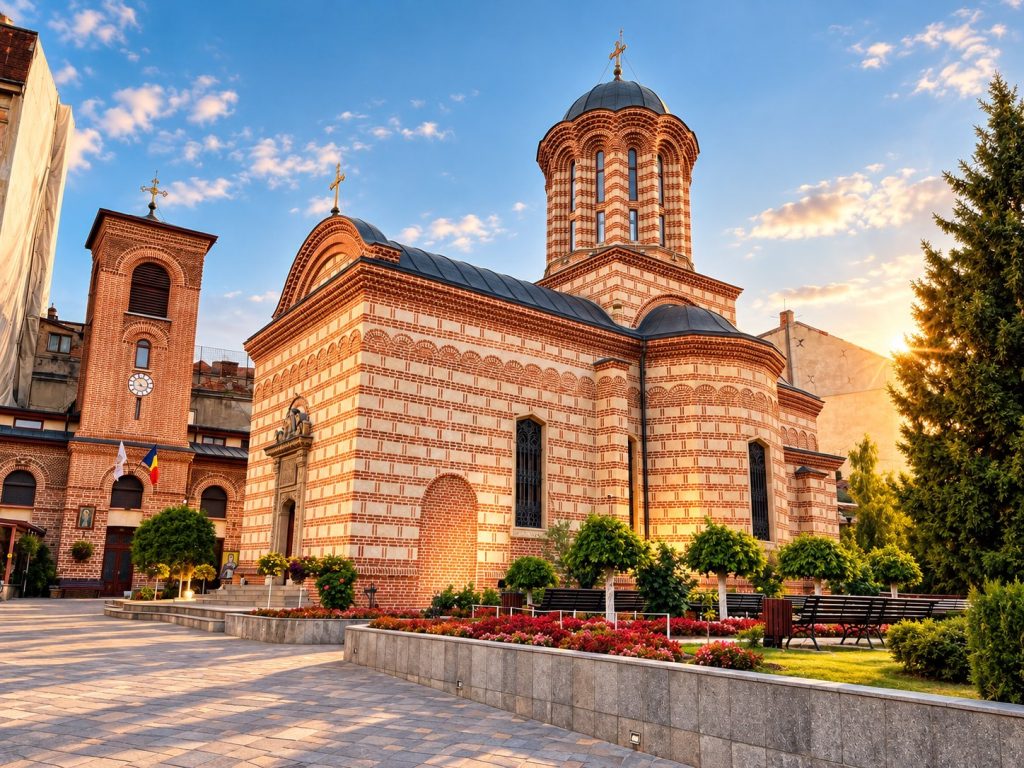
General view of the Biserica Sfântul Anton – Curtea Veche and its courtyard, uniting the architectural legacy of the early princely foundation with the urban landscape of modern Bucharest.
The Enduring Memory of Old Wallachia
Biserica Sfântul Anton – Curtea Veche brings together several layers of Bucharest’s past. Its foundations belong to the princely world of Mircea Ciobanul and Doamna Chiajna; its original dedication recalls the Orthodox devotional culture of sixteenth-century Wallachia; its later appearance reflects centuries of repairs and restoration; and its association with Saint Anthony preserves the memory of a neighbouring church lost in the fire of 1847.
Few monuments express the continuity of a city’s religious memory in quite this way. The church stands not simply as a remnant of the former princely court, but as a place where the history of a vanished sanctuary has been carried forward through an icon and the devotion attached to it.
For the visitor, its importance lies as much in these interwoven histories as in the building itself. Behind the familiar name of Sfântul Anton lies the older identity of the princely Church of the Annunciation – a foundation of Mircea Ciobanul, closely bound to the history of Wallachia and to the emergence of Bucharest as a political and spiritual centre.
Basarab Heritage
— A.C.
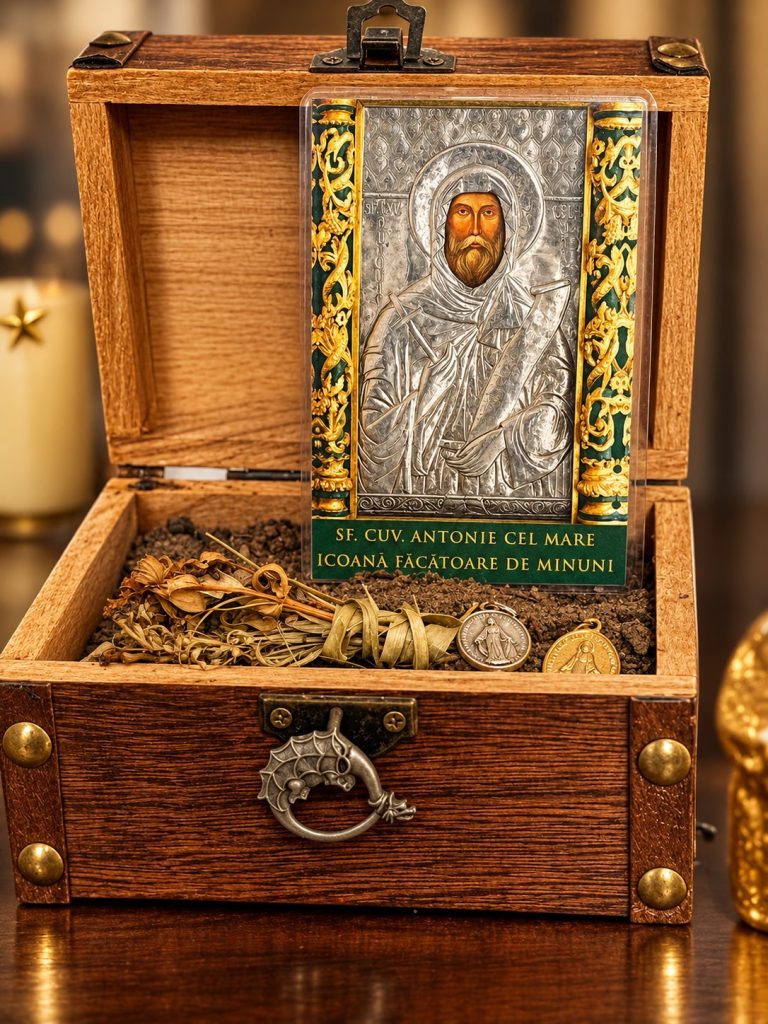
Devotional arrangement on Vladislav Carol Nicolae’s icon table, uniting the icon of Saint Anthony with soil from Argeș and holy medals within a small wooden chest.