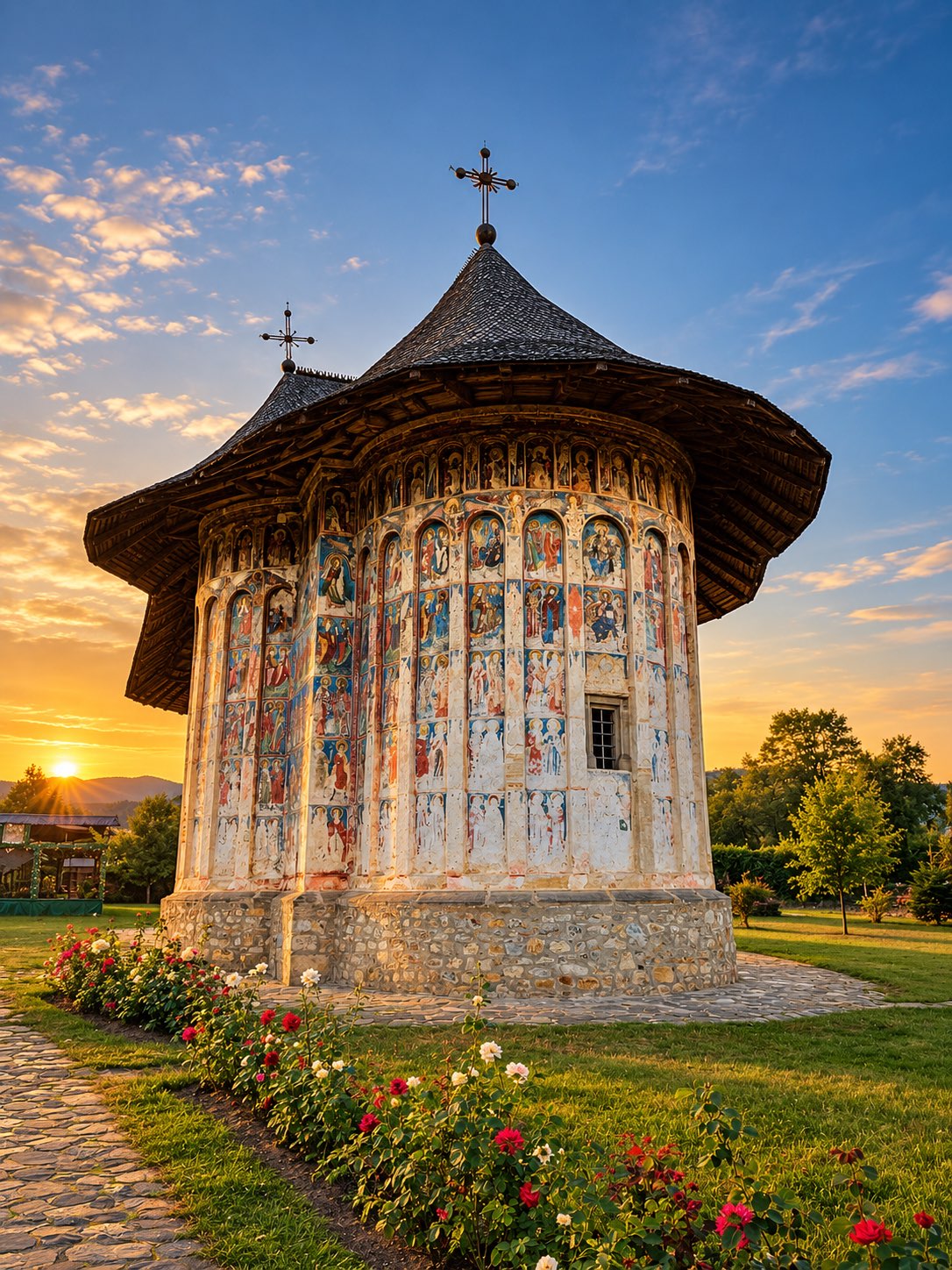
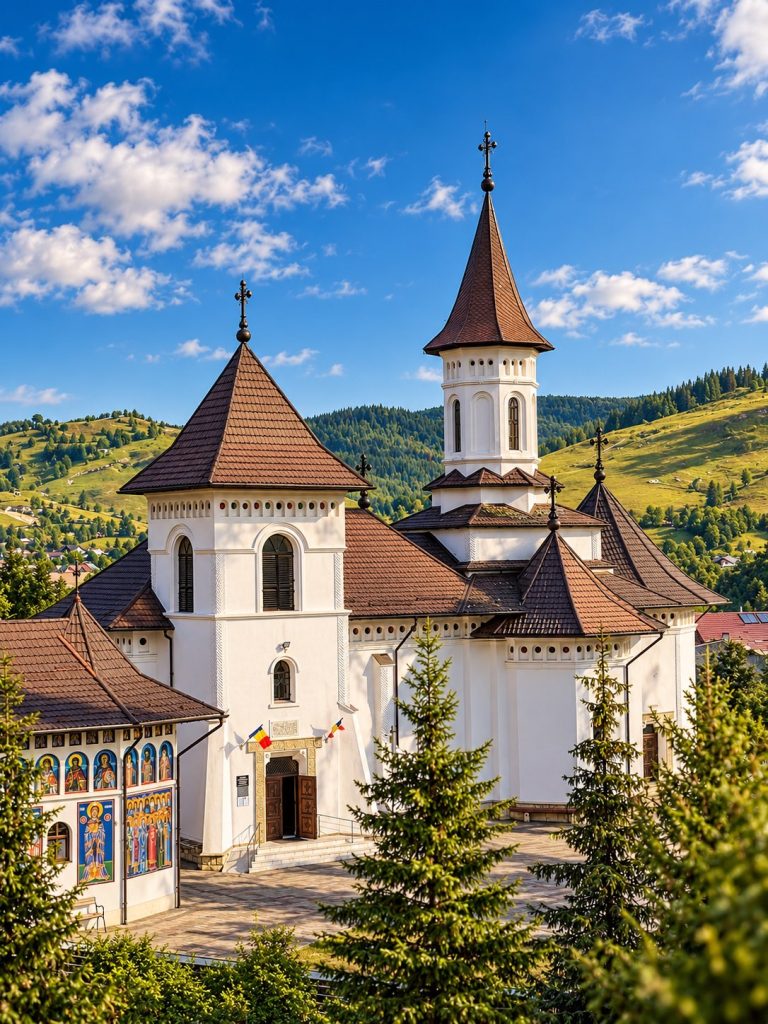
In the wooded landscape of northern Moldavia, near the town of Gura Humorului, stands one of the region’s most remarkable monuments of medieval religious art: the Church of the Dormition of the Mother of God at Humor. Its walls, adorned with vivid scenes from the Christian tradition, preserve an exceptional testimony to the spiritual, artistic and political world of sixteenth-century Moldavia.
The church is particularly admired for its exterior frescoes, whose warm reddish tones give the building a distinctive appearance among the painted churches of Bukovina. Yet its importance extends far beyond its remarkable decoration. Humor is also a place where the history of an earlier monastic foundation, the patronage of a high-ranking Moldavian official and the artistic ambitions of the age of Prince Petru Rareș come together.
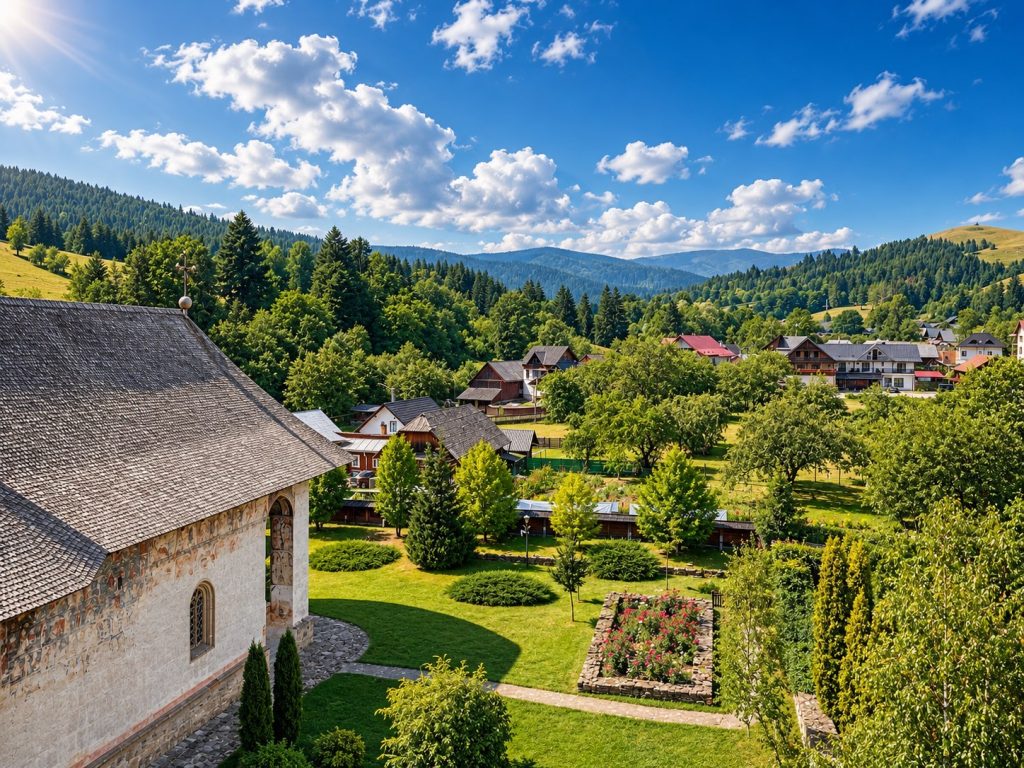
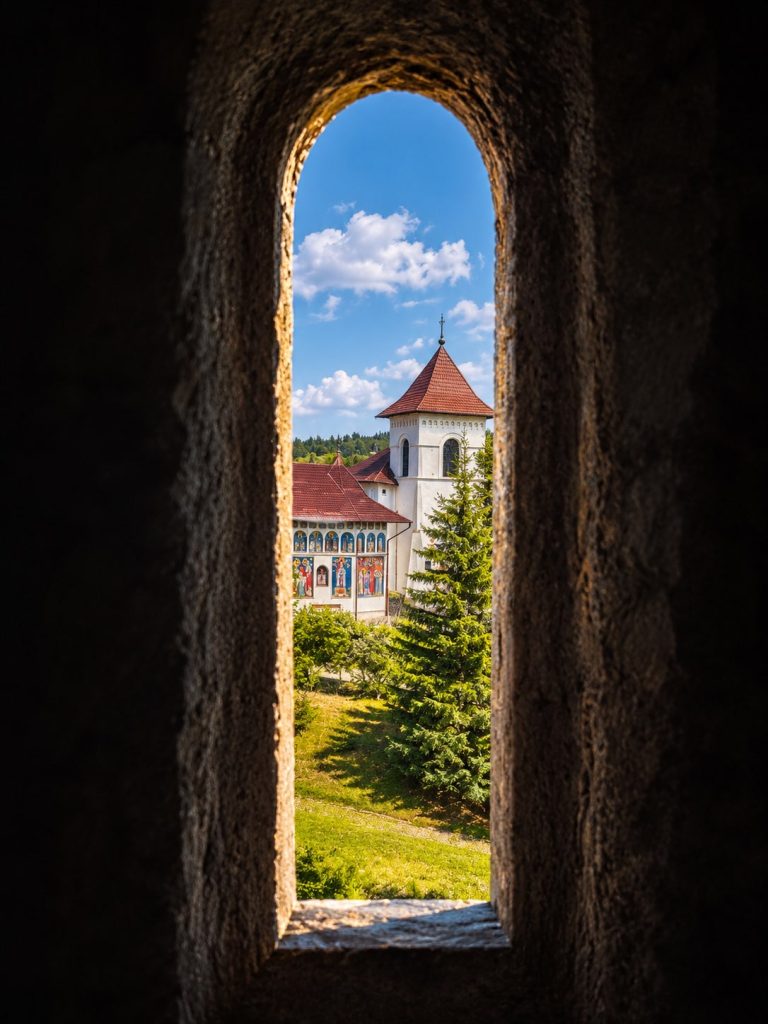
The Church of the Dormition of the Mother of God at Humor, set within the wooded landscape of northern Moldavia.
An Earlier Monastic Foundation
The history of the monastic site reaches back to the beginning of the fifteenth century. A donation document issued by Prince Alexandru cel Bun in 1415 mentions a monastery at Humor associated with a boyar known as Ivan Vornicul. This reference provides the earliest documentary evidence for the older religious establishment.
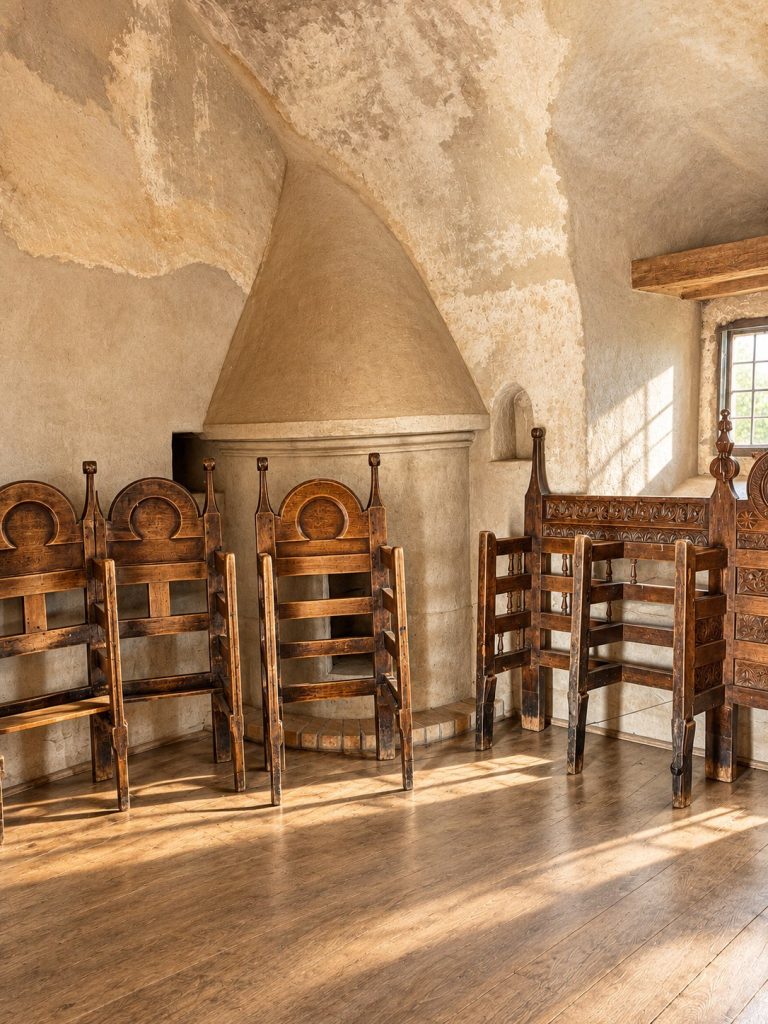
Relatively little is known about the appearance of this first monastery or the details of its community. Its buildings eventually fell into ruin, although the precise circumstances and date of their decline remain uncertain. Archaeological and architectural remains in the vicinity of the present church preserve traces of this earlier foundation.
The distinction between the two phases is important. The monastery documented in 1415 and the church that visitors see today belong to different periods in the history of the site. The present church was erected more than a century later, during the reign of Petru Rareș.
The Foundation of Toader Bubuiog
The present Church of the Dormition of the Mother of God was built in 1530 under the patronage of Toader Bubuiog, the great logothete of Moldavia, and his wife, Anastasia. The foundation took place during the reign of Prince Petru Rareș, son of Ștefan cel Mare and one of the most significant rulers of sixteenth-century Moldavia.
Toader Bubuiog occupied an important position within the princely administration. As great logothete, he belonged to the highest circle of officials surrounding the ruler. His foundation at Humor therefore reflects both personal religious devotion and the close relationship between ecclesiastical patronage, political standing and cultural life in the Moldavian principality.
The church’s foundation inscription, carved in stone and set into the exterior wall near the entrance, records the year 7038 according to the Byzantine calendar, corresponding to 1530, and the date of 15 August. It names Toader, the great logothete, and his wife Anastasia as the founders, while also acknowledging the authority and support of Prince Petru Voievod, son of Ștefan cel Mare.
This inscription is among the monument’s most important historical witnesses. It connects the surviving building directly to its founders and to the political circumstances of its construction.
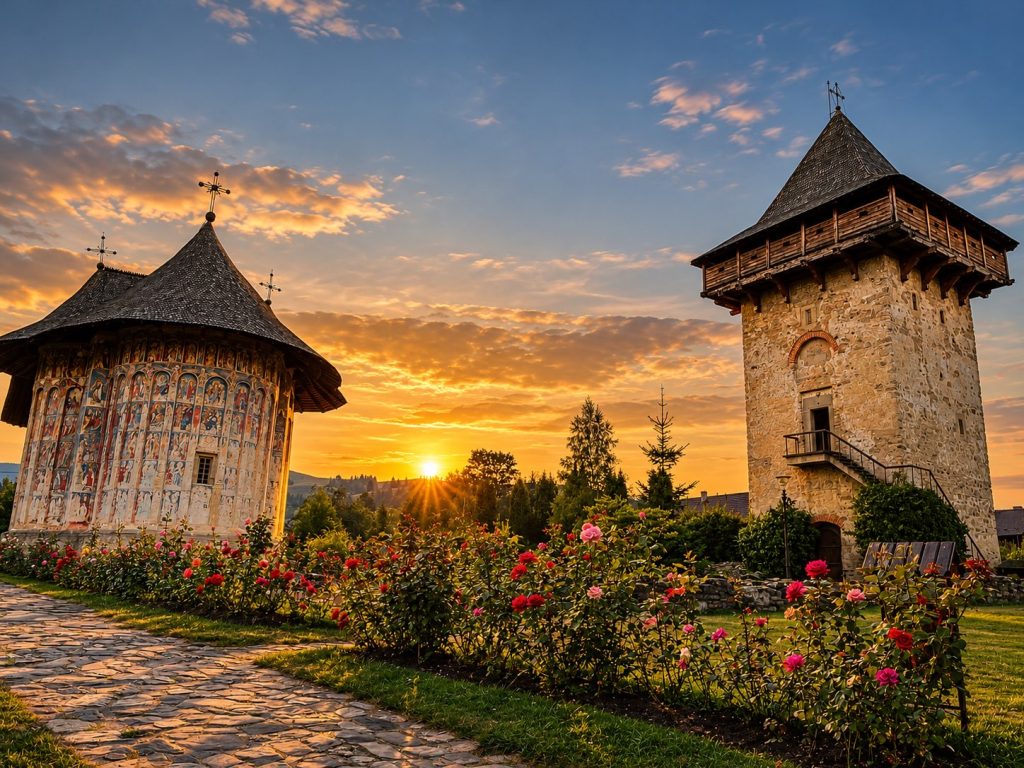
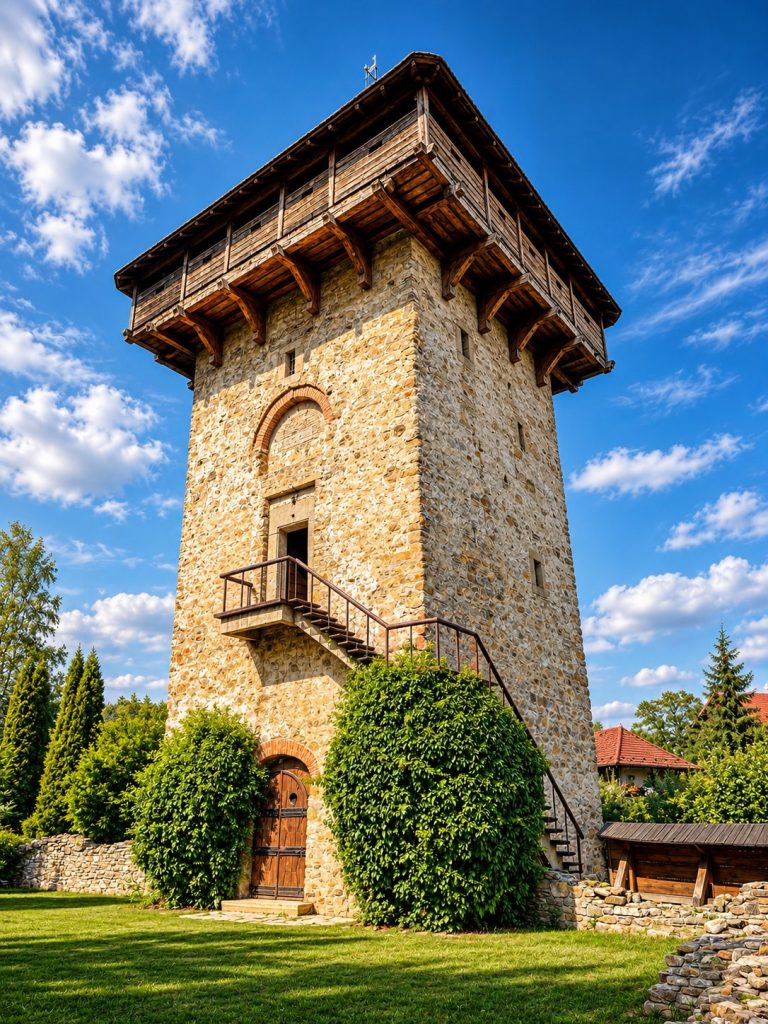
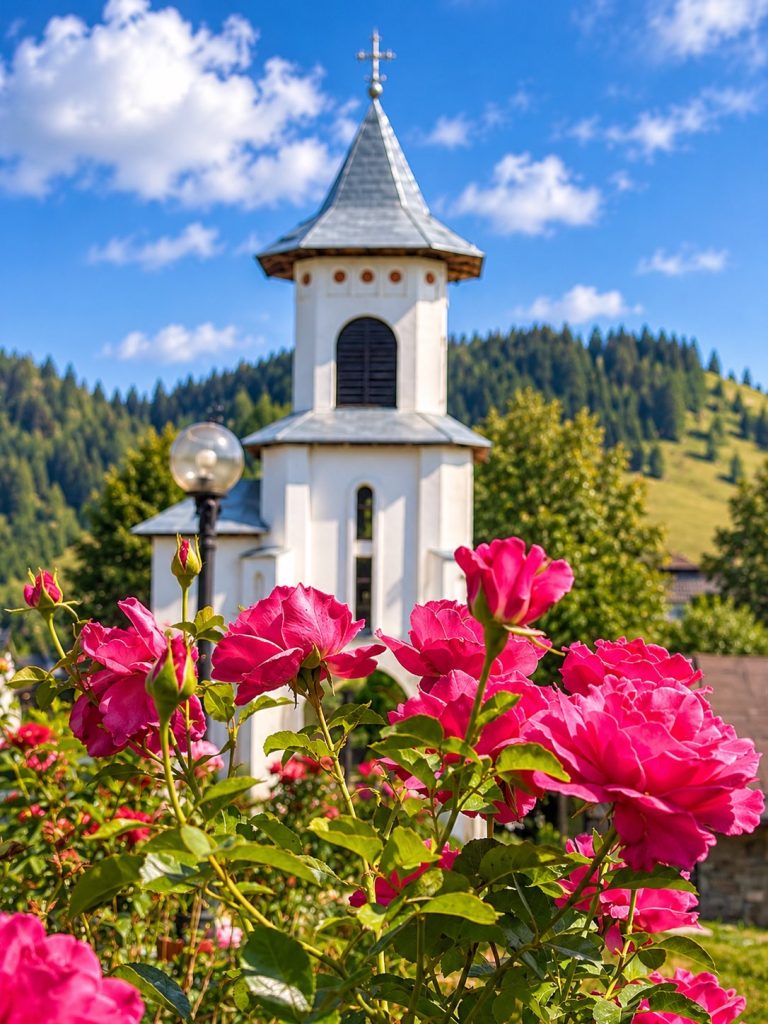
The Church of Humor and the defensive tower erected during the reign of Vasile Lupu, illustrating the architectural evolution of the monastic complex.
Architecture: A Distinctive Moldavian Church
The church at Humor belongs to the architectural tradition that flourished in Moldavia during the reign of Petru Rareș. Its design draws upon established Orthodox forms while displaying features that distinguish it from other religious buildings of the period.
Its plan follows the triconch arrangement, with an altar apse and lateral apses extending from the central sanctuary. Unlike several other Moldavian churches of the period, however, the nave is not crowned by a raised drum and dome. The building also incorporates a funerary chamber and, above it, a concealed upper room known as the tainiță.
Another particularly striking feature is the open western porch, or pridvor. Its arcades, supported by substantial masonry pillars, create a transition between the exterior and the more enclosed interior of the church. This arrangement gives the building much of its distinctive character.
The architecture thus combines liturgical function, commemorative purpose and practical ingenuity. The church should be understood within the wider development of Moldavian ecclesiastical architecture, while its particular arrangement reveals the individuality of its design.
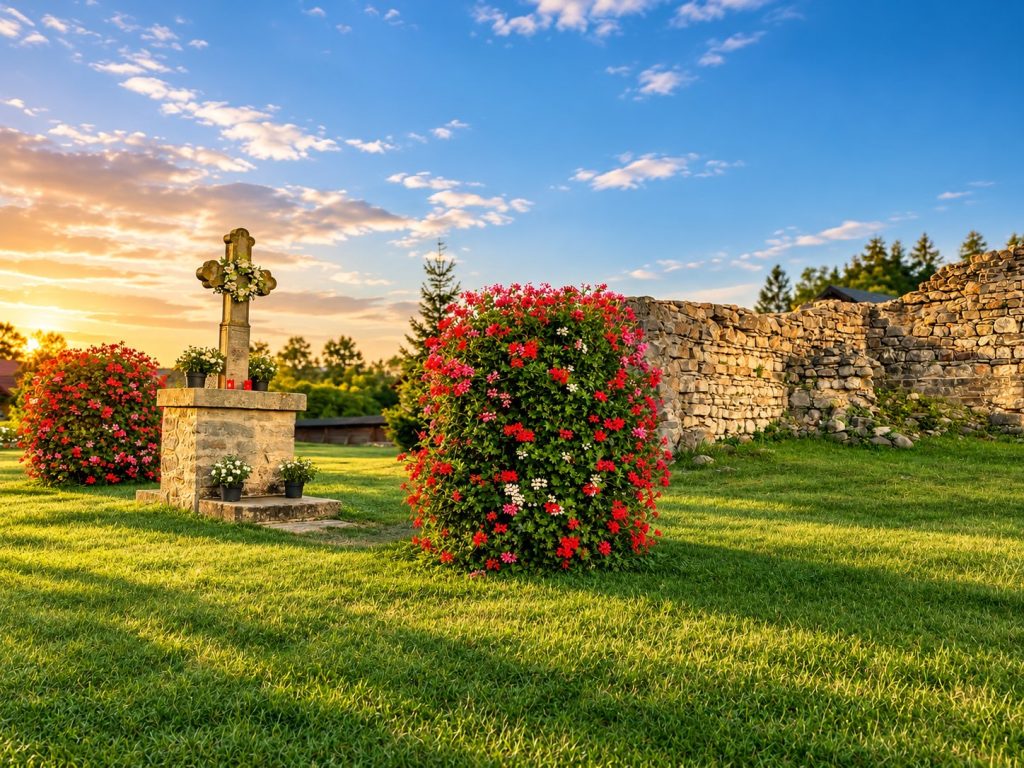
Stone cross and historic enclosure wall within the quiet grounds of Humor Monastery.
The Frescoes: Scripture Across the Walls
The painted decoration is among the principal reasons for Humor’s enduring importance.
The church’s interior and exterior were decorated with frescoes around 1535. The paintings are generally associated with a workshop probably led by Toma of Suceava. His name appears in connection with the celebrated scene of the Siege of Constantinople on the southern façade, and a document from 1541 identifies a painter named Toma of Suceava as a painter at the court of Petru Rareș. The association is compelling, although it is more accurate to speak of a workshop than to attribute every painted scene directly to his hand.
The exterior paintings are particularly memorable for their reddish tonal range. This colour gives the church a visual unity and distinguishes it from other painted monuments in the region. Yet the frescoes should not be regarded simply as decoration. They form an extensive visual programme through which biblical narratives, saints and themes of Orthodox theology were presented across the church’s walls.
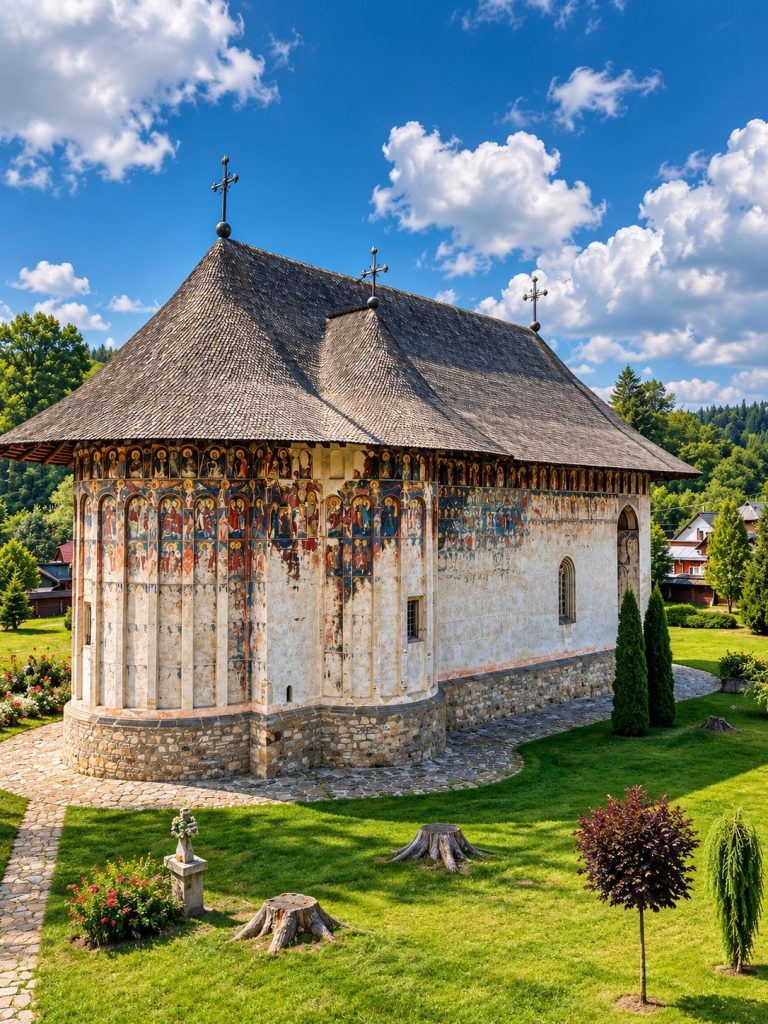
Among the principal subjects are the Hymn of the Akathist to the Mother of God on the southern façade, the Tree of Jesse on the northern side, and the Last Judgment in the western porch. The exterior apses display the ecclesiastical hierarchy, while the southern wall also contains the famous scene of the Siege of Constantinople.
This last composition is especially striking. It belongs to an iconographic tradition that recalls the historical fate of Constantinople, conquered by the Ottomans in 1453. The scene at Humor is associated with the wider visual tradition of depicting the siege of the Byzantine capital, in which the attackers are represented in contemporary terms.
The interior paintings continue this visual language within the sacred space. They include scenes from the life of the Virgin Mary, the life and Passion of Christ, saints and the traditional representation of Christ Pantocrator. The founders are also commemorated through their portraits within the church.
Together, the interior and exterior decoration create a coherent religious environment in which architecture and painting are inseparable. The images invite the visitor to look closely: individual figures, gestures and narrative scenes reveal a carefully organised theological world.
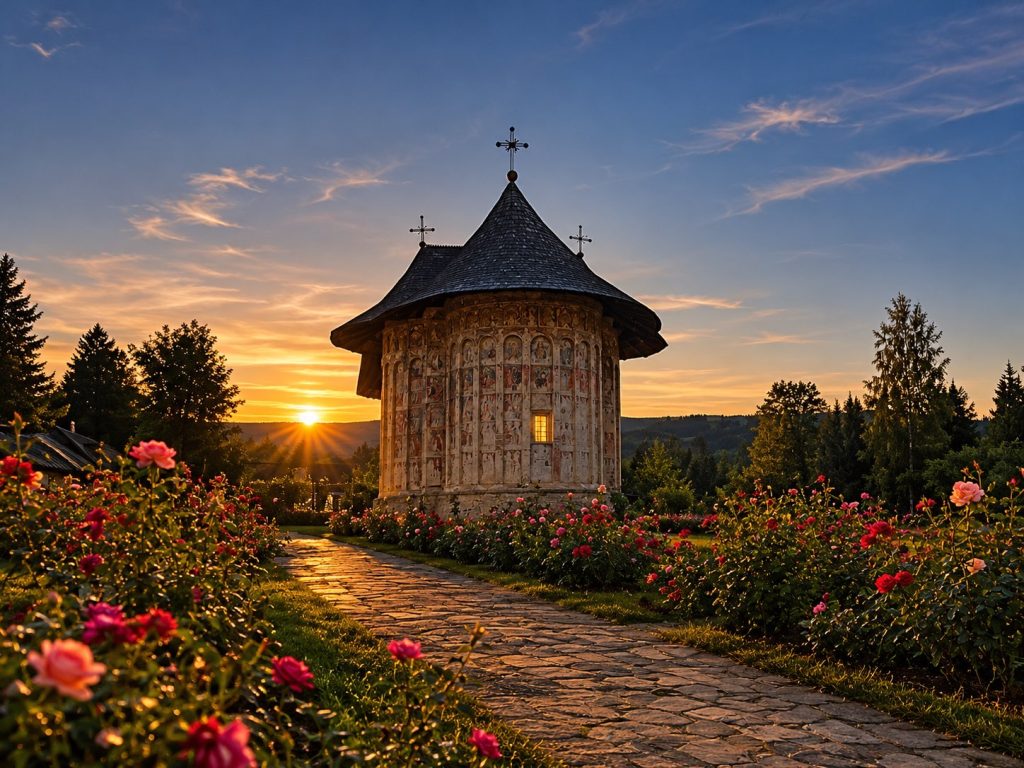
Approach to the painted apse of the Church of Humor at sunset, illustrating the architectural harmony of the monument.
Moldavia in the Age of Petru Rareș
Humor belongs to a period in which Moldavian rulers and members of the boyar elite invested considerable resources in the construction and decoration of churches and monasteries.
Petru Rareș ruled Moldavia from 1527 to 1538 and again from 1541 to 1546. His reign continued a tradition of religious patronage associated especially with his father, Ștefan cel Mare. The churches founded or renewed during this period became important expressions of Orthodox religious life and of the cultural identity of the principality.
The foundation at Humor illustrates how this tradition extended beyond the ruling family. High-ranking officials such as Toader Bubuiog could also establish significant religious monuments, supported by their wealth, status and proximity to the princely court.
The church’s foundation inscription makes this relationship particularly clear. It names the founders while also recording the role of Prince Petru Rareș. Religious patronage was therefore not merely a private matter: it formed part of the wider cultural and political life of medieval Moldavia.
The Tower of Vasile Lupu and the Later Monastery
The history of Humor did not end with the completion of the church and its frescoes.
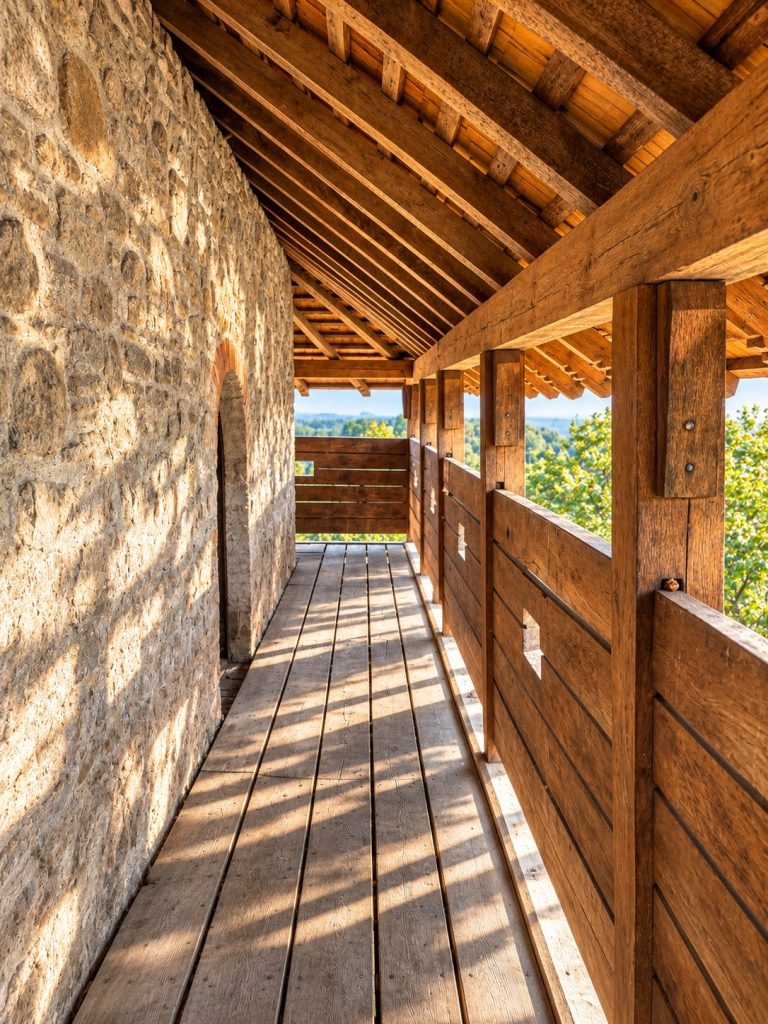
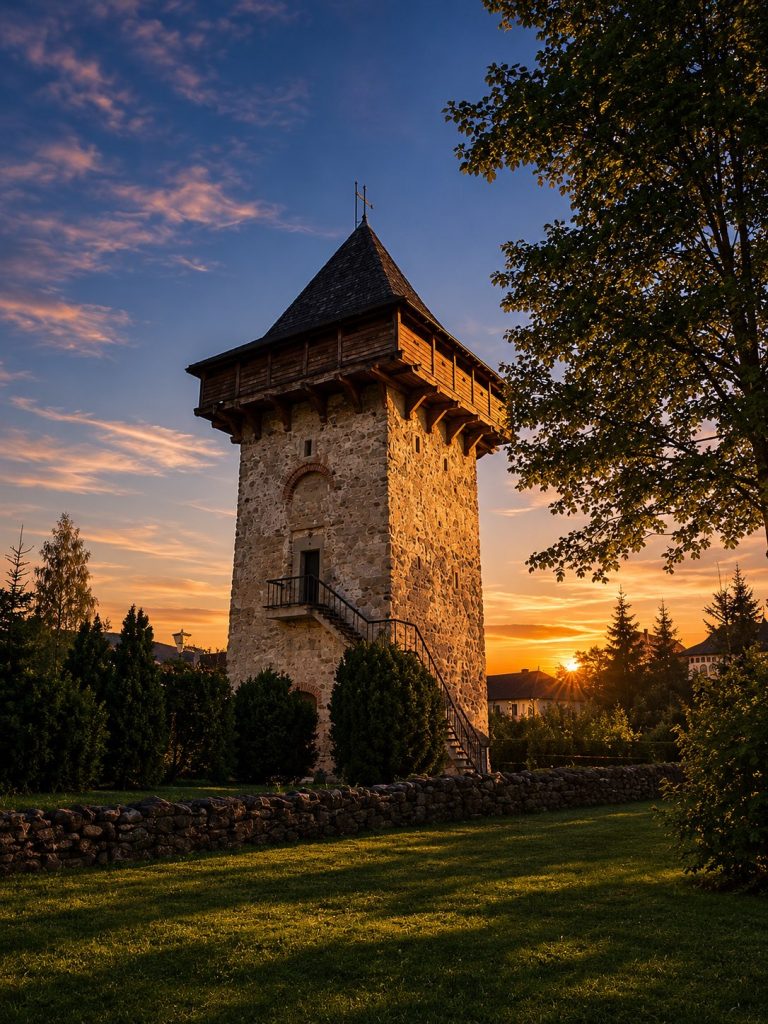
In 1641, during the reign of Vasile Lupu, a substantial tower was erected within the monastic complex. The ensemble also received a stone enclosure wall intended to protect the church and its monastic community. The tower, with its solid construction and narrow openings, reflects the defensive concerns of the period.
The monastery nevertheless experienced difficult times. Historical records report that in 1653 the Cossack forces of Timuș Khmelnytsky plundered and set fire to the religious establishment. The later history of the complex was also shaped by the political changes that followed the Habsburg occupation of Bukovina in 1774.
In 1785, the church became the parish church of the village, and the monastic community ceased to function as before. The building nevertheless remained in religious use, preserving its role as a place of worship.
After more than two centuries as a parish church, the monastic establishment was reactivated in 1990, this time as a convent of Orthodox nuns. The site thus regained a monastic community, although under very different historical circumstances from those of its medieval foundation.
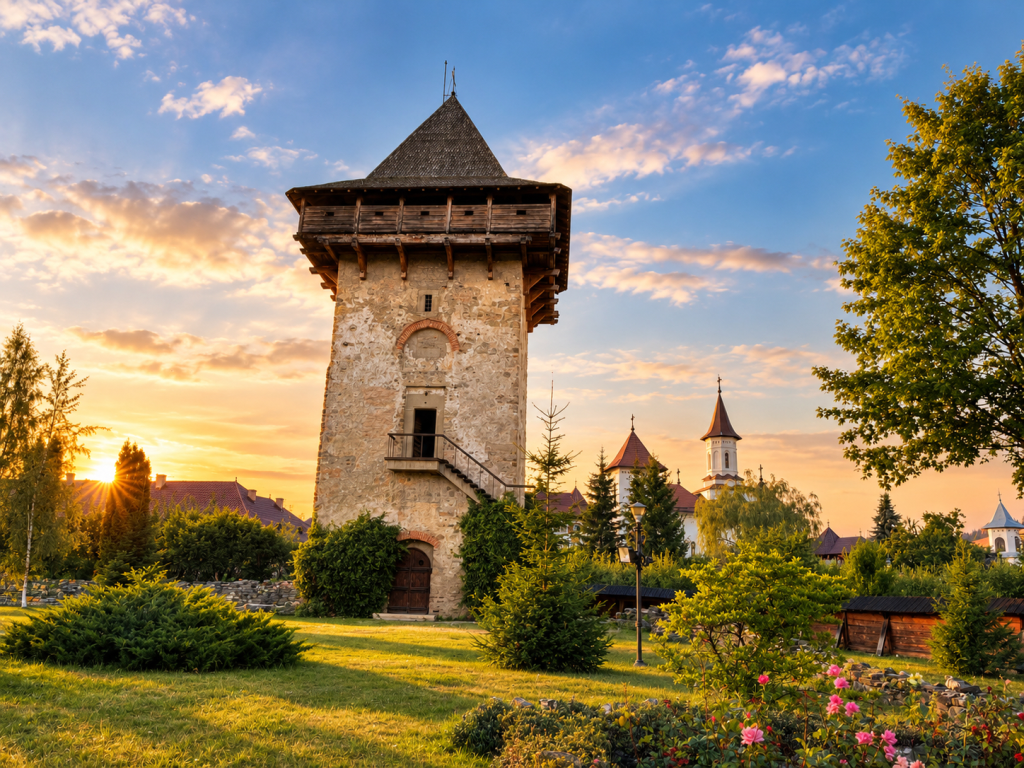
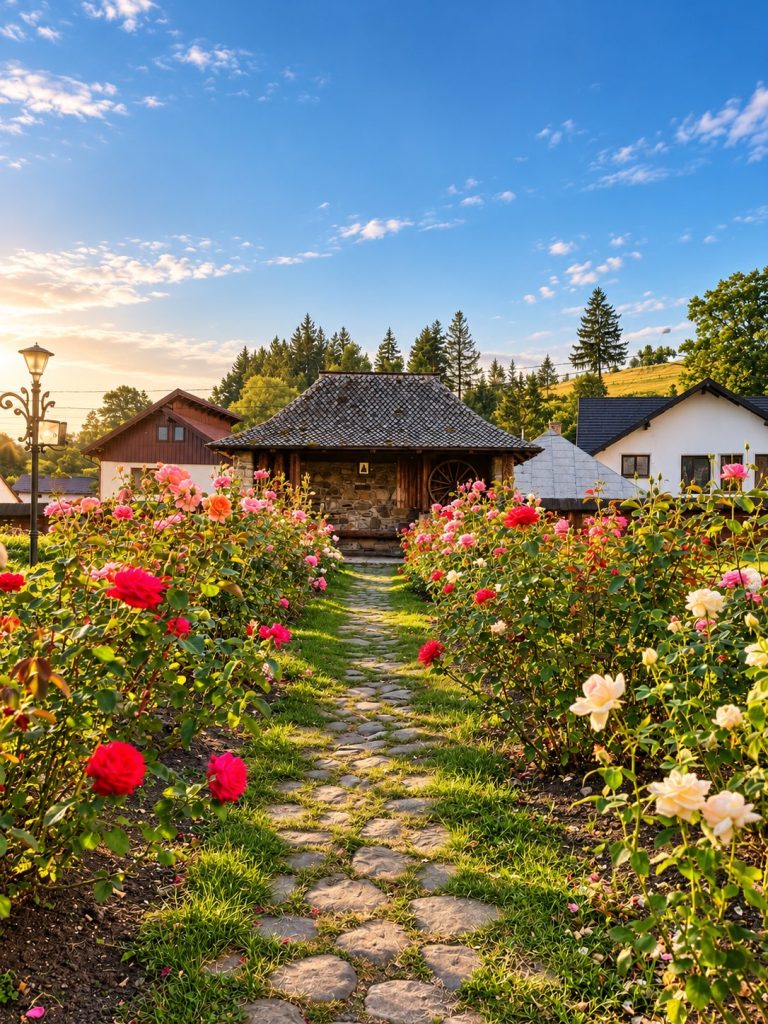
View of the monastic courtyard and tower at Humor, designated as part of the UNESCO World Heritage ensemble.
A Monument of World Heritage
The artistic and historical significance of Humor extends far beyond the region. In 1993, the church was inscribed on the UNESCO World Heritage List as part of the group known as the Churches of Moldavia. The World Heritage property was subsequently extended in 2010 to include the Church of the Resurrection at Sucevița.
UNESCO recognises these churches for their exceptional mural paintings, which cover their façades with extensive cycles of religious imagery inspired by Byzantine art. Their importance lies not merely in the preservation of individual frescoes, but in the remarkable integration of architecture, painting and religious meaning.
Humor is an essential member of this group. Its distinctive reddish exterior, open western porch and unusual architectural arrangement give it a character of its own within the wider tradition of Moldavian painted churches.
Conservation has played an important role in preserving this heritage. Restoration campaigns have addressed both the building and its mural decoration, while archaeological investigations have continued to contribute to our understanding of the historical development of the monastic site.
A Living Encounter with Medieval Moldavia
To visit Humor is to encounter more than a beautiful church. It is to stand before a monument that preserves several layers of Moldavian history: the memory of a foundation documented in 1415, the religious patronage of Toader Bubuiog and Anastasia, the artistic culture of the age of Petru Rareș, and the later transformations of monastic life under changing political circumstances.
The frescoes remain the most immediately visible expression of this heritage. Their colours and narratives invite the visitor to look closely, while the architecture reveals the skill and imagination of the builders who shaped the church nearly five centuries ago.
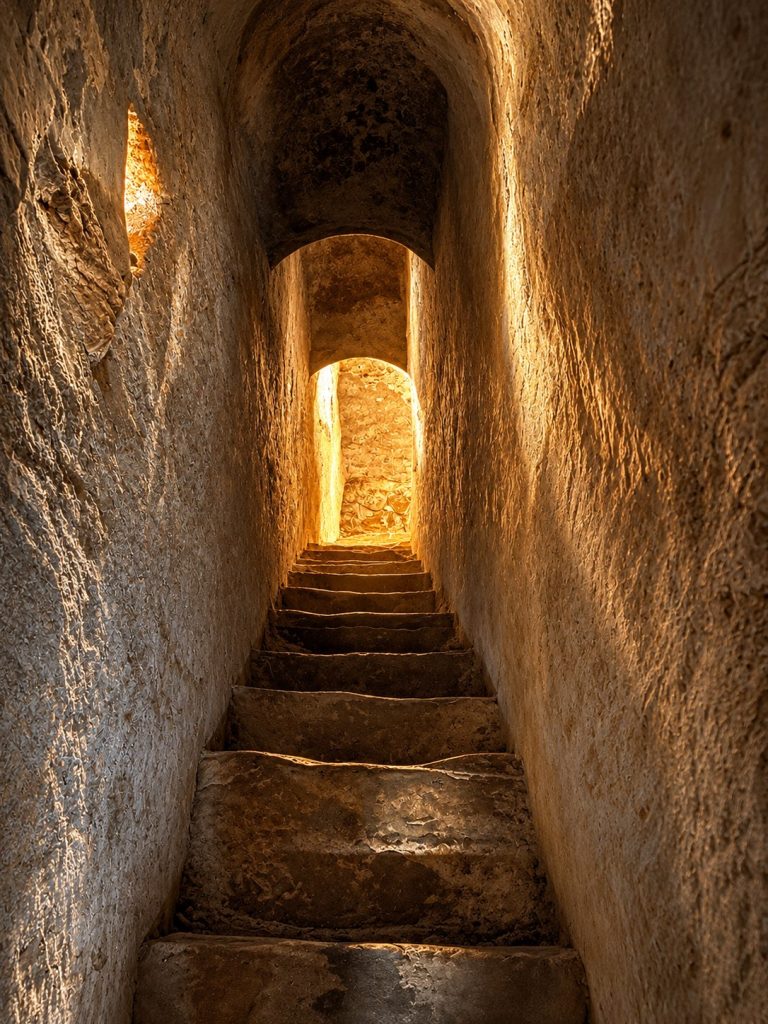
Together, these elements make Humor one of the defining monuments of medieval Moldavian culture. Its walls preserve a world in which faith, art and political life were closely connected – a world that can still be approached today through the surviving fabric of the church and the images that adorn it.
The photographs accompanying this article document the church and its surroundings, including architectural details and the remarkable painted decoration that makes Humor one of the most distinctive monuments of Bukovina.
Basarab Heritage
— A.C.
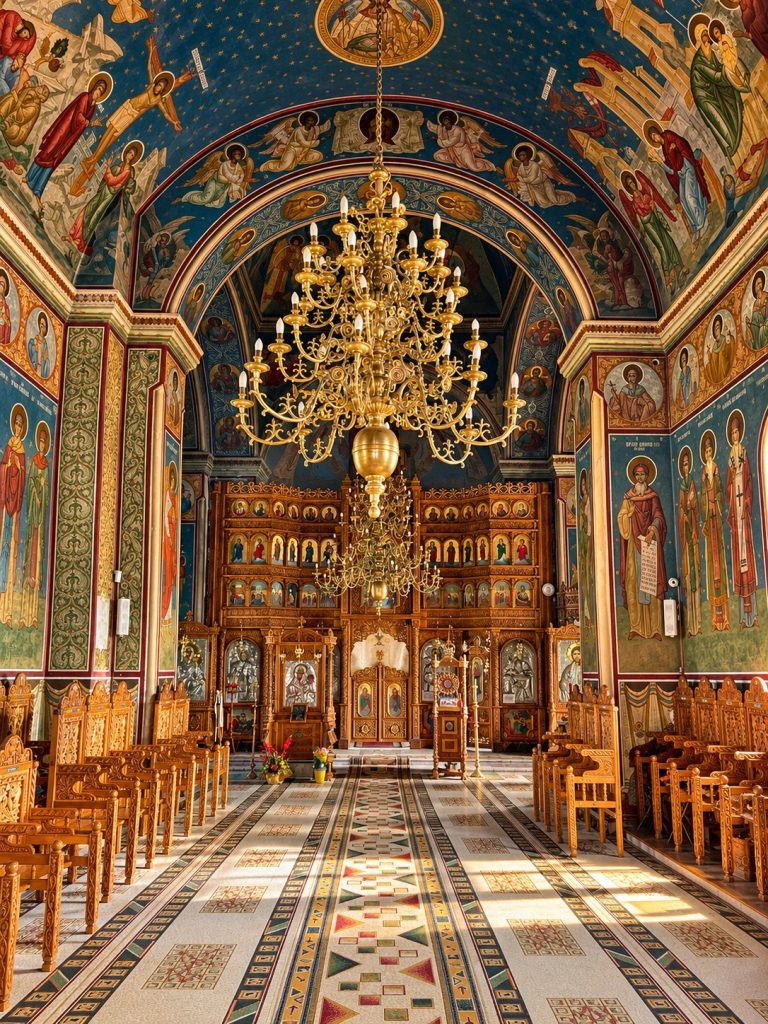
Interior view of the monastic church at Humor, facing the iconostasis and illustrating the rich iconographic programme of the nave.