
What Passes, and What Remains
Everything passes in time. Generations rise and disappear, kingdoms change, and the works of human hands gradually give way to the passage of centuries. What once seemed permanent becomes part of memory; what was familiar to one generation may be almost forgotten by the next.
Yet the human experience of time also gives rise to a deeper question: if everything in the created world is subject to change, is there anything that does not pass away?
The composition Chronos approaches this question through the language of Scripture and the spiritual tradition of Eastern Christianity. Its central contrast is between the passing nature of earthly existence and the enduring glory of God. The generations succeed one another, but the divine word remains. Human memory may be incomplete, but nothing is lost in the presence of the Eternal.
The title, Χρόνος – Chronos, is the ancient Greek word for time. It provides the starting point for a meditation that moves from the passing of generations towards the eternity of God, and finally towards praise.
Chronos in the Ancient Greek World
The Greek word χρόνος refers to time, its passage, duration and succession. It is important, however, to distinguish the ordinary meaning of the word from its mythological associations. Greek mythology and later philosophical traditions developed different associations with time and its personification; these should not be treated as a single, uniform ancient doctrine.
The nature of time became one of the enduring questions of Greek philosophy.
In Plato’s Timaeus, time is described in relation to the creation and ordered movement of the heavens. Plato calls it a moving image of eternity, a formulation that became particularly influential in later philosophical and theological reflection. The temporal world is characterised by movement and change, whereas eternity belongs to a different order of existence.
Aristotle approached the question differently. In Book IV of his Physics, he examined time in relation to movement, defining it in terms of the number or measure of motion with respect to what comes before and after. Time, in this account, is not identical with movement itself, but is understood through the succession by which movement can be measured.
These philosophical approaches were not identical, and neither should be mistaken for the complete Christian understanding of time. Nevertheless, they provided an intellectual vocabulary that later Christian writers could engage with, adapt and sometimes challenge.
The distinction between what changes and what endures is central to the present composition. Its opening lines do not attempt to define time philosophically. They express something more immediate: the experience of generations passing and the conviction that God’s word remains beyond their succession.
The Biblical Witness: Generations Pass, but God Remains
The strongest foundations of the song are found in the Old Testament, particularly in the Psalms and the prophetic writings.
The opening declaration,
Πάντα παρέρχεται ἐν τῷ χρόνῳ,
καὶ πάντα μεταβάλλονται ἐν τῇ γῇ.
“Everything passes in time,
and everything changes upon the earth,”
is a poetic statement of a theme that appears repeatedly in Scripture.
One particularly close parallel is Isaiah 40:8. The Septuagint reads:
ἐξηράνθη ὁ χόρτος, καὶ τὸ ἄνθος ἐξέπεσεν,
τὸ δὲ ῥῆμα τοῦ θεοῦ ἡμῶν μένει εἰς τὸν αἰῶνα.
“The grass has withered, and the flower has fallen, but the word of our God remains for ever.”
The contrast is unmistakable: earthly life is subject to passing and decay, whereas the word of God endures. The first movement of Chronos develops this biblical idea in its own poetic language:
ἀλλ’ ὁ λόγος σου μένει εἰς τὸν αἰῶνα.
“but Your word remains for ever.”
Another important passage is Psalm 101 in the Septuagint, corresponding to Psalm 102 in the numbering used by most modern English Bibles. In verses 26-28, the psalm contrasts the created heavens and earth, which are subject to change, with the permanence of God:
“They will perish, but You endure; they will all wear out like a garment. But You are the same, and Your years have no end.”
The song’s declaration that God’s glory has no end and His kingdom no boundary belongs to this same scriptural tradition.
The language of eternity is also found in Psalm 89 in the Septuagint, corresponding to Psalm 90 in modern English numbering:
“From everlasting to everlasting, You are God.”
These passages do not describe eternity merely as a very long period of time. They express the difference between the changing world of creation and the enduring permanence of its Creator.
From Generation to Generation
The second movement turns from the passing of generations to the continuity of faith.
Ἐκ γενεᾶς εἰς γενεάν,
αἰνεῖται τὸ ὄνομά σου.
“From generation to generation,
Your name is praised.”
This is closely related to Psalm 144:4 in the Septuagint, corresponding to Psalm 145:4 in modern English numbering:
“One generation shall praise Your works to another, and shall declare Your mighty acts.”
The idea is not simply that religious traditions survive because people remember them. Scripture presents the transmission of faith as a responsibility: what has been received must also be communicated.
This principle appears clearly in Deuteronomy 6, where the people of Israel are instructed to teach God’s commandments to their children and to speak of them in the ordinary circumstances of daily life. Psalm 77 in the Septuagint, corresponding to Psalm 78 in modern English numbering, likewise speaks of the duty to transmit God’s works and commandments to succeeding generations, so that those yet to be born may place their hope in Him.
The words of the song,
Ἐκ τῶν πατέρων πρὸς τοὺς υἱούς,
μεταδίδοται ἡ πίστις.
“From the fathers to the sons,
the faith is passed on,”
express this scriptural principle in concise poetic form.
The following declaration – one hope, one faith, one glory, one kingdom – gives the movement a communal character. Faith is not portrayed as an isolated possession, but as an inheritance received and transmitted across generations.
This theme also has a particular resonance in the history of Eastern Christianity. The Byzantine world experienced the succession of dynasties, wars, territorial changes and political transformations. Yet the liturgical and theological traditions of the Church continued to be transmitted through worship, manuscripts, teaching and communal life.
The composition does not refer to one particular Byzantine event. Rather, it evokes a much wider historical experience: political structures may disappear, but the spiritual and cultural inheritance carried by successive generations can continue.
Chronos and Eternity in Christian and Byzantine Thought
The third movement introduces the central theological contrast of the composition.
Πρὸ πάντων τῶν αἰώνων,
σὺ εἶ ὁ ὢν καὶ ὁ μένων.
“Before all the ages,
You are the One who is and remains.”
The expression πρὸ πάντων τῶν αἰώνων – “before all the ages” – belongs to the language of Christian confession and worship. It expresses the belief that God is not confined by the succession of created ages.
The words ὁ ὢν – “the One who is” – also recall the Greek wording of Exodus 3:14, where God reveals Himself to Moses:
Ἐγώ εἰμι ὁ ὤν.
“I am the One who is.”
The song’s complete phrase, ὁ ὢν καὶ ὁ μένων, is not a direct quotation of that verse. Rather, it combines the biblical language of divine being with the additional poetic affirmation that God remains.
In Christian theology, the distinction between time and eternity became a subject of sustained reflection. The Church Fathers engaged with the philosophical questions inherited from the Greek world while interpreting them in the light of biblical revelation.
Saint Basil the Great, in his writings on creation, considered time in relation to the existence and succession of the created world. Saint Gregory of Nyssa also reflected upon the difference between created existence and the eternal divine life.
This distinction was important in Byzantine theology. God was not understood simply as a being who had existed for an infinitely long time before the world. Rather, He is the Creator of the world and of time itself. Created existence is subject to beginning, change and succession; the divine being is not confined by these limitations.
The Greek terms χρόνος and αἰών have a long and complex history, and their meanings overlap in some ancient and Christian texts. They should not be reduced to a rigid opposition in which one always means ordinary time and the other always means eternity. Nevertheless, Christian theological writing increasingly used the language of the ages and of eternity to express the transcendent life of God.
The song’s declaration that God’s kingdom does not pass away reflects this understanding. It is not merely a kingdom that lasts longer than earthly kingdoms. It belongs to the divine order that stands beyond the succession of human rulers and generations.
The Scriptural Light of the Final Movement
The fifth movement contains one of the most recognisable biblical expressions in the entire composition:
Ἐν τῷ φωτί σου ὀψόμεθα φῶς.
“In Your light we shall see light.”
These words are drawn directly from Psalm 35:10 in the Septuagint, corresponding to Psalm 36:9 in modern English numbering:
ὅτι παρὰ σοὶ πηγὴ ζωῆς,
ἐν τῷ φωτί σου ὀψόμεθα φῶς.
“For with You is the fountain of life; in Your light we shall see light.”
In its original psalmic setting, the expression belongs to a prayer celebrating God’s steadfast love, righteousness and protection. Within Christian interpretation, it also acquired a rich spiritual resonance: divine light is not merely something observed from a distance, but the light through which life and understanding become possible.
The song continues:
ἐν τῇ χάριτί σου ζῶμεν.
“By Your grace we live.”
This is a concise theological statement rather than a direct quotation from a single biblical verse. It expresses the conviction that human life is sustained by divine grace.
The final lines return to the theme with which the composition began:
Καὶ ἃ ὁ χρόνος καλύπτει,
παρὰ σοὶ οὐκ ἀπόλλυνται.
“And what time conceals,
with You is not lost.”
This is perhaps the most personal and contemplative statement in the song. Time may obscure memories, alter the appearance of the world and remove the visible traces of earlier generations. Yet the composition places its hope in a reality beyond human remembrance: what is entrusted to God is not lost in His presence.
Five Movements: From Time to Eternity
The composition unfolds in five movements. Their sequence creates a clear progression: the passing of the world, the continuity of faith, the eternity of God, the praise of His kingdom and the final affirmation that nothing is lost in His presence.
I. Ὁ Χρόνος – Time
The opening movement is a meditation on transience.
Generations come and go, and all things upon the earth are subject to change. Against this movement of passing time stands the permanence of God’s word and the endlessness of His kingdom.
The solo voice introduces the central theme in a restrained and contemplative manner.
II. Αἱ Γενεαί – The Generations
The second movement broadens the perspective from the individual to the community.
The choir proclaims that God’s name is praised from generation to generation and that faith is transmitted from fathers to sons. The repeated declarations of hope, faith and glory give the movement the character of a communal confession.
Here, continuity is not presented as the mere survival of customs. It is the living transmission of a spiritual inheritance.
III. Ἡ Αἰωνιότης – Eternity
The third movement turns directly towards the divine.
God is confessed as the One who existed before all ages and remains beyond the limitations of created time. The language of beginning and ending, so familiar to human experience, is no longer applicable to His eternal kingdom.
The movement brings the philosophical and theological heart of the composition into focus: the world changes, but God remains.
IV. Ἡ Δοξολογία – Doxology
The fourth movement is a proclamation of praise.
The choir addresses God as the King of the ages and repeats the declaration Νῦν καὶ ἀεί – “Now and always.”
The language recalls the enduring doxological vocabulary of Christian worship, in which praise is offered not merely for a particular moment, but for all ages.
V. Τὸ Ἀμήν – The Amen
The final movement returns to the image of light and to the assurance that what time conceals is not lost in God’s presence.
The solo voice gives way to the choir, whose repeated words Νῦν καὶ ἀεί lead into the familiar liturgical conclusion:
Καὶ νῦν καὶ ἀεὶ
καὶ εἰς τοὺς αἰῶνας
τῶν αἰώνων.
“Both now and ever,
and unto the ages
of ages.”
The final Ἀμήν brings the composition to a close, not as a denial of time, but as an affirmation of the eternal hope that gives meaning to life within it.
Songtext
The following is the complete Greek text of Chronos, preserving the five-part structure and the wording supplied for the composition. The translation seeks to preserve the meaning, imagery and solemn character of the Greek original. It is not intended as a strict word-for-word rendering, but as a faithful English version that can be read and understood independently.
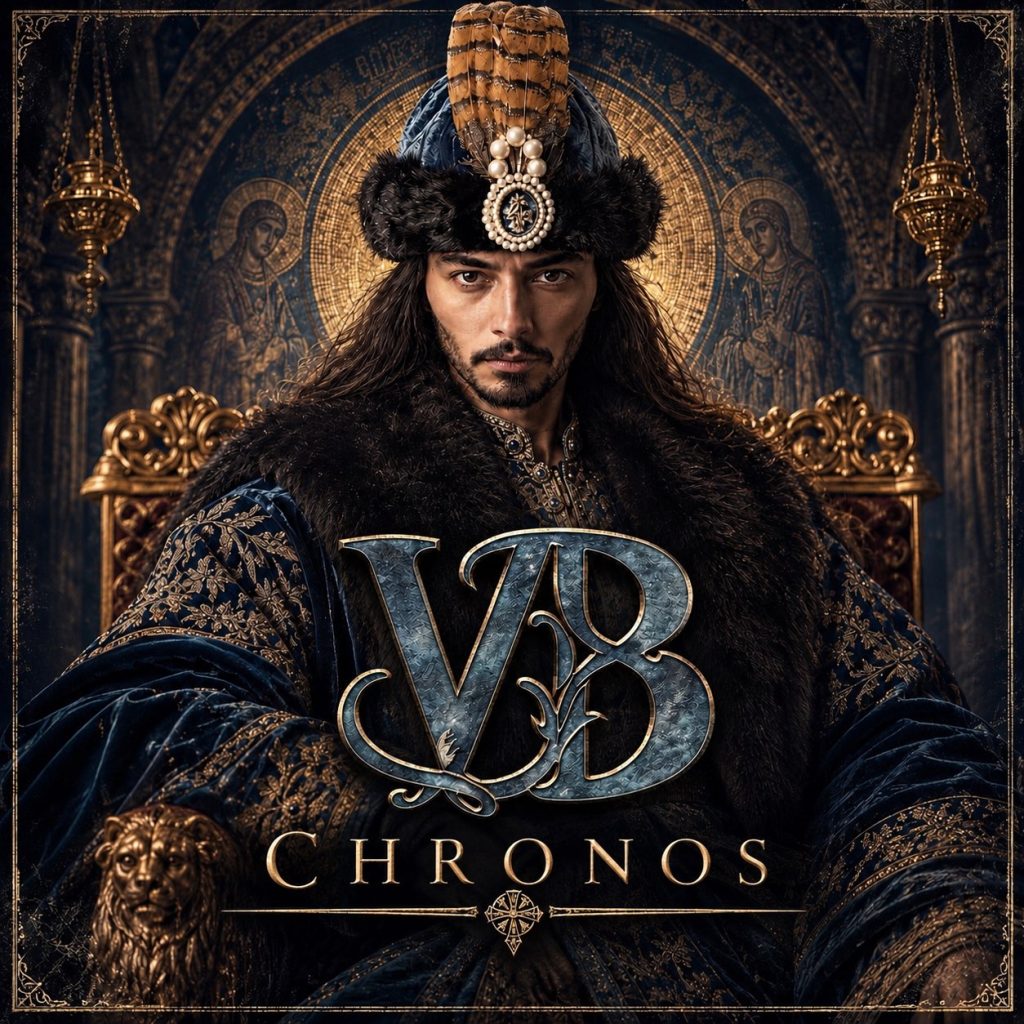
Χρόνος – Chronos
Ι. Ὁ Χρόνος
Πάντα παρέρχεται ἐν τῷ χρόνῳ,
καὶ πάντα μεταβάλλονται ἐν τῇ γῇ.
Αἱ γενεαὶ ἔρχονται καὶ παρέρχονται,
ἀλλ’ ὁ λόγος σου μένει εἰς τὸν αἰῶνα.
Οὐκ ἔχει τέλος ἡ δόξα σου,
οὐκ ἔχει πέρας ἡ βασιλεία σου.
ΙΙ. Αἱ Γενεαί
Ἐκ γενεᾶς εἰς γενεάν,
αἰνεῖται τὸ ὄνομά σου.
Ἐκ τῶν πατέρων πρὸς τοὺς υἱούς,
μεταδίδοται ἡ πίστις.
Μία ἡ ἐλπίς,
μία ἡ πίστις,
μία ἡ δόξα,
ἡ σὴ βασιλεία.
ΙΙΙ. Ἡ Αἰωνιότης
Πρὸ πάντων τῶν αἰώνων,
σὺ εἶ ὁ ὢν καὶ ὁ μένων.
Οὔτε ἀρχὴν οὔτε τέλος ἔχεις,
καὶ ἡ βασιλεία σου οὐ παρέρχεται.
Ἐν σοὶ τὰ πάντα μένουσιν,
ἐν σοὶ τὰ πάντα πληροῦνται.
IV. Ἡ Δοξολογία
Δόξα σοι, ὁ Θεὸς ἡμῶν!
Δόξα σοι, ὁ Βασιλεὺς τῶν αἰώνων!
Νῦν καὶ ἀεί!
Νῦν καὶ ἀεί!
Καὶ εἰς τοὺς αἰῶνας
τῶν αἰώνων!
V. Τὸ Ἀμήν
Ἐν τῷ φωτί σου ὀψόμεθα φῶς,
ἐν τῇ χάριτί σου ζῶμεν.
Καὶ ἃ ὁ χρόνος καλύπτει,
παρὰ σοὶ οὐκ ἀπόλλυνται.
Νῦν καὶ ἀεί.
Νῦν καὶ ἀεί.
Καὶ νῦν καὶ ἀεὶ
καὶ εἰς τοὺς αἰῶνας
τῶν αἰώνων.
Ἀμήν.
I. Time
Everything passes in time,
and everything changes upon the earth.
Generations come and generations pass,
but Your word remains for ever.
Your glory has no end,
Your kingdom has no boundary.
II. The Generations
From generation to generation,
Your name is praised.
From the fathers to the sons,
the faith is passed on.
One is the hope,
one is the faith,
one is the glory,
Your kingdom.
III. Eternity
Before all the ages,
You are the One who is and remains.
You have neither beginning nor end,
and Your kingdom does not pass away.
In You all things remain,
in You all things are fulfilled.
IV. Doxology
Glory to You, our God!
Glory to You, King of the ages!
Now and always!
Now and always!
And unto the ages
of ages!
V. The Amen
In Your light we shall see light,
by Your grace we live.
And what time conceals,
with You is not lost.
Now and always.
Now and always.
Both now and ever,
and unto the ages
of ages.
Amin.
Listen to the Song
Beyond the Passing of Time
Chronos brings together several strands of a long intellectual and spiritual tradition.
Its title belongs to the vocabulary of ancient Greek thought. Its central images are rooted in the Psalms and the prophetic writings of the Old Testament. Its distinction between created time and divine eternity reflects questions explored by the Church Fathers and developed within Byzantine theology. Its final language of praise belongs to the living tradition of Christian worship.
Yet the composition is not simply a historical summary of these traditions. It gives them a new musical expression through five movements that lead from the passing of generations towards the enduring presence of God.
The song does not deny the reality of time. Human life remains finite; generations succeed one another, and the visible world changes. Its message is rather that time does not possess the final word.
What passes from human sight need not be lost. What disappears from the memory of one generation remains known to God. And what is entrusted to Him belongs to a hope that reaches beyond the limits of earthly existence.
The final words therefore bring the whole composition back to its central conviction:
Νῦν καὶ ἀεί – Now and always.
For the world, time passes. For God, eternity remains.
Basarab Heritage
— A.C.