
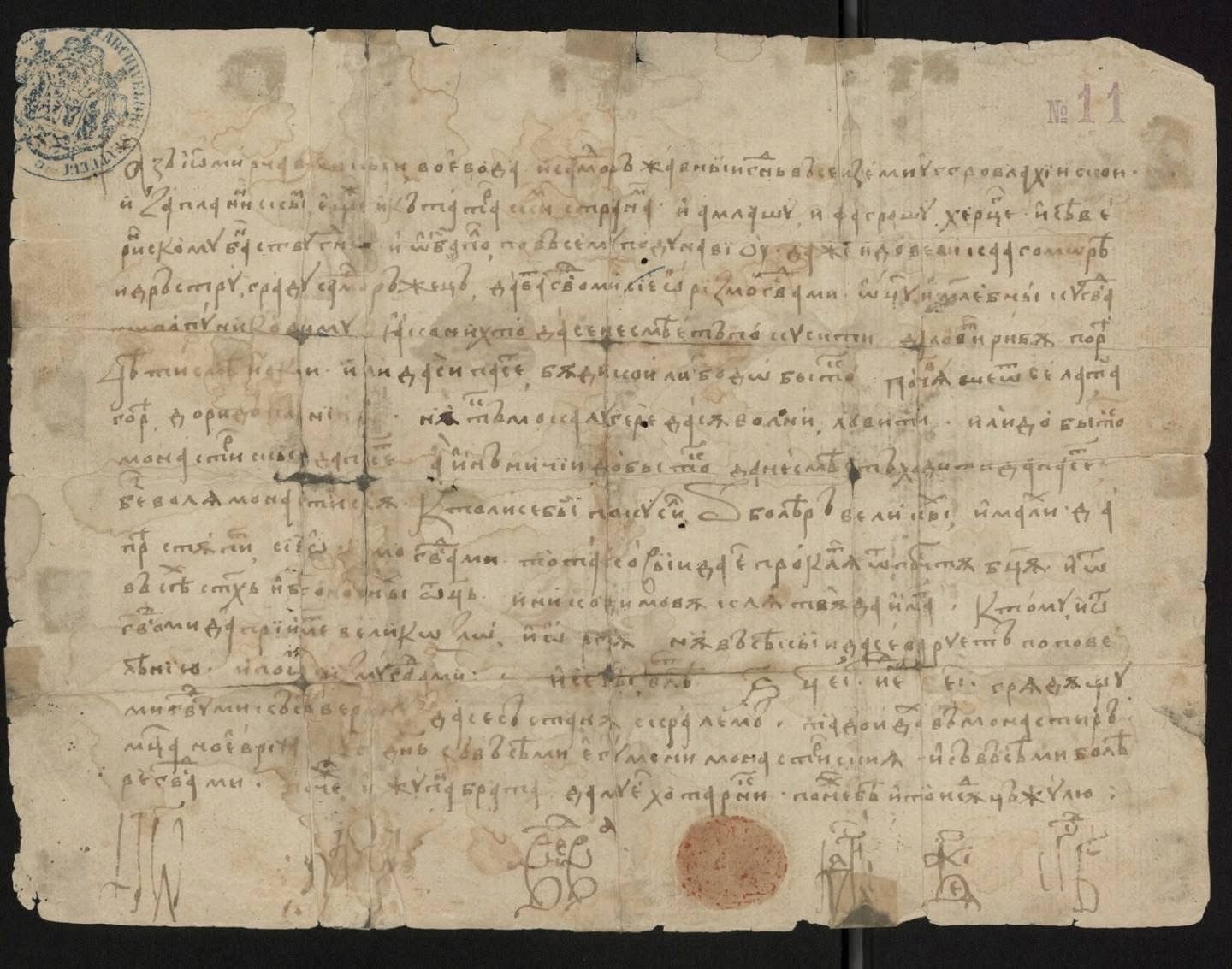
On 23 November 1406, Mircea cel Bătrân, Prince of Wallachia, issued an important princely act at the Monastery of Tismana. Its immediate purpose was to protect the monastery’s exclusive rights to fish in the river Tismana and to graze its livestock on the surrounding lands extending from the village towards the mountains. Yet the significance of this document reaches far beyond the regulation of local resources. Its remarkable opening titulature, its references to ecclesiastical authority and boyar administration, and its account of the prince’s journey towards Severin offer a revealing glimpse into the political and institutional world of Wallachia at the beginning of the fifteenth century.
The charter is particularly noteworthy for the breadth of Mircea’s titulature. It names territories and lordships extending beyond the central lands of Wallachia, from Amlaș and Făgăraș to the Banate of Severin, the lands along the Danube, the Black Sea and the fortress of Dristra. These expressions must be understood within their medieval political context, rather than as a description of a modern state with precisely defined borders. Nevertheless, they convey the wide geographical horizon of the claims and responsibilities associated with Mircea’s rule.
The document also brings us close to the spiritual world of Tismana and its founder, the monk Nicodim, whom Mircea addresses with particular reverence as his spiritual father and intercessor. It is a source in which princely authority, monastic privilege, territorial claims and personal devotion are brought together in a single act.
The Historical Document
The document is preserved in Church Slavonic, the established language of the Wallachian princely chancery during this period. Its formal language and titulature reflect the diplomatic and ecclesiastical traditions of the Orthodox lands of south-eastern Europe.
The act is dated according to the Byzantine chronological system: the year 6915, corresponding to 1406, and the fifteenth indiction. It was issued on 23 November at the Monastery of Tismana. In the scholarly edition Documenta Romaniae Historica, series B, Țara Românească, volume I, it is listed as document no. 32.
The original is a parchment document measuring approximately 21.5 by 29 centimetres. According to the archival description reproduced in the scholarly edition, its seal has become detached. The document is therefore not merely known through later copies: the medieval original itself has survived.
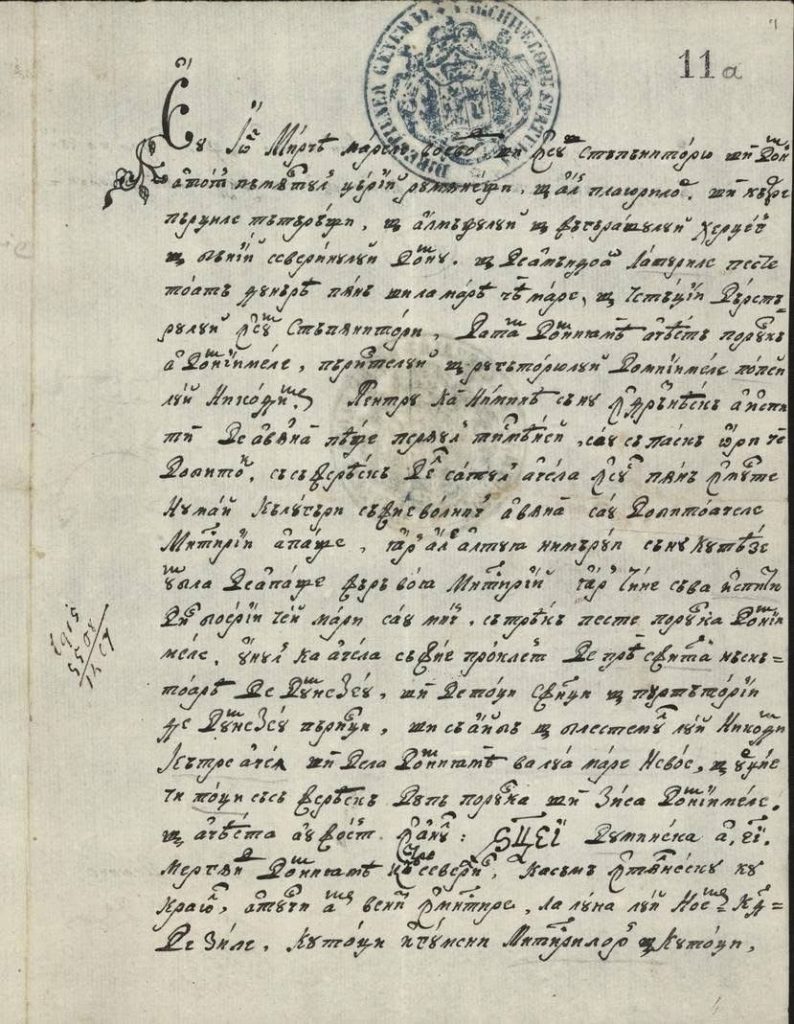
The following presentation follows the arrangement of the historical material published by Tipărituri vechi: first, the reproduced excerpt of the original Slavonic text; then the Romanian translation from the late eighteenth century; and finally an English translation prepared for this article.
Original Document – Church Slavonic Text
† Aзъ, Iѡ Mирча вєʌикыи воєвода и самодръжавныи господинь въсєи зєми Ȣггровʌхїискои и запʌанинскым, єщєжє и къ Tатарским странам и AмʌашȢ и ФаргашȢ хєрцєг и CѣвєринскомȢ БанствȢ господинь и ѡБа поʌ по въсємȢ ПодȢнавїоу, дажє и до Вєʌикаaго Mѡрѣ и ДръстрȢ градȢ самодръжєцъ…
The Slavonic passage is reproduced as an excerpt, following the transcription published by Tipărituri vechi. The ellipsis indicates that the original text continues.
Romanian Translation from the Late Eighteenth Century
The following translation preserves the historical Romanian wording reproduced in the source. Its spelling and vocabulary have deliberately not been modernised.
„Eu, Io Mircea marele voevod și însuș stăpânitoriu și Domn a tot pământul Țărâi Rumânești, și al plaiurilor, și cătră părțile tătărăști, și Almăjului și Făgărașului herțeg, băniei Severinului domn, și de amândoao laturile peste toată Dunărea până și la Marea cea Mare, și cetății Dârstărului însuș stăpânitoriu, dat-am domnia mea această poruncă a domniei mele părintelui și rugătoriului domniei mele popei, lui Nicodim.
Pentru ca nimenea să nu îndrăznească a ispiti de a vâna pește pe râul Tismanei, sau să pască orice dobitoc, să să ferească de la satul acela în sus până în munte.
Numai călugări să fie volnici a vâna sau dobitoacele mănăstirii a paște, iar ale altuia nimărui să nu cuteze umbla de a paște fără voia mănăstirii, iar cine să va ispiti din boerii cei mari sau mici, să treacă peste porunca domniei mele, unul ca acela să fie proclet de prea sfânta Născătoare de Dumnezeu, și de toți sfinții și purtătorii de Dumnezeu părinți, și să aibă și blestemul lui Nicodim.
Către aceia și de la domnia mea va lua mare nevoie și urgie, și toți să să ferească după porunca și zisa domniei mele.
Și aceasta au fost în anul 6915 (=1406), dumineca a 15-a, mergând domniea mea către Severin, ca să mă întâlnescu cu craiul, atunci am venit în mănăstire, la luna lui noiemvrie, 23 de zile, cu toți egumeni mănăstirilor și cu toți boerii domniei mele, mai vârtos și jupan Brata să-i fie hotarnic, pentru că au fost și acela judecător Jiiului.”
English Translation
“I, Io Mircea, great voivode and autocratic lord of the whole land of Ungro-Wallachia and of the lands beyond the mountains, also towards the Tatar regions, and Duke of Amlaș and Făgăraș, lord of the Banate of Severin and of both sides along the whole Danube, even as far as the Great Sea and the fortress of Dristra, sovereign ruler, have issued this princely command of mine to the father and intercessor of my lordship, the priest Nicodim.
No one shall dare to fish in the river Tismana or to pasture any livestock there, from the village upstream as far as the mountains.
Only the monks shall have the right to fish, and the monastery’s own livestock may graze there. No one else shall dare to bring animals to pasture without the monastery’s permission. Whoever, whether among the great or the lesser boyars, attempts to act against this princely command shall be accursed by the Most Holy Mother of God, by all the saints and God-bearing Fathers, and shall also incur the curse of Nicodim.
Such a person shall likewise incur the severe displeasure and wrath of my lordship. Let everyone therefore refrain from such actions, in accordance with my princely command and decree.
This took place in the year 6915 [1406], in the fifteenth indiction. As my lordship was travelling towards Severin in order to meet the king, I came to the monastery on the twenty-third day of the month of November, together with all the abbots of the monasteries and all the boyars of my lordship. In particular, the boyar Brata was appointed to act as the boundary official, since he was also judge of the Jiu district.”
Editorial note: This English rendering follows the historical Romanian translation, with the chronological formula checked against the scholarly edition of the original document. The Romanian version reproduced above reads “dumineca a 15-a”; the scholarly edition identifies the original dating formula as “indiction 15”. The English translation therefore follows the latter. The title “Duke of Amlaș and Făgăraș” reflects the wording of the historical translation; the precise political and administrative meaning of these titles is discussed below.
Source of the reproduced document and Romanian translation: Tipărituri vechi, “Întinderea Țării Românești în timpul lui Mircea cel Bătrân. Hrisov pentru mânăstirea Tismana (1406)”. The image of the original is credited there to the Arhiva Medievală a României.
Mircea cel Bătrân and the Political World of Wallachia
Mircea cel Bătrân ruled Wallachia from 1386 until 1418. His reign unfolded during a period of profound political change in south-eastern Europe. The Ottoman advance into the Balkans altered the balance of power, while the rulers of Wallachia had to maintain relations with neighbouring principalities, the Kingdom of Hungary and the political powers beyond the Danube.
Wallachia occupied a strategically important position between the Carpathians and the lower Danube. Its political and economic interests extended beyond the central territory of the principality, particularly towards Transylvania and the Danubian frontier. Mircea’s reign is associated with the consolidation of princely authority, the defence of the lower Danube and diplomatic engagement with the Kingdom of Hungary.
The charter of 1406 reflects this wider political setting. Its language is that of a ruler conscious of the extent of his authority, while its practical provisions demonstrate how that authority was exercised in relation to a particular religious institution and its lands.
The Princely Titulature and the Extent of Wallachian Authority
The opening of the charter is remarkable for the breadth of Mircea’s titulature. He identifies himself as great voivode and autocratic lord of Ungro-Wallachia, of the lands beyond the mountains, of territories towards the Tatar regions, of Amlaș and Făgăraș, of the Banate of Severin, and of lands on both sides of the Danube, extending to the Great Sea and the fortress of Dristra.
Each geographical reference carries a particular historical significance.
Ungro-Wallachia was the formal designation of the principality. The expression concerning the lands beyond the mountains refers to territories associated with Wallachian authority north of the Carpathians. Amlaș and Făgăraș were Transylvanian possessions or fiefs connected with the Wallachian ruler. The Banate of Severin was an important frontier territory in the western part of the principality.
The reference to Podunavia concerns the Danubian lands, while Dristra is the medieval name for the fortress and settlement corresponding to modern Silistra in Bulgaria. The Great Sea is generally understood as a reference to the Black Sea.
It is important, however, not to read this titulature as though it were a modern geographical description of a state with precisely defined borders. Medieval princely titles could encompass hereditary claims, fiefs, possessions, political influence and spheres of authority. Their language was also shaped by diplomatic convention. The charter therefore provides valuable evidence for the political claims associated with Mircea’s rule, but it should not be treated as a precise map of the principality in 1406.
Even with this qualification, the titulature remains a striking expression of Wallachia’s regional position and of the political ambitions and responsibilities of its ruler.
Tismana and the Spiritual Authority of Nicodim
The Monastery of Tismana occupies a distinguished place in the religious history of Wallachia. Situated in a mountainous landscape in what is now Gorj County, it became one of the most important centres of Orthodox monastic life in the principality.
Its foundation is traditionally associated with Saint Nicodim, a monk whose activity connected Wallachia with the wider spiritual world of the Balkans and Mount Athos. His life is known through a combination of historical evidence and later ecclesiastical tradition, and individual details should therefore be treated with appropriate care.
The monastery’s church is traditionally dated to a consecration on 15 August 1378. A charter issued by Prince Dan I on 3 October 1385 provides documentary evidence for the monastery and its church by that date. Tismana was therefore already an established religious institution before Mircea’s charter of 1406.
Nicodim’s importance extended beyond the foundation of a single monastery. He is associated with the development of monastic life in Wallachia and with the transmission of Orthodox spiritual and literary traditions. Among the most notable objects connected with him is the Tetraevangelion of 1405, a manuscript copied and illuminated by Nicodim on parchment and bound in silver-gilt covers. It is regarded as an important early dated manuscript from Wallachia.
The wording of Mircea’s charter is particularly revealing. He addresses Nicodim as “the father and intercessor of my lordship”. This designation is more than a conventional expression of respect. It reflects the spiritual standing of the monk and the close relationship between princely authority and the Orthodox Church.
According to ecclesiastical tradition, Nicodim died on 26 December 1406, just over a month after the charter was issued. The document thus belongs to the final weeks of his life and is particularly valuable as a contemporary witness to his standing at the Wallachian court.
The Protection of the Monastery’s Rights
The immediate purpose of the charter was to protect the monastery’s rights to use the river Tismana and the surrounding pastureland. Mircea expressly forbade other persons from fishing in the river or grazing their livestock on the lands extending from the village towards the mountains.
These rights were reserved for the monks and for the monastery’s own animals. Other livestock could not be brought onto the land without the monastery’s permission.
Such provisions were of considerable practical importance. A monastery required reliable access to natural resources in order to sustain its community. Fishing provided food, while pastureland supported the animals that formed part of the institution’s agricultural economy. The charter protected these resources from competing claims and unauthorised use.
The wording also makes clear that the prohibition applied across social ranks. Mircea expressly mentions both great and lesser boyars. No member of the aristocracy was exempt from the princely command.
The sanctions combine religious and secular authority. Anyone violating the charter would incur the curse of the Mother of God, the saints and the God-bearing Fathers, as well as the curse of Nicodim. The offender would also face the wrath of the prince.
This combination of spiritual condemnation and princely punishment reflects the close relationship between ecclesiastical privilege and political authority in medieval Wallachia. The monastery’s rights were not merely a matter of local custom: they were protected by a formal act of the ruler.
Boyar Brata and the Administration of Land
The final part of the charter contains a revealing reference to a boyar named Brata. Mircea states that Brata was to act as hotarnic, a person entrusted with establishing or confirming boundaries. The document adds that he also held the office of judge of the Jiu district.
This detail is important because the protection of monastic rights required more than a general princely declaration. Boundaries had to be identified, local claims clarified and the relevant land placed under the protection of the monastery.
The office of hotarnic was therefore an administrative and practical one. Its holder was entrusted with the delimitation or confirmation of property boundaries. Brata’s additional position as judge of the Jiu suggests that he possessed recognised authority in the region.
The charter thus offers a valuable insight into the workings of Wallachian administration. It reveals the cooperation between the prince, the boyar elite and the monastic institution in the regulation of property and resources.
On the Road to Severin: The Meeting with the King
One of the most interesting passages appears near the end of the document. Mircea records that he was travelling towards Severin in order to meet “the king” and that, during this journey, he came to the monastery of Tismana on 23 November 1406.
The king is generally identified as Sigismund of Luxembourg, King of Hungary and Croatia. This identification is consistent with the political relationship between Mircea and the Hungarian monarch, whose cooperation was of particular importance in the context of Ottoman expansion.
The charter does not, however, state that the meeting took place at Tismana. Nor does it provide further details of the negotiations or establish that the encounter occurred exactly as planned. What it does tell us is that Mircea was travelling towards Severin with the intention of meeting the king and that he visited Tismana during that journey.
The prince also records that he came to the monastery accompanied by the abbots of the monasteries and by his boyars. This is a significant indication of the company in which he travelled, although the document does not provide enough information to identify the visit as a formal political assembly.
The reference nevertheless places the charter within a wider diplomatic context. The act was issued not in isolation, but during a journey connected with the ruler’s relations with one of the principal powers of the region.
A Document at the Intersection of Power and Faith
The charter of 23 November 1406 is valuable precisely because it brings together several dimensions of medieval Wallachian life. Its opening titulature expresses the territorial claims and political authority of Mircea cel Bătrân. Its central provisions protect the economic resources of the Monastery of Tismana. Its references to Nicodim reveal the spiritual standing of the monastery’s founder, while the appointment of Brata illustrates the administrative mechanisms through which princely decisions were put into practice.
The document also reminds us that medieval power was exercised through concrete acts. The authority of a ruler was expressed not only in warfare and diplomacy, but also in the confirmation of property rights, the protection of religious institutions and the regulation of the resources on which local communities depended.
For the history of Tismana, the charter is a testimony to the monastery’s established position and to its relationship with the princely court. For the history of Wallachia, it is a source of particular interest because it preserves a broad formulation of Mircea’s titulature and records his movement towards the Danubian frontier.
More than six centuries later, the document remains a compelling witness to the political and spiritual world of Mircea cel Bătrân: a world in which princely authority, territorial claims, monastic privilege and diplomatic relationships were closely interwoven.
Basarab Heritage
— A.C.
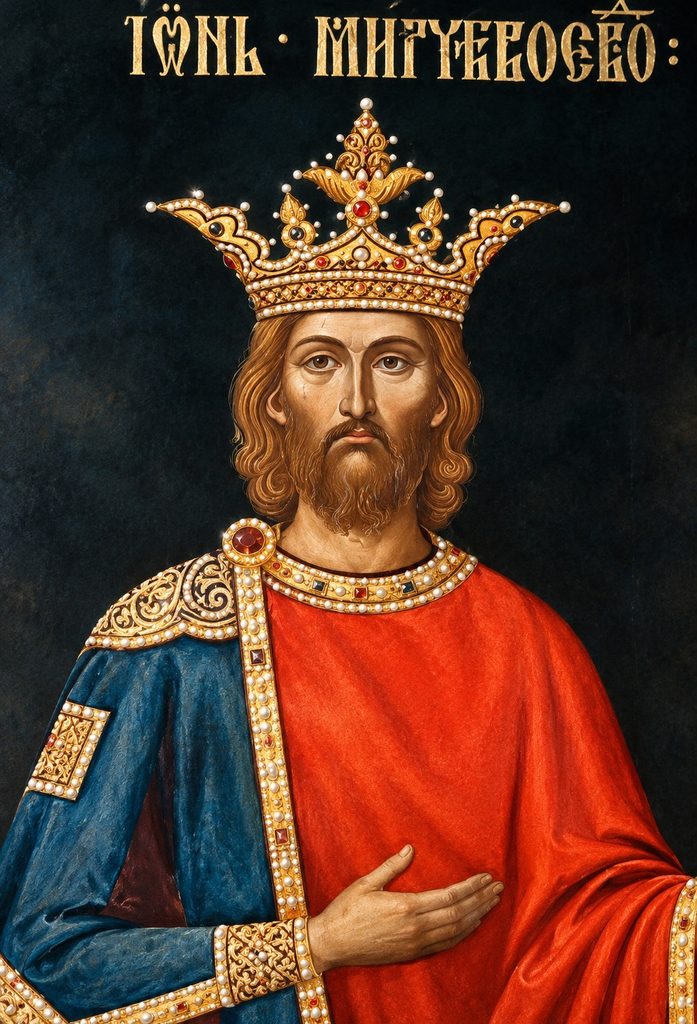
The Voivode Mircea cel Bătrân, whose expansive titulature and sovereign authority defined Wallachia’s geopolitical standing at the turn of the fifteenth century.
⸻
Sources and Further Reading
- P. P. Panaitescu and Damaschin Mioc (eds.), Documenta Romaniae Historica, series B, Țara Românească, vol. I (1247–1500), Bucharest, 1966, document no. 32, pp. 69-70.
2. Tipărituri vechi, “Întinderea Țării Românești în timpul lui Mircea cel Bătrân. Hrisov pentru mânăstirea Tismana (1406)”.
3. Mitropolia Olteniei, “Istoric Mănăstirea Tismana”.
4. Ioan Bogdan, “Un chrisov al lui Mircea-cel-Bătrân”, Analele Academiei Române, Seria II, Tomul XXVI.