

The City Behind the Song
For more than a thousand years, Constantinople stood at the crossroads of Europe and Asia, commanding the passage between the Mediterranean and the Black Sea. Its harbours welcomed merchants from distant shores; its churches, palaces and monasteries reflected the religious, artistic and intellectual achievements of the Eastern Roman Empire. Its walls, repeatedly repaired and strengthened over the centuries, became among the most celebrated defensive fortifications of the medieval world.
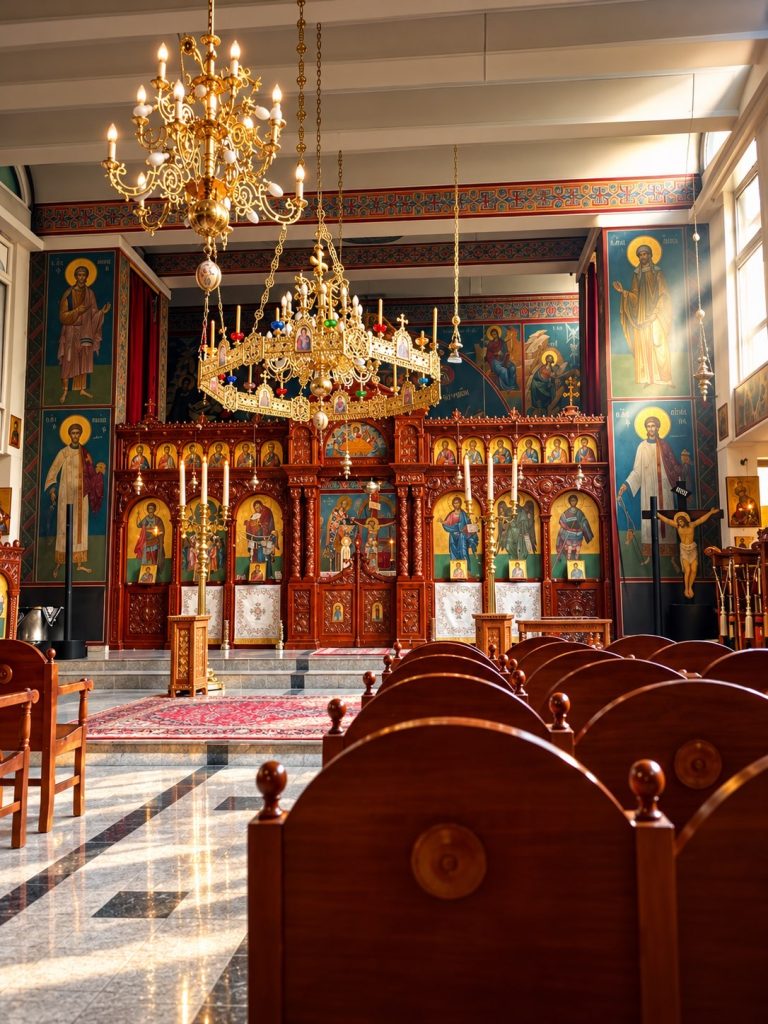
Yet even the strongest walls cannot guarantee permanence.
In the spring of 1453, the armies of Sultan Mehmed II gathered before Constantinople. Within the city, Emperor Constantine XI Palaiologos prepared for what would become the final defence of the imperial capital. The defenders knew the danger. They were vastly outnumbered, their resources were limited, and the prospect of effective assistance from the West remained uncertain.
For fifty-three days, the city resisted.
On 29 May 1453, the Ottoman assault succeeded. Constantinople was taken, Constantine XI fell during the final fighting, and the Byzantine Empire came to an end.
The song Byzantine, bearing the Greek title Οὐκ Ὑποχωροῦμεν – “We Do Not Retreat” – draws upon the memory of this extraordinary historical moment. Its subject is not the denial of defeat, nor a claim that the city remained unconquered. Rather, it turns towards a different question: what remains when walls fall, voices are silenced and an empire disappears?
Its answer is expressed through four recurring ideas: faith, courage, memory and the transmission of light from one generation to the next.
The subtitle, Ὕμνος τῆς Ἀκαταλύτου Πίστεως, may be rendered as “Hymn of Unconquered Faith”. It establishes the spiritual character of the work from the outset. This is not simply a song about a siege. It is a meditation on the endurance of belief and identity in the face of historical catastrophe.
Constantinople: The Capital of the Eastern Roman Empire
The empire commonly known today as the Byzantine Empire was, in its own understanding, the continuation of the Roman Empire in the East. Its inhabitants generally called themselves Rhōmaioi – Romans – and regarded their state as the Roman Empire. The designation “Byzantine Empire” became the conventional term in modern historical scholarship, derived from the ancient name Byzantion, on whose site Constantinople was built.
The city itself had a much older history. Originally founded as Byzantion by Greek settlers, it was refounded and greatly enlarged by the Roman emperor Constantine I, who established it as his new imperial capital in 324. The city was formally inaugurated in 330 and became known as Constantinople, the city of Constantine. It was also called New Rome, reflecting its position as the principal imperial centre in the eastern part of the Roman world.
Its geographical position was exceptional. Situated on the Bosporus, between Europe and Asia, the city controlled important maritime and commercial routes. Its strategic importance was matched by its symbolic significance: it was the seat of the emperor and the Ecumenical Patriarchate, and home to churches, monasteries, libraries and institutions that preserved and developed the intellectual traditions of the ancient world.
The most visible expression of its defensive strength was the great system of land walls associated with Emperor Theodosius II. Constructed in the early fifth century and subsequently strengthened, these fortifications consisted of a series of defensive elements, including a moat, an outer wall and a massive inner wall reinforced by towers. They formed a formidable barrier along the western approach to the city and had withstood numerous sieges over the centuries.
Yet the empire surrounding these walls had gradually contracted. Territorial losses, civil conflicts, economic difficulties and the expansion of neighbouring powers had transformed the political circumstances of the later Eastern Roman centuries. By the fifteenth century, imperial authority extended over only a fraction of the territories once governed from Constantinople.
The city remained a place of immense historical and religious importance, but its resources were no longer those of the great empire of earlier centuries.
The Siege of 1453
Mehmed II, who had become Ottoman sultan in 1451, was determined to capture Constantinople. His preparations included the construction of the fortress of Rumeli Hisarı on the European shore of the Bosporus, north of the city. Completed in 1452, it strengthened Ottoman control over the strait and made the arrival of outside assistance more difficult.
The siege began on 6 April 1453. The Ottoman forces possessed a substantial numerical advantage and made extensive use of artillery, including large bombards capable of damaging the city’s formidable walls. The defenders, commanded by Constantine XI, included Byzantine soldiers and volunteers as well as foreign contingents, among them Genoese and Venetian participants.
One of the most important figures in the defence was the Genoese commander Giovanni Giustiniani Longo, who played a major role in organising the landward defences. His presence illustrates that the defence of Constantinople was not exclusively a Byzantine undertaking: men from different parts of the Christian Mediterranean took part in the struggle.
The siege was not a simple or uninterrupted advance. The defenders repaired damaged sections of the walls, resisted repeated attacks and continued to hold the city despite growing exhaustion. The Ottoman fleet also sought to overcome the maritime defences. On 22 April, Ottoman vessels were transported overland into the Golden Horn, bypassing the defensive chain that had blocked the entrance to the harbour.
The final assault began before dawn on 29 May. After successive attacks, Ottoman troops broke through the defences. Giustiniani was wounded and withdrawn from the fighting; the circumstances surrounding his departure and its effect on the defenders are described differently in the historical accounts. The resistance eventually collapsed.
Constantine XI fell during the final fighting. The precise circumstances of his death and the identification of his remains have remained uncertain, and later accounts have added legendary elements to the story. It is therefore more responsible to say that he died during the defence than to repeat a dramatic description of his final moments as established fact.
Later that day, Mehmed II entered the conquered city. Constantinople became the principal capital of the Ottoman Empire, while the Byzantine state ceased to exist.
The fall was a profound political and cultural turning point. It did not, however, bring an end to the Greek language, Orthodox Christianity, Byzantine artistic traditions or the intellectual heritage of the Eastern Roman world. These continued in new political and ecclesiastical circumstances, both within the former Byzantine territories and among communities beyond them.
This distinction is essential to understanding the central idea of Byzantine.
Beyond the Fall: What Cannot Be Taken by Force
The history of Constantinople is often told through its emperors, its churches, its walls and its military struggles. Yet the city’s legacy cannot be reduced to the fate of its fortifications or the disappearance of its imperial government.
Eastern Roman civilisation had developed over centuries through the interaction of Roman political traditions, Greek language and learning, and Christian theology and worship. Its influence extended far beyond the borders of the empire. Orthodox liturgy, iconography, architecture, manuscript culture, music and theological thought became part of the heritage of many peoples across south-eastern Europe and the eastern Mediterranean.
The fall of 1453 altered the political setting in which this inheritance was preserved. It did not erase the inheritance itself.
The Orthodox Church continued its life under Ottoman rule, although under circumstances very different from those of the imperial period. The Ecumenical Patriarchate remained an important ecclesiastical institution, while monasteries and religious communities continued to serve as centres of worship, learning and cultural continuity. Byzantine artistic forms and liturgical traditions also continued to develop, while manuscripts, religious objects and the memory of the former imperial capital circulated across the wider Christian world.
The song’s language of light, prayer and remembrance belongs to this broader understanding of continuity. Its message is not that history can be reversed, but that historical loss need not entail spiritual or cultural oblivion.
The distinction is both subtle and important. A fortress may be taken; a capital may fall; an empire may disappear. Yet the beliefs, traditions and memories shaped over centuries can survive through the people who preserve and transmit them.
Οὐκ Ὑποχωροῦμεν – We Do Not Retreat
The Greek title Οὐκ Ὑποχωροῦμεν means “We Do Not Retreat” or, more literally, “We Do Not Withdraw”.
The choice of the first-person plural is significant. The statement is not made by a solitary hero, ruler or soldier. It is expressed in the collective voice. The repeated “we” places the emphasis on solidarity: the refusal to abandon one another, to forget the light or to remain silent about the truth.
The subtitle, Ὕμνος τῆς Ἀκαταλύτου Πίστεως, describes the work as a hymn of unconquered or indestructible faith. The adjective ἀκατάλυτος conveys the idea of something that cannot be destroyed or brought to an end. In this context, “unconquered faith” expresses the spiritual meaning particularly well.
The five sections of the composition form a carefully ordered progression. They move from the darkness of the night, through watchfulness and trial, towards a public declaration and, finally, the preservation of memory.
The result is less a conventional battle song than a spiritual narrative.
I. Ἡ Νύξ – The Night
The opening section establishes the atmosphere of the work. Night has fallen over the walls, silence has descended upon the earth, and violent winds strike against the gates.
The imagery evokes a besieged city awaiting the next assault. Yet the final line introduces the central contrast: the heart does not lose courage.
The night is real, and the danger is acknowledged. The song does not pretend that fear or uncertainty can simply be wished away. Its emphasis lies instead on the decision not to surrender inwardly.
II. Ἡ Φρουρά – The Watch
The second movement turns from the city itself to those who keep watch.
Light remains in darkness; faith remains in human hearts. Even if the whole world should be shaken, hope is not extinguished.
The image of the watch is particularly appropriate to the historical setting. The defence of Constantinople depended upon men standing at their assigned positions, maintaining vigilance and protecting one another. In the song, however, the watch also becomes a spiritual image: the preservation of faith requires attention, commitment and constancy.
III. Ἡ Δοκιμασία – The Trial
The third section acknowledges suffering more directly.
There are many hardships and many sorrows; the night is heavy and the road is long. The decisive statement follows: strength does not lie in fear, but in faith and love.
This is perhaps the most important theological distinction in the text. Courage is not presented as the absence of suffering or the denial of danger. Nor is it simply a matter of military strength. The source of endurance is placed in faith and love.
The section thus prepares the transition from individual endurance to collective confession.
IV. Ἡ Ὁμολογία – The Confession
Here the composition reaches its central declaration:
Οὐκ Ὑποχωροῦμεν!
“We do not retreat!”
The following lines explain what this declaration means. The community will not abandon one another. It will not forget the light. It will not remain silent about the truth.
The repeated refrain gives the section the character of a communal profession of faith. Its force comes not merely from the words themselves, but from their collective delivery. The individual voice becomes the voice of a community.
The Greek word ὁμολογία can mean confession, profession or declaration. In an ecclesiastical context, it can refer to the public profession of faith. The title therefore gives this movement a significance beyond a military proclamation.
V. Ἡ Μνήμη – Memory
The final section turns from the immediate struggle towards the generations that follow.
Even if the stones should fall, memory remains. Even if voices fall silent, prayer remains. From generation to generation, the light is handed on.
The conclusion brings together the principal images of the entire composition: light in the night, hope in the heart, and a refusal to abandon what has been entrusted to the community.
The final words, Εἰς τοὺς αἰῶνας τῶν αἰώνων, mean “Unto the ages of ages” or, in more familiar English liturgical language, “For ever and ever”.
This is a traditional expression in Christian prayer and worship. It gives the song a distinctly liturgical resonance and places its final declaration within a horizon extending beyond any single historical age.
Songtext
The following is the complete Greek text of Byzantine, preserving the five-part structure and the wording supplied for the composition. The translation seeks to preserve the meaning, imagery and solemn character of the Greek original. It is not intended as a strict word-for-word rendering, but as a faithful English version that can be read and understood independently.

ΟΥΚ ὙΠΟΧΩΡΟΥΜΕΝ – WE DO NOT RETREAT
Ὕμνος τῆς Ἀκαταλύτου Πίστεως • Hymn of Unconquered Faith
I. Ἡ Νύξ
Ἡ νὺξ ἐκάλυψε τὰ τείχη,
καὶ σιγὴ κατέβη ἐπὶ τὴν γῆν.
Ἄνεμοι σφοδροὶ τὰς πύλας κρούουσιν,
ἀλλ’ ἡ καρδία οὐ δειλιάζει.
II. Ἡ Φρουρά
Μένει τὸ φῶς ἐν τῷ σκότει,
μένει ἡ πίστις ἐν ταῖς καρδίαις.
Κἂν ὁ κόσμος ὅλος σαλευθῇ,
ἡ ἐλπὶς ἡμῶν οὐ σβέννυται.
III. Ἡ Δοκιμασία
Πολλὰ τὰ δεινά, πολλοὶ οἱ πόνοι,
βαρεῖα ἡ νύξ, μακρὰ ἡ ὁδός.
Ἀλλ’ οὐκ ἐν τῷ φόβῳ κεῖται ἡ δύναμις,
ἀλλ’ ἐν πίστει καὶ ἀγάπῃ.
IV. Ἡ Ὁμολογία
Οὐκ ὑποχωροῦμεν!
Οὐκ ἀλλήλους ἐγκαταλείπομεν!
Οὐ λησμονοῦμεν τὸ φῶς!
Οὐ σιωπῶμεν περὶ τῆς ἀληθείας!
V. Ἡ Μνήμη
Ἐὰν πέσωσιν οἱ λίθοι,
μένει ἡ μνήμη.
Ἐὰν σιγήσωσιν αἱ φωναί,
μένει ἡ προσευχή.
Καὶ ἀπὸ γενεᾶς εἰς γενεάν,
τὸ φῶς παραδίδοται.
Φῶς ἐν τῇ νυκτί,
ἐλπὶς ἐν τῇ καρδίᾳ.
Οὐκ ὑποχωροῦμεν.
Εἰς τοὺς αἰῶνας τῶν αἰώνων.
I. The Night
Night has covered the walls,
and silence has descended upon the earth.
Violent winds beat against the gates,
yet the heart does not falter.
II. The Watch
The light remains in the darkness,
faith remains in our hearts.
Even if the whole world should be shaken,
our hope shall not be extinguished.
III. The Trial
Many are the hardships, many are the sorrows,
heavy is the night, long is the road.
But strength does not lie in fear,
but in faith and love.
IV. The Confession
We do not retreat!
We do not abandon one another!
We do not forget the light!
We shall not remain silent about the truth!
V. Memory
Even if the stones should fall,
memory remains.
Even if the voices should fall silent,
prayer remains.
And from generation to generation,
the light is handed on.
Light in the night,
hope in the heart.
We do not retreat
Unto the ages of ages.
Listen to the Song
From the Walls of Constantinople to the Present
The historical images in Byzantine are rooted in the memory of Constantinople, but the song’s meaning reaches beyond the events of 1453.
Its five movements do not attempt to reconstruct the siege as a historical narrative. They do not name the emperor, the sultan or the commanders, nor do they describe the military operations. Instead, the composition uses the language of walls, gates, darkness, watchfulness and prayer to evoke a world under threat.
This distinction matters. The work is a contemporary artistic interpretation of Byzantine historical and spiritual memory, not a medieval hymn preserved from the last days of the empire. Its Greek language and liturgical vocabulary deliberately create an association with the religious and cultural world of the Eastern Roman Empire.
The central declaration is also carefully framed. “We do not retreat” does not mean that Constantinople was never conquered. It means that the fall of a city need not entail the disappearance of everything that gave it meaning.
The final movement makes this particularly clear. The stones may fall, and voices may become silent, but memory and prayer remain. The light is not described as the possession of one generation alone. It is something entrusted to the next.
In this sense, the song speaks not only of the last days of the Byzantine Empire, but also of the responsibility that accompanies the preservation of any historical and spiritual inheritance.
The Light That Is Passed On
The history of the Eastern Roman Empire is one of remarkable endurance, transformation and transmission. Its political institutions came to an end in 1453, but its cultural and religious inheritance continued to shape the history of south-eastern Europe and the wider Christian world.
The churches and monasteries, the liturgical traditions, the icons and mosaics, the manuscripts and theological writings all testify to a civilisation whose influence cannot be measured solely by the duration of its empire.
Byzantine approaches this legacy through a simple but powerful sequence: the night, the watch, the trial, the confession and the memory. Its imagery is restrained, yet its message is unmistakable. It does not deny the darkness; it insists that darkness is not the end of the story.
The final words, “Unto the ages of ages”, leave the listener with a sense of continuity that extends beyond the immediate historical setting. The song closes not with the image of a conquered city, but with the passing of light from one generation to another.
And perhaps that is the deeper meaning of its title.
Οὐκ Ὑποχωροῦμεν.
We do not retreat – not from memory, not from faith, and not from the responsibility to preserve what has been entrusted to us.
Basarab Heritage
— A.C.