
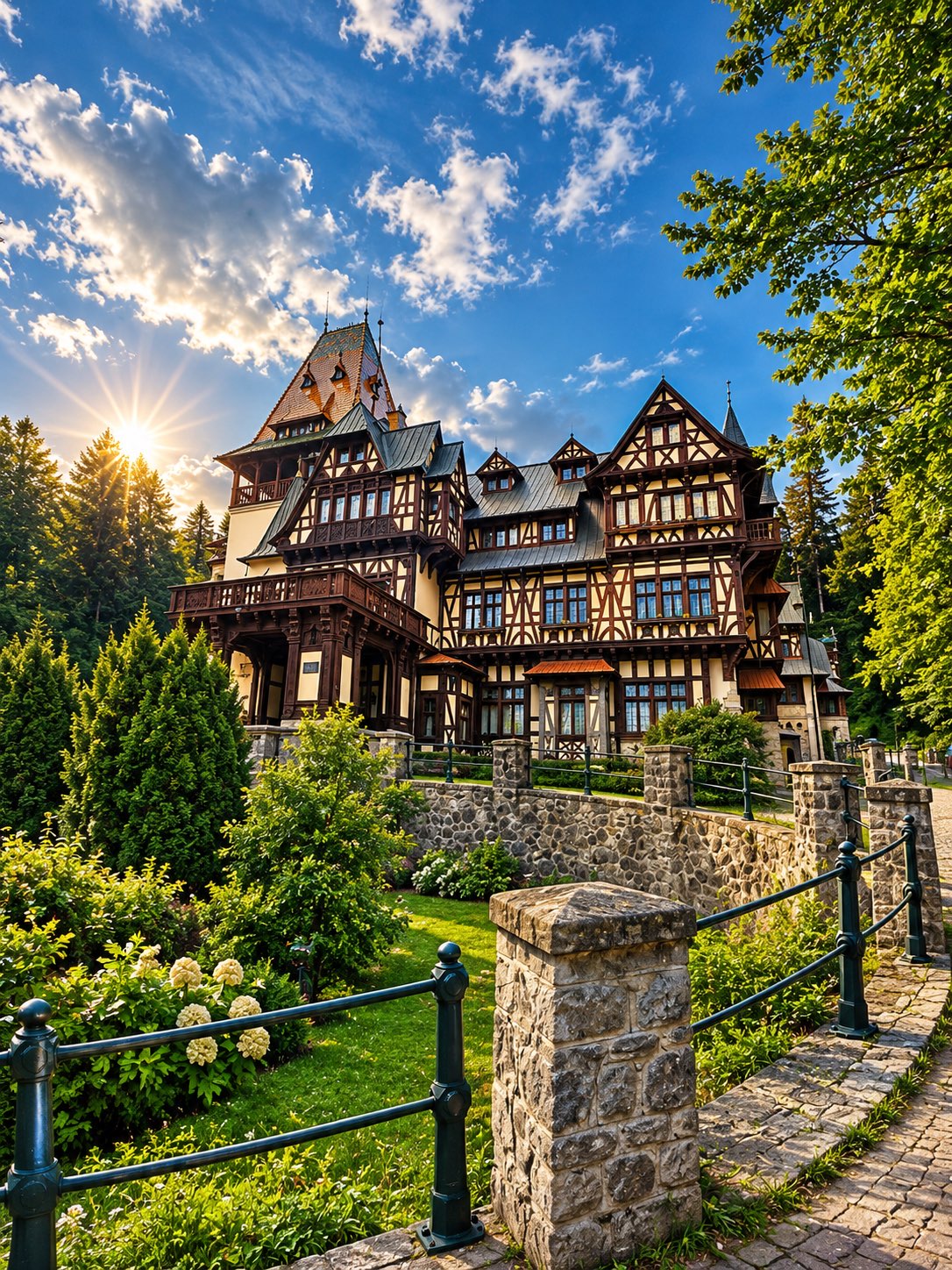
Among the wooded slopes of the Carpathians, above the mountain resort of Sinaia, stands a residence whose character differs markedly from that of its celebrated neighbour. Pelișor Castle belongs to the same royal architectural ensemble as Peleș, yet it expresses a more intimate and personal vision.
Its scale is more restrained, its atmosphere more domestic, and its interiors reflect the artistic sensibility of a woman who would become one of the most distinctive figures in Romania’s modern history: Queen Marie.
Built at the initiative of King Carol I for the Crown Prince Ferdinand and his wife, Princess Marie, Pelișor was intended as a residence for the next generation of the Romanian royal family. Its exterior preserves a visual relationship with the architecture of the royal estate, while its interiors reveal a more modern and individual approach to design. Art Nouveau, or Art 1900, is combined with Romanian architectural references and an appreciation of decorative craftsmanship.
Pelișor is therefore more than a smaller companion to Peleș. It is a monument to the artistic development of Queen Marie, to the domestic life of the royal family and to the gradual emergence of a distinctive Romanian expression within the international artistic culture of the early twentieth century.
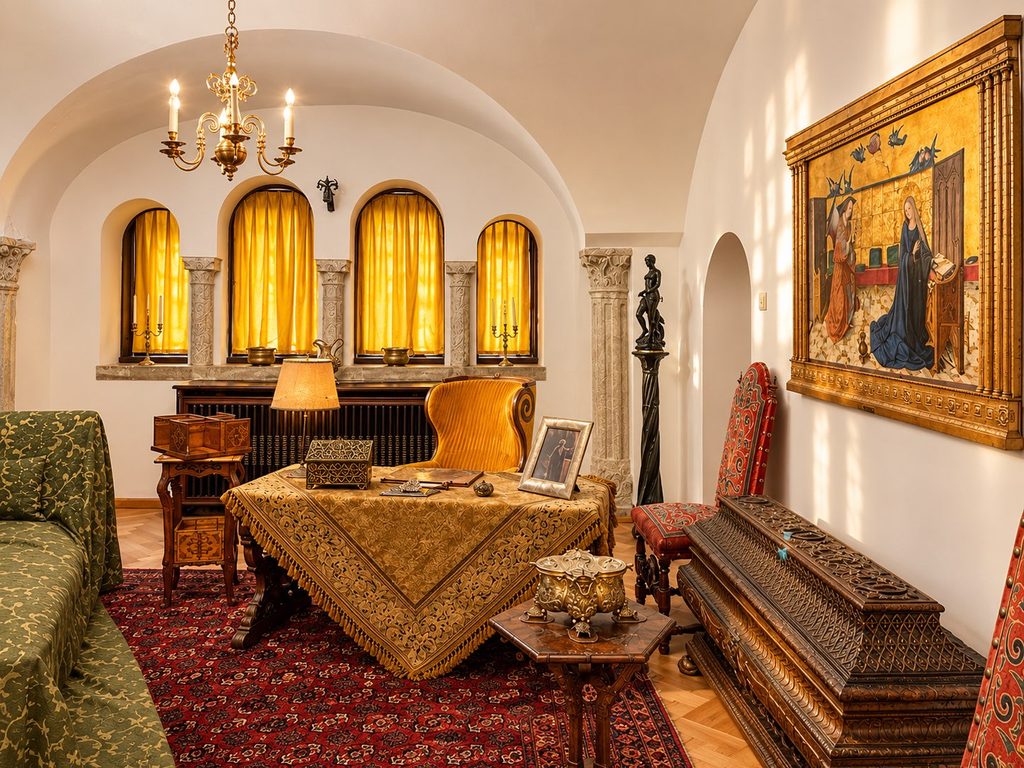
Queen Marie’s private study at Pelișor Castle, illustrating the synthesis of Byzantine motifs, Art Nouveau aesthetics, and personal craftsmanship.
A Residence for the Royal Heirs
The origins of Pelișor are inseparable from the development of the royal estate at Sinaia under King Carol I. After acquiring the surrounding land in 1871, the sovereign gradually transformed the valley of the Peleș stream into a complex of royal residences, administrative buildings and service facilities. Peleș formed the centre of this undertaking, but the estate was never intended to consist of the principal castle alone.
As the royal family developed, a separate residence for the heir to the throne became increasingly desirable. King Carol I therefore commissioned a new building for his nephew and heir, Prince Ferdinand, and Ferdinand’s wife, Princess Marie.
The project was entrusted to the Czech architect Karel Liman, who was already closely involved in the architectural development of the royal estate. Construction took place between 1899 and 1902. The castle was inaugurated on 24 May 1903; in accounts using the alternative calendar reckoning of the period, the date is also given as 5 June 1903.
The inauguration was marked by a particularly personal document: the castle’s inaugural act, painted by Princess Marie herself on parchment. Decorated with irises and religious motifs, it records that King Carol I had built the residence beside Peleș for his beloved grandchildren. It also commemorates the arrival of Ferdinand, Marie and their children in their new home and gives the building its name, Pelișor.
The act is more than a formal record of a royal foundation. Marie’s own artistic contribution already hints at the role she would play in shaping the character of the residence.
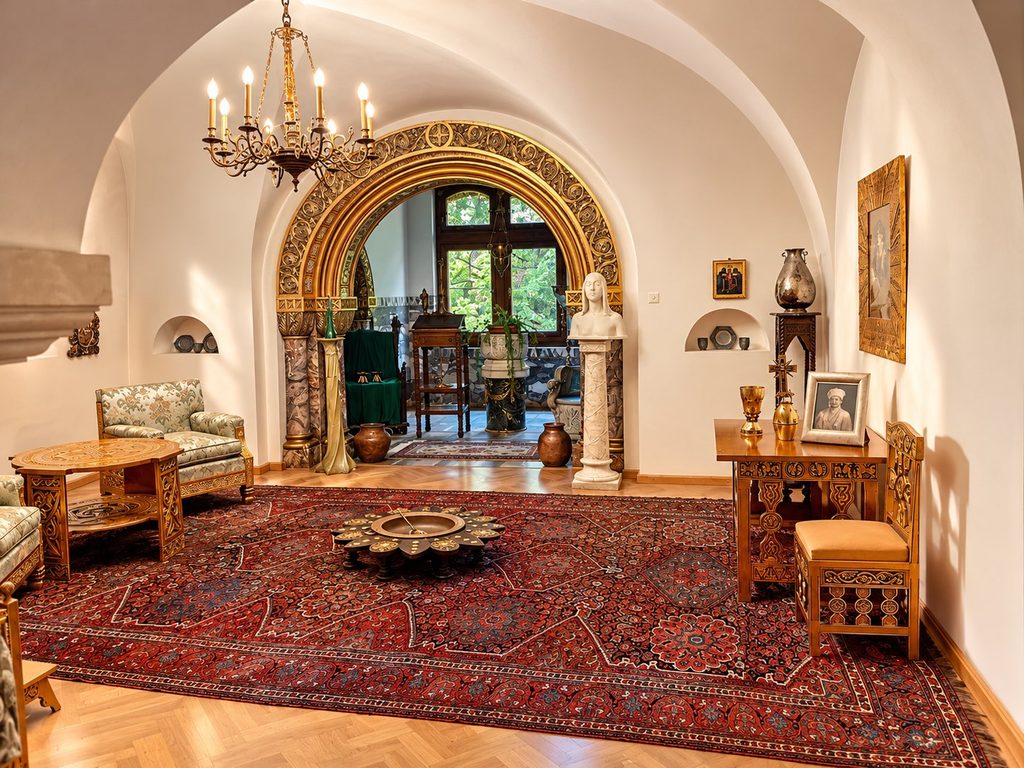
Interior of Pelișor Castle, showcasing the monumental carved archway, gilded detailing, and the refined fusion of Art Nouveau and Byzantine decorative traditions.
Karel Liman and the Architecture of Pelișor
Karel Liman’s task was to create a residence that belonged unmistakably to the royal ensemble at Sinaia while possessing an architectural identity of its own.
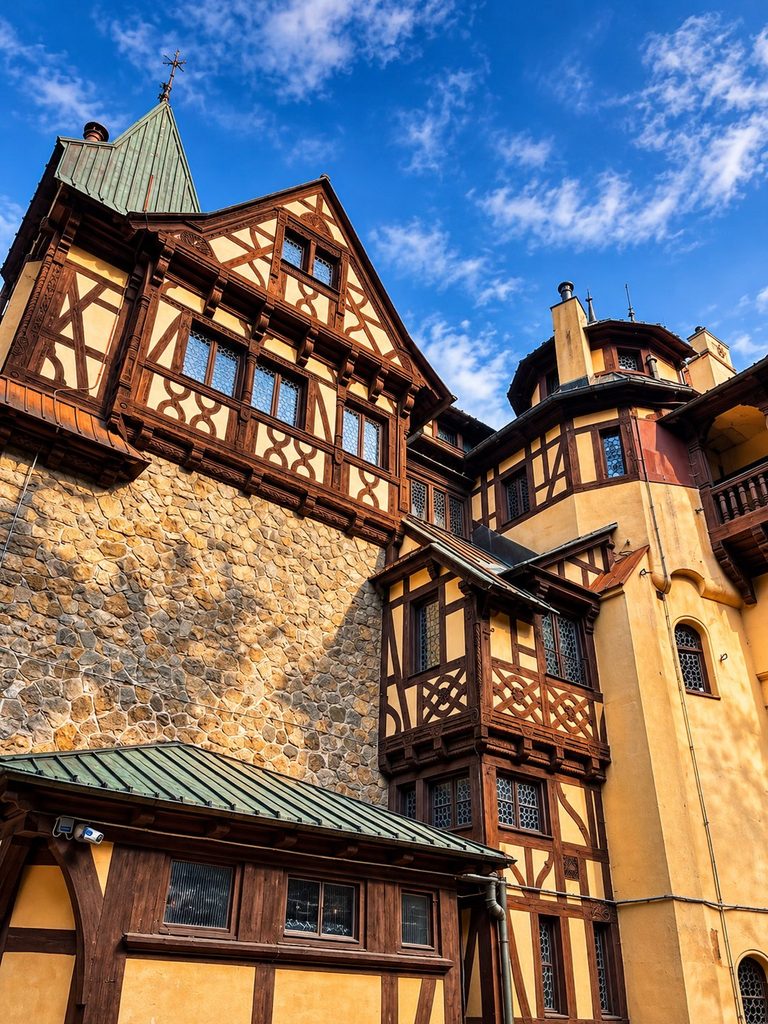
The exterior follows the general language established at Peleș, particularly through its German Neo-Renaissance character and the use of timber framing, or Fachwerk. This approach ensured a degree of architectural continuity across the estate. Yet Pelișor was not conceived as a simple reduction of the larger castle.
Its silhouette is more compact and domestic. Particularly distinctive are the two towers covered with coloured sandstone tiles, whose appearance recalls the church spires of Bucovina. These details introduce a Romanian architectural reference into a building whose overall exterior language remains connected to Central European traditions.
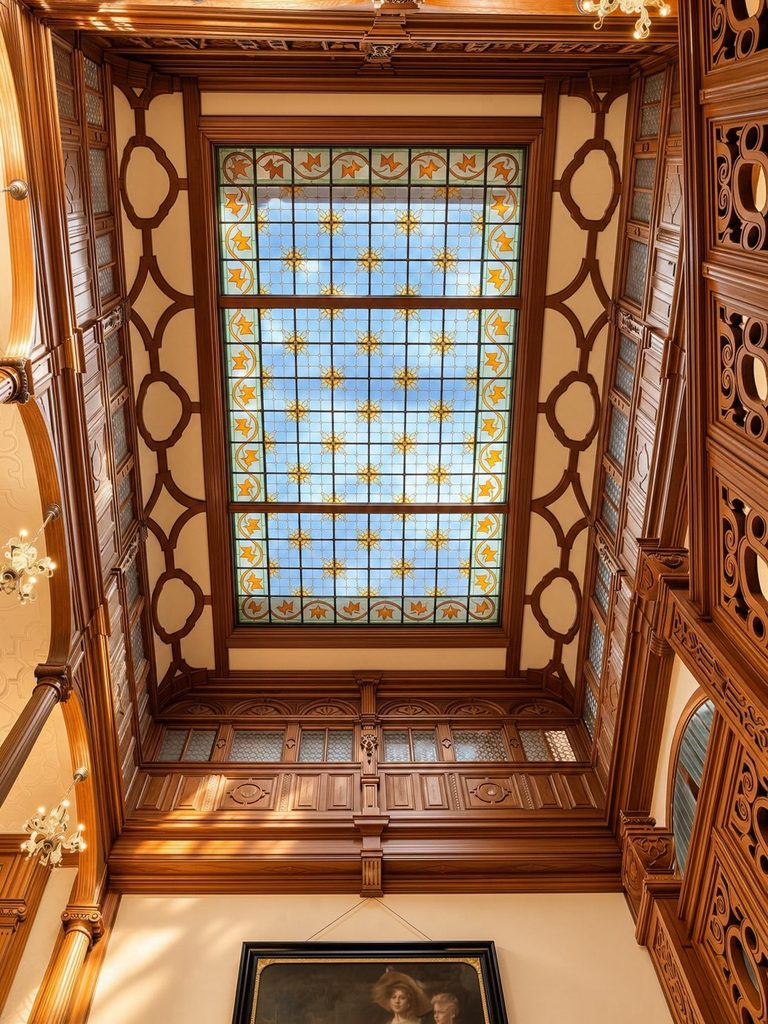
The result is a synthesis rather than a strict reproduction of any single historical style. The residence belongs to the architectural world of the royal estate, but its details anticipate the more personal and culturally distinctive character of its interiors.
The architectural design and the interior decoration should nevertheless be considered separately. Liman was responsible for the building’s architectural conception, while Princess Marie played a decisive role in developing its decorative character. The interiors were not completed as one unchanging scheme in 1903; they evolved through successive phases, reflecting the changing tastes and interests of their principal patron.
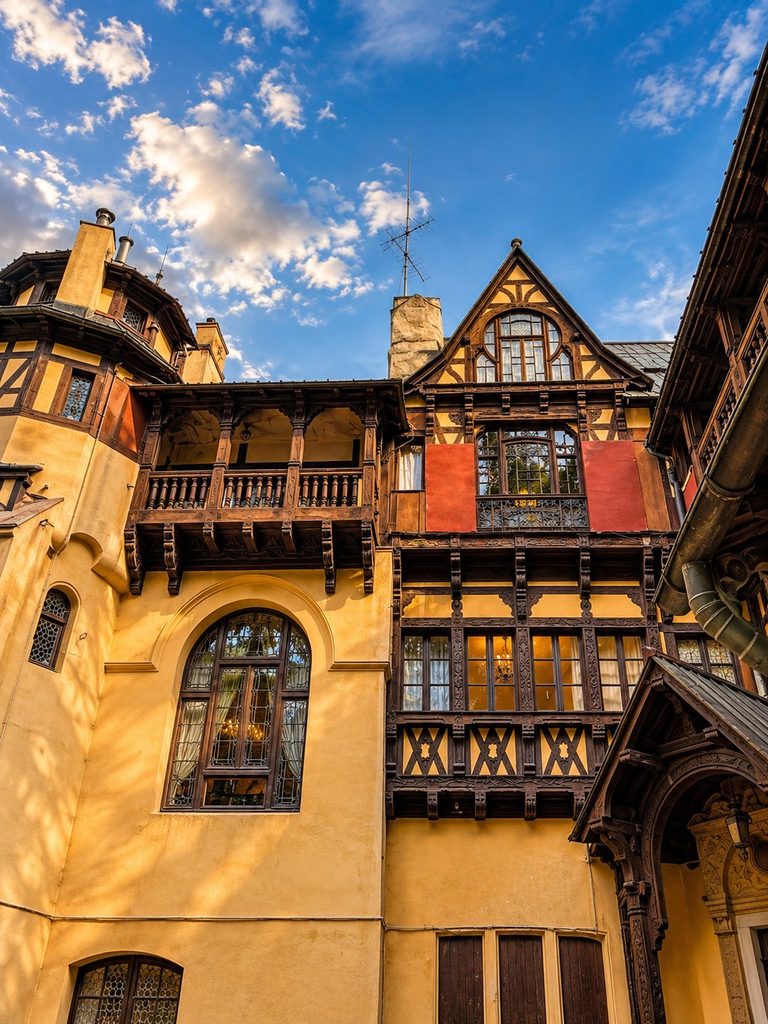
Exterior view of Pelișor Castle, highlighting Karel Liman’s synthesis of Central European timber framing (Fachwerk) and domestic royal architecture.
Princess Marie and the Art of the Interior
If Karel Liman gave Pelișor its architectural form, Princess Marie was central to the conception of its interior world.
Born on 29 October 1875 at Eastwell Park in England, Marie was a granddaughter of Queen Victoria and the daughter of Prince Alfred, Duke of Edinburgh, and Grand Duchess Maria Alexandrovna of Russia. She married Prince Ferdinand of Romania on 10 January 1893 and entered a royal household whose cultural outlook had been strongly shaped by King Carol I.
Marie brought with her an international education and a pronounced interest in art, design and decoration. At Pelișor, these interests found an especially personal expression. She took an active part in the conception of the interiors, regarding the arrangement of rooms, furniture, colours and ornament as an integrated artistic undertaking.
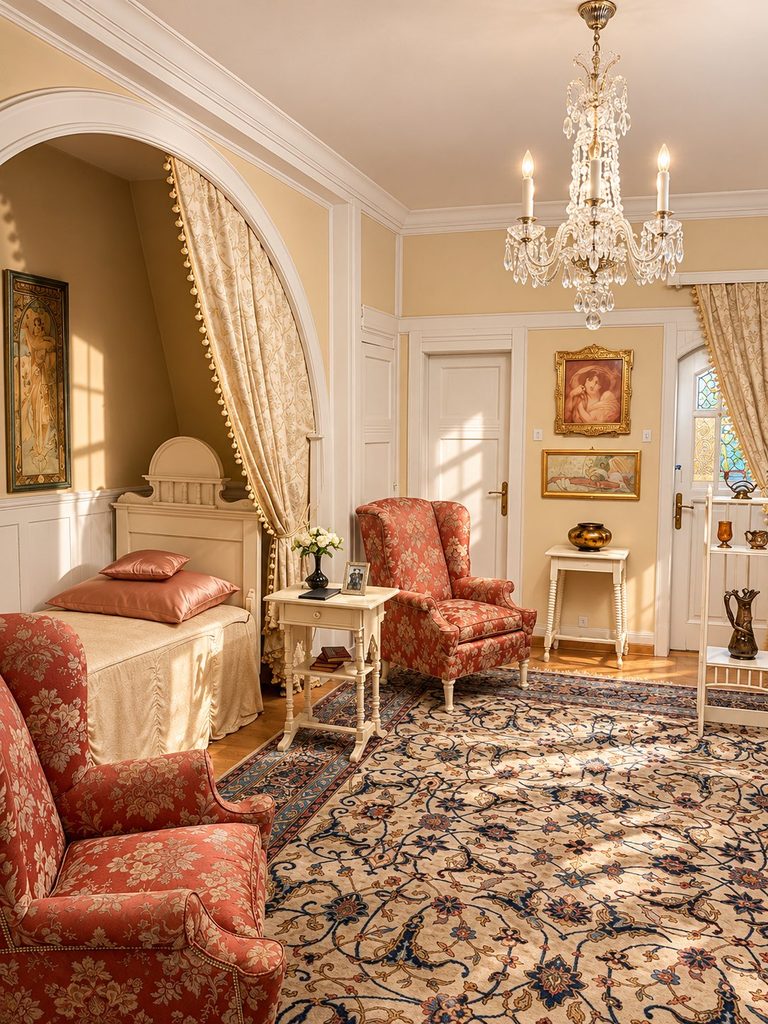
The decorative programme developed in two principal phases. The first belongs to 1902–1903, around the completion and inauguration of the castle. A second major phase took place between 1925 and 1928, by which time Marie had become queen and her artistic outlook had developed considerably.
These phases should not be understood as a simple replacement of one style by another. Rather, they reveal the evolution of her preferences: from richly decorated, intimate interiors towards a more restrained use of line and ornament, accompanied by a growing interest in Romanian artistic traditions.
Pelișor is consequently not a frozen image of royal taste at the beginning of the twentieth century. Its interiors preserve the record of an evolving artistic personality.
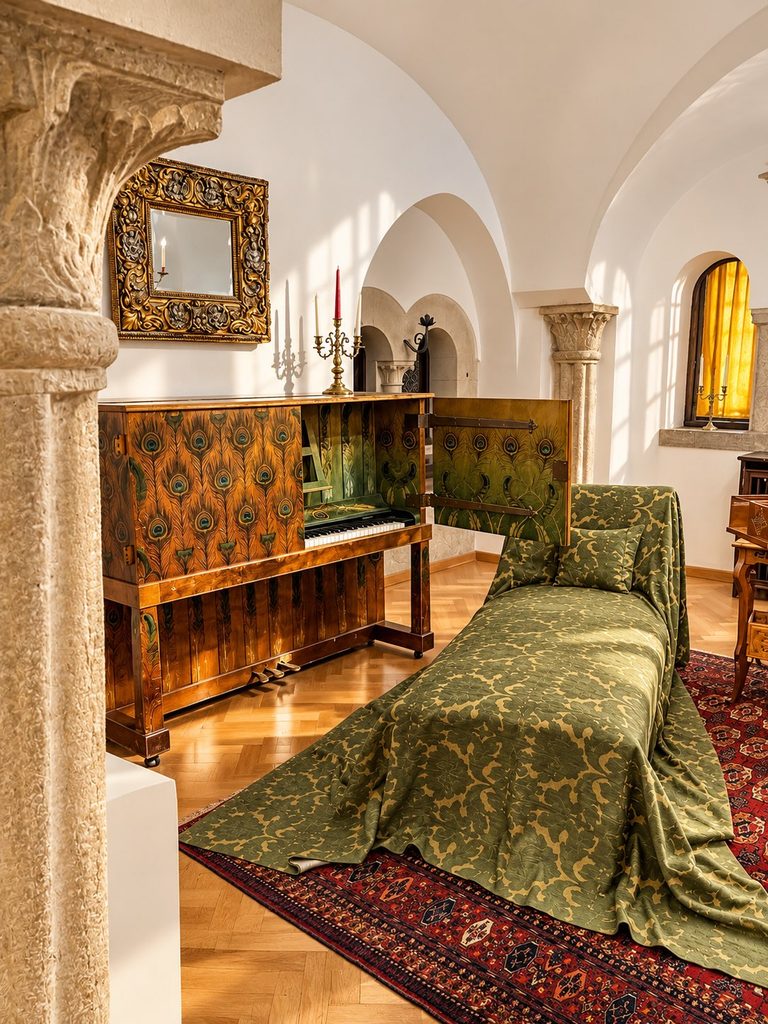
Custom-crafted furnishings and decorative detailing within Pelișor Castle, reflecting Queen Marie’s unique integration of Art Nouveau and symbolic motifs.
Art Nouveau and Romanian Architectural Traditions
The principal artistic language of Pelișor is associated with Art 1900, the broader European movement commonly known as Art Nouveau or Jugendstil. Its emphasis on flowing lines, organic forms, decorative unity and the integration of art into everyday life offered an alternative to the more formal historicism that characterised many nineteenth-century royal interiors.
At Pelișor, this modern language was combined with Romanian architectural references. The official history of the Peleș National Museum identifies elements inspired by the Brâncovenesc style, including the horizontal organisation of interior spaces, as well as niches characteristic of the Prahova Valley.
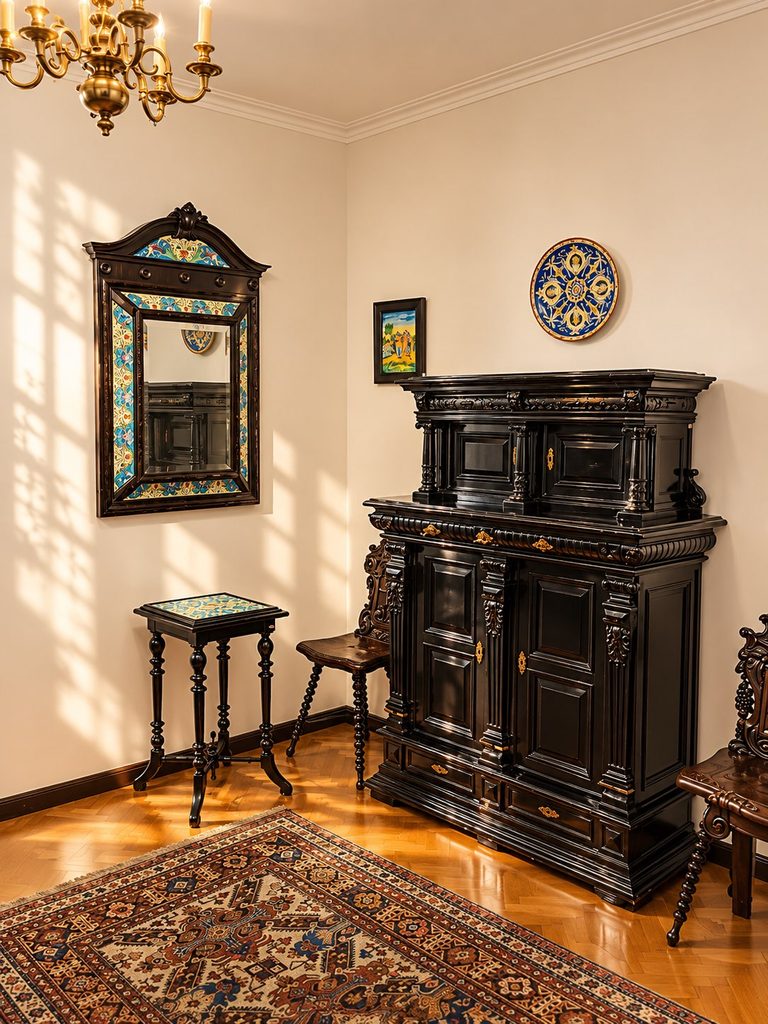
These features are significant because they reveal an intention to give the residence a recognisably Romanian dimension. The national character of the interiors was not achieved by abandoning European artistic influences, but by adapting them and bringing them into dialogue with local architectural traditions.
The decorative programme also reflects the wider international culture of the period. The Arts and Crafts movement, with its appreciation of craftsmanship and the relationship between architecture and domestic objects, provides a useful context for understanding the artistic ambitions of the residence. The influence of contemporary British and Central European design is part of the broader cultural environment in which Marie developed her ideas.
The interiors should not, however, be attributed indiscriminately to a single foreign designer or movement. Their distinctive character emerged from the collaboration of architect, decorators and craftsmen, under Marie’s sustained direction and through successive phases of alteration.
The result is an individual synthesis: modern in its artistic outlook, international in its references and increasingly attentive to the cultural traditions of Romania.
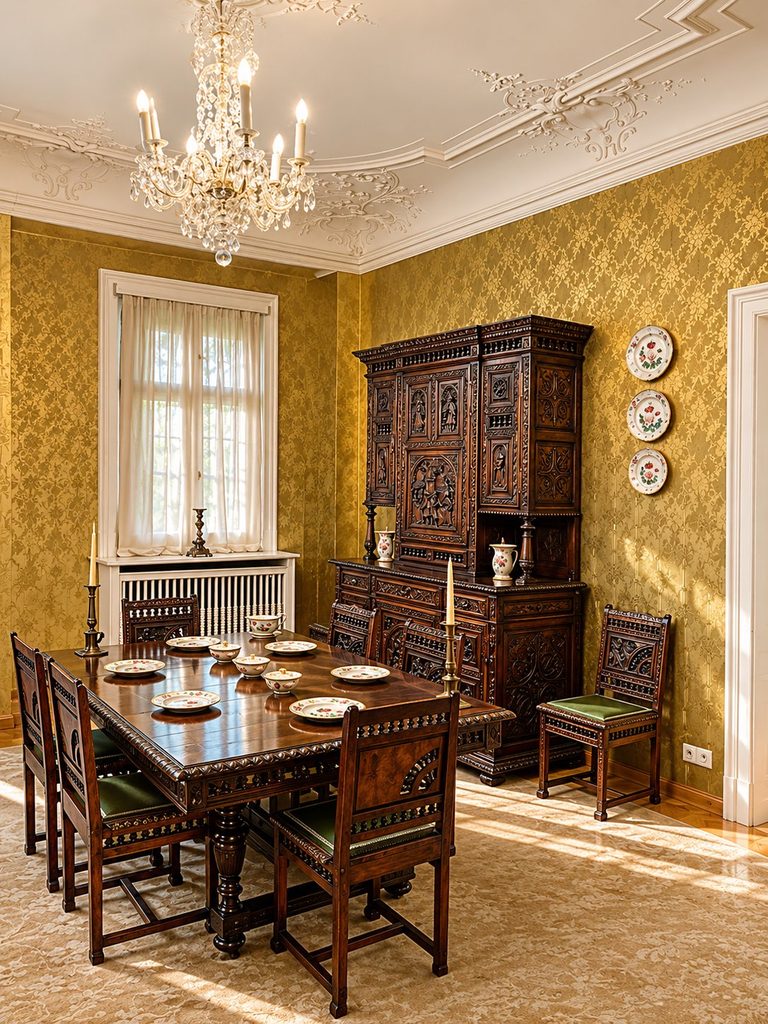
A formal dining and assembly space within Pelișor Castle, featuring custom-carved wooden furnishings, decorative wall displays, and refined interior ornamentation.
The Golden Room and the Evolution of Marie’s Taste
Among the most memorable spaces at Pelișor is the Golden Room, an interior closely associated with Queen Marie and the artistic atmosphere of the residence.
Its decorative character belongs to the more intimate and imaginative world that Marie sought to create. The room illustrates the importance she attached to colour, ornament and the emotional qualities of an interior. Rather than relying solely on the formal grandeur expected of a royal residence, Pelișor uses decoration to establish spaces with individual moods and meanings.
The museum’s account of the castle’s decorative history describes an evolution from the richly ornamented interiors of Marie’s early years towards a more restrained treatment of surfaces and lines, including geometric tendencies associated with the Modern Style. Romanian artistic elements increasingly became part of this personal decorative language.
This development reflects both Marie’s own changing preferences and the wider transformation of European decorative arts during the first decades of the twentieth century. The coexistence of different decorative phases is one of the most valuable aspects of Pelișor: the castle preserves not one moment of artistic taste, but a sequence of them.
The Golden Room also acquired a profound memorial significance. Queen Marie died at Pelișor on 18 July 1938, in the room decorated according to her own artistic vision. In 2015, her heart was returned to the castle and placed in the Golden Room during a solemn ceremony. The room thus became a place of remembrance as well as an important part of the castle’s artistic heritage.
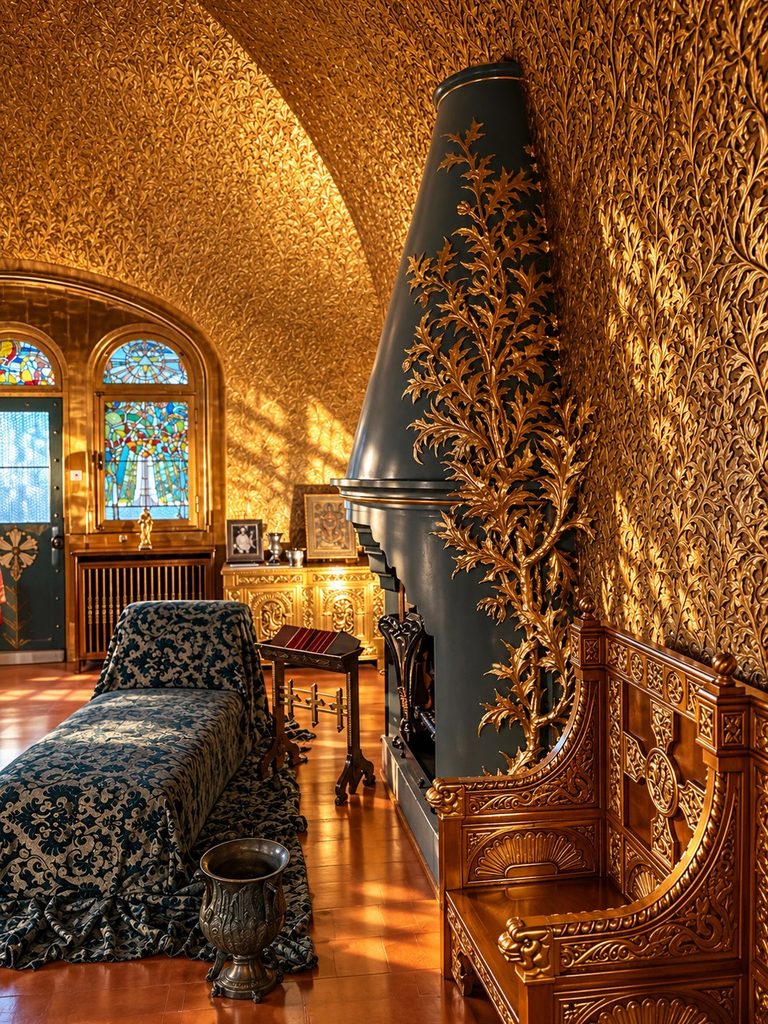
Interior view of the Golden Chamber, showcasing Queen Marie’s masterwork of decorative art defined by luminous gold-stamped surfaces and symbolic detailing.
A Home for Ferdinand and Marie
Pelișor was conceived as a family residence, and its history is inseparable from the private life of Ferdinand and Marie.
The Crown Prince and Princess had previously lived at Foișor, another residence within the royal estate. Pelișor provided them with a more substantial home, suited to the needs of a growing family. Its rooms accommodated the education and everyday life of the royal children, visits from relatives and friends, and the domestic activities of a princely household.
The residence was not isolated from public affairs. Court life, official hospitality and meetings with visitors from political and diplomatic circles formed part of its history. Pelișor therefore occupied an interesting position between private home and royal residence: more intimate than Peleș, but still connected to the representative functions of the monarchy.
The family’s connection with the castle was soon strengthened by an important event. On 5/18 August 1903, Prince Nicholas, the couple’s fourth child, was born at Pelișor. The dual date reflects the difference between the Julian and Gregorian calendars.
The castle thus became associated not only with the establishment of the royal heirs’ household, but also with the growth of the family itself.
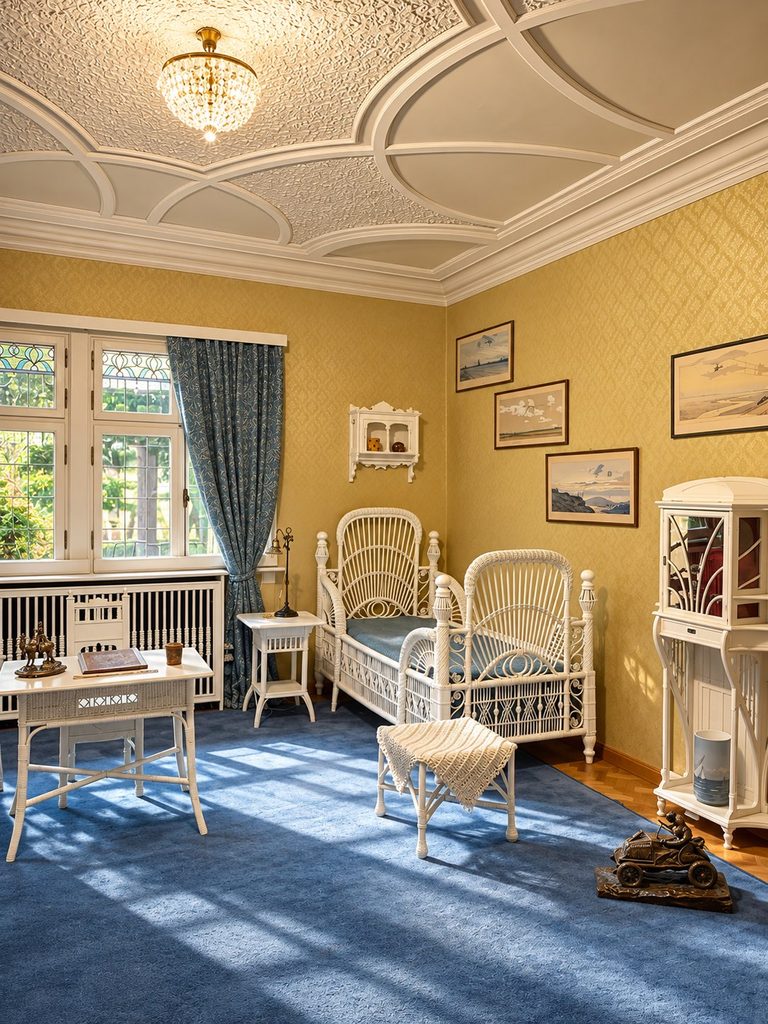
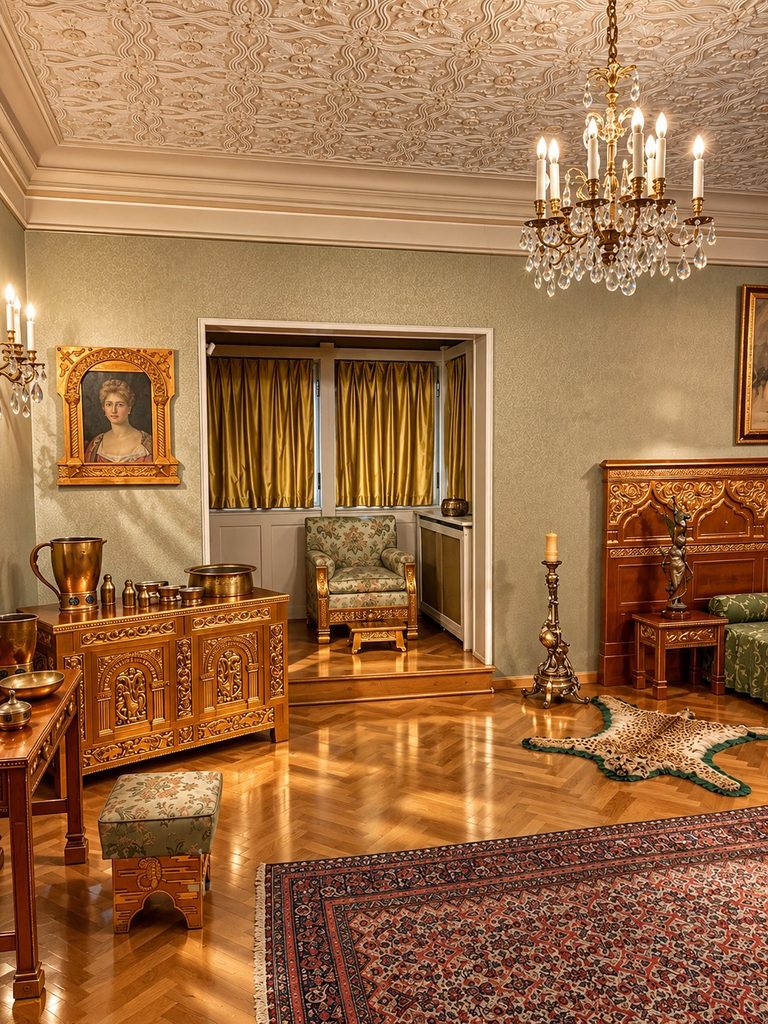
One of the private chambers at Pelișor Castle, featuring light wicker furnishings, delicate wall arrangements, and a bright, harmonious color palette reflecting the intimate domestic character of the royal residence.
From Crown Princess to Queen
The history of Pelișor acquired a new dimension in October 1914, when Ferdinand succeeded Carol I as King of Romania. Marie became queen, and the residence that had been built for the Crown Prince and Princess now belonged to the reigning royal couple.
Her public role expanded considerably during the First World War and the years that followed. Queen Marie became a prominent figure in the country’s wartime experience, known for her charitable work, her visits to hospitals and military facilities, and her public presence during a period of national hardship.
In 1922, she and King Ferdinand were crowned at Alba Iulia, in a ceremony that symbolically marked the new political reality of Greater Romania following the unions of 1918.
The castle’s decorative development continued during these years. The changes made between 1925 and 1928 reveal a more mature artistic approach, in which the earlier decorative richness was combined with simplified forms and a stronger presence of Romanian references.
Marie’s attachment to Romania was expressed in many ways, and Pelișor offers a particularly tangible example of it. Here, an internationally educated princess developed a personal artistic language that increasingly incorporated the country’s architectural and decorative traditions.
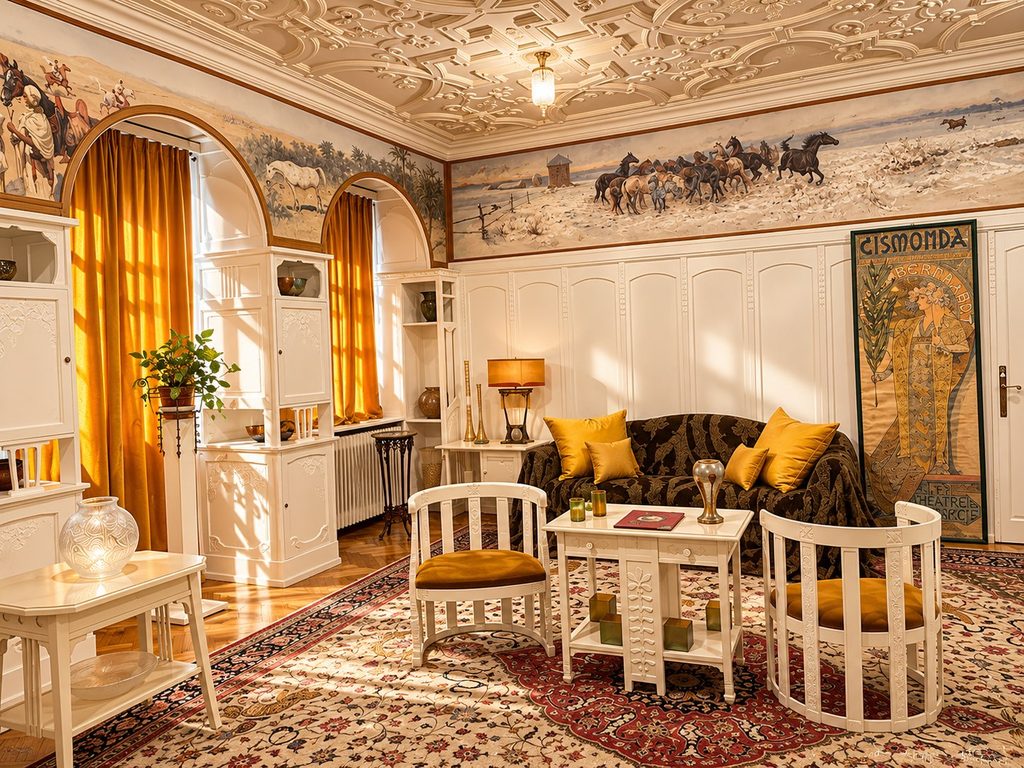
The White Salon at Pelișor Castle, combining Secessionist white-lacquered furniture, rich interior textiles, and prominent Art Nouveau graphic art.
The Final Years of Ferdinand and Marie
Pelișor also occupies a deeply personal place in the final chapters of the lives of its royal inhabitants.
King Ferdinand died at the castle on 20 July 1927, after a prolonged illness. His death marked the end of a reign closely associated with the First World War and the creation of Greater Romania. He was succeeded by his young grandson, Michael, as his son Carol had previously renounced his rights to the throne.
Queen Marie continued to be an important public and cultural figure, although her position within the royal household changed during the reign of her son, Carol II. In her later years, she spent considerable time away from the political centre of the monarchy.
After returning to Romania from medical treatment abroad, she died at Pelișor on 18 July 1938. Her death in the Golden Room gave the residence a memorial significance that has remained central to its identity.
Her heart, which had originally been placed according to her wishes in the chapel at her beloved Balchik residence, followed a separate and complex history after that territory became part of Bulgaria in 1940. It was subsequently moved to Bran and later held by the National Museum of Romanian History. In 2015, it was transferred to Pelișor and placed in the Golden Room, reconnecting this deeply personal relic with the place where the queen had died.
The history of the heart is therefore not merely an episode in the biography of a royal figure. It reflects the political changes that affected Romania and the royal family during the twentieth century.
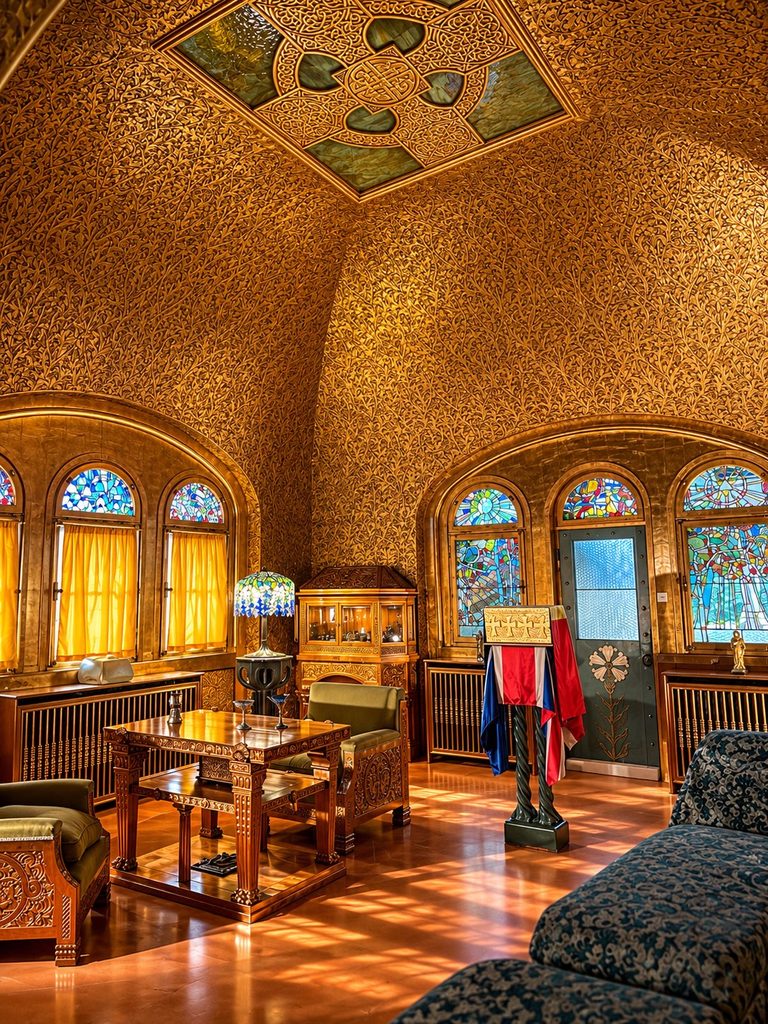
The iconic Golden Room at Pelișor Castle, featuring gilded stucco, sculpted thistle motifs, and the intimate interior vision that became the sanctuary and final resting place of Queen Marie’s heart.
Pelișor within the Royal Estate at Sinaia
Although Pelișor possesses a distinct identity, its history remains closely connected with the wider royal ensemble at Sinaia.
Peleș was the principal royal residence and the architectural expression of Carol I’s reign. Pelișor, by contrast, was built for the heirs and developed into a more intimate setting shaped by Marie’s artistic preferences. The two buildings therefore represent different generations and different approaches to royal life.
Together with Foișor and the associated buildings, gardens and landscaped grounds, they form a historical ensemble in which architecture, court life and the surrounding Carpathian landscape are closely interwoven.
In 2024, Romania included the Royal Residences of Sinaia on its UNESCO World Heritage Tentative List. The proposal recognises the architectural and historical significance of the ensemble, including the distinctive contribution of Pelișor. It is important, however, to distinguish tentative-list status from inscription on the World Heritage List: the royal residences have been proposed for consideration, but have not yet been inscribed as a UNESCO World Heritage property.
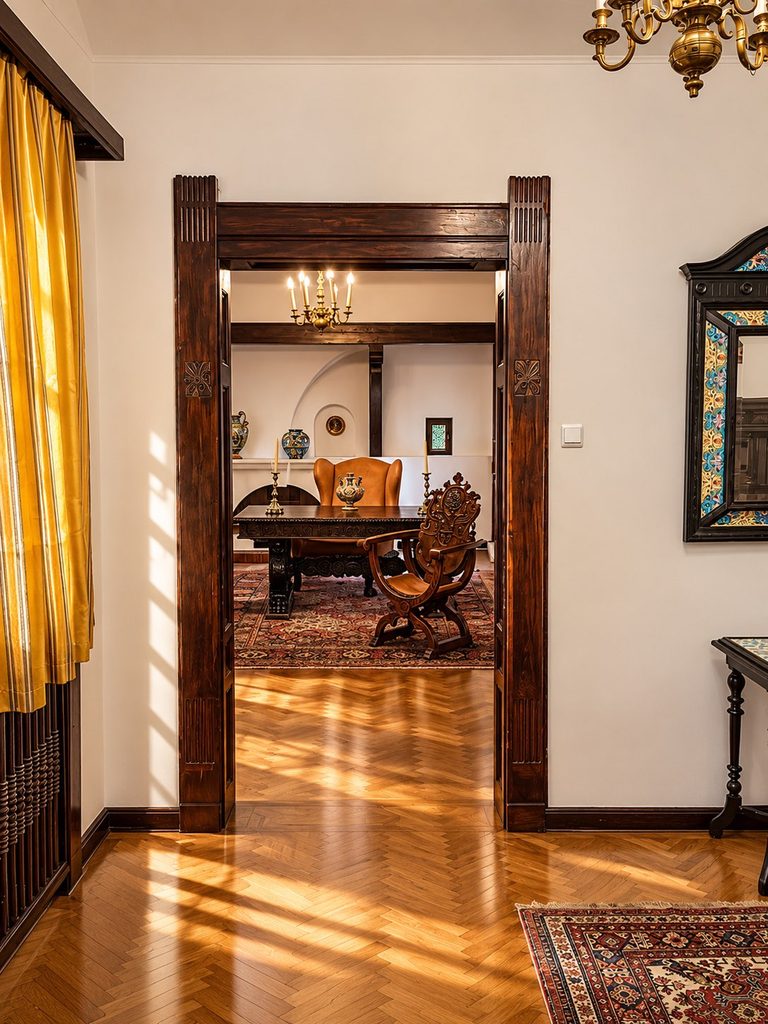
Enfilade view into King Ferdinand’s study at Pelișor Castle, framing the massive carved writing desk and dark timbered architecture of the princely office.
From Royal Home to Museum
The end of the monarchy in December 1947 brought a profound change to the royal estate. Following King Michael I’s forced abdication, the royal residences passed into state control, and the properties were nationalised in 1948.
Pelișor’s later history was different in certain respects from that of Peleș. It was opened to the public as a museum in February 1993, allowing visitors to encounter the architecture and artistic world of the royal heirs’ residence.
Its present function is both historical and commemorative. The preserved interiors, furnishings and decorative objects provide evidence of the tastes and cultural aspirations of the royal household, while the building itself remains closely associated with the memory of Queen Marie.
Pelișor is therefore not simply a museum of decorative arts. It is also a memorial environment in which the rooms, objects and personal history of their former inhabitants remain closely connected.
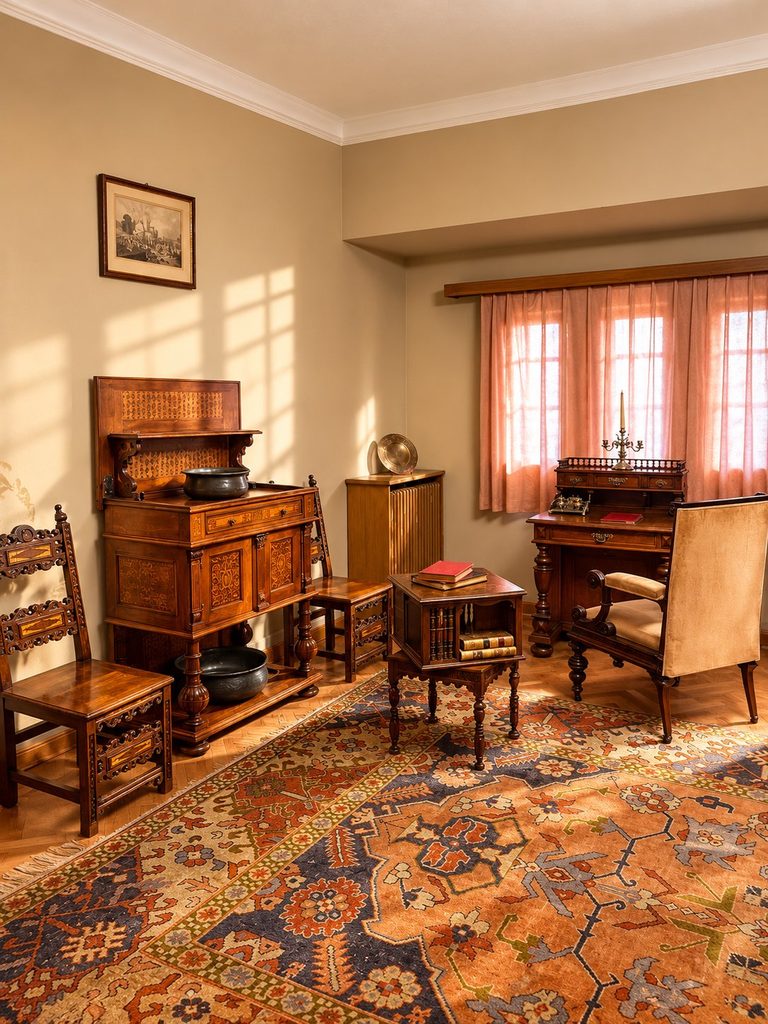
A private study and writing cabinet at Pelișor Castle, featuring finely crafted wooden furnishings, period writing desks, and an intimate domestic ambiance.
A Castle That Reveals a Queen
Pelișor is one of the most personal monuments associated with the Romanian royal family. Its architecture reflects the continuity of the royal estate at Sinaia, while its interiors reveal the distinctive artistic vision of Queen Marie.
Here, Art Nouveau meets Romanian architectural traditions; international artistic influences are adapted to a local cultural setting; and the formal world of the monarchy is given a more intimate and individual expression.
The castle also tells a story of artistic development. The interiors created around 1903 and those altered during the 1920s reflect different stages in Marie’s life and taste. Their coexistence makes Pelișor more than a perfectly preserved image of one historical moment. It is a record of change, personal expression and cultural exchange.
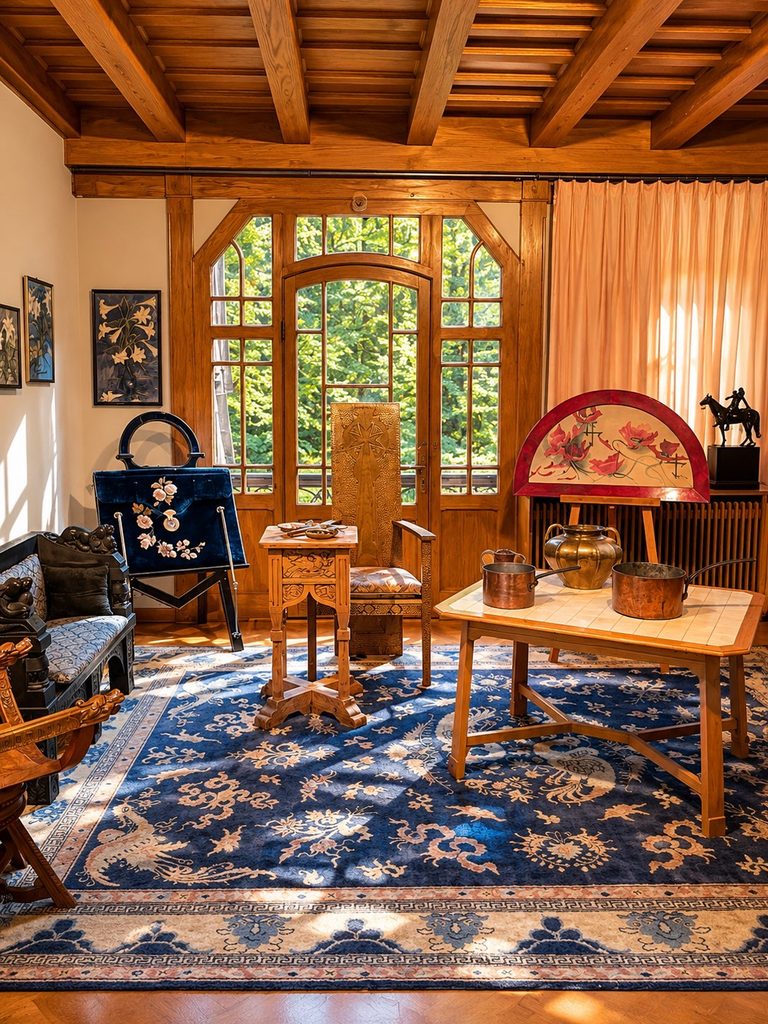
Set among the forests of the Carpathians, close to the more imposing Peleș, Pelișor offers a different perspective on Romania’s royal heritage. It reminds us that the history of a monarchy is preserved not only in ceremonies, political decisions and monumental architecture, but also in the homes its members created, the objects they cherished and the artistic ideals through which they sought to give form to their world.
Basarab Heritage
— A.C.
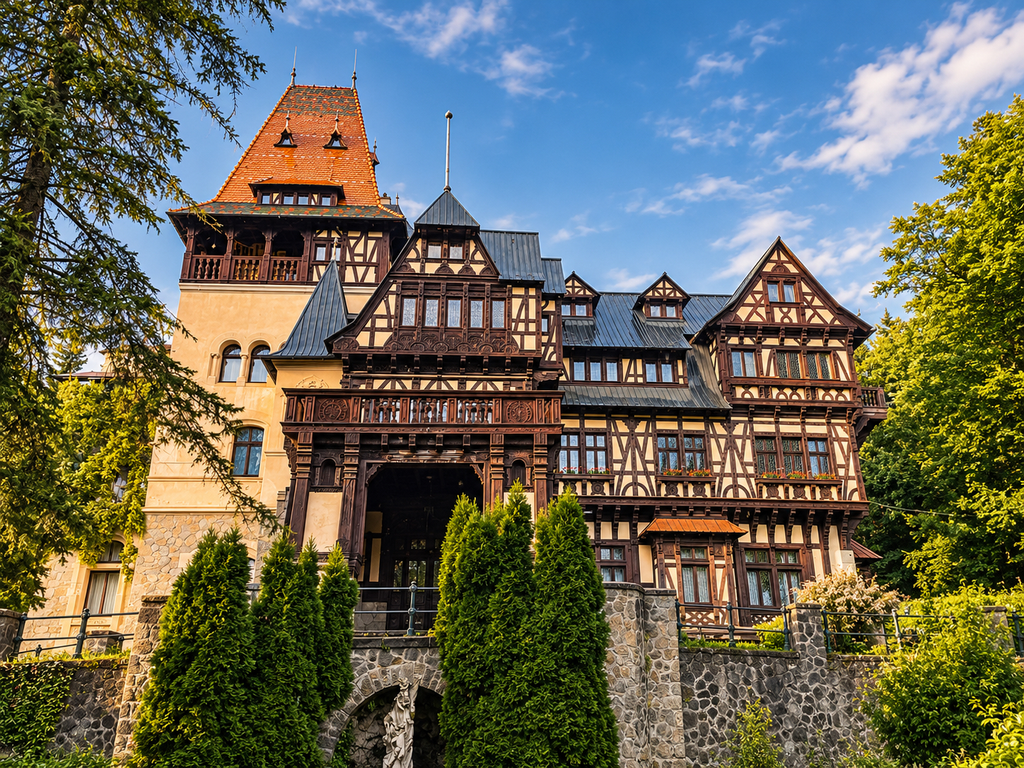
The principal façade of Pelișor Castle, standing as a monument to Queen Marie’s artistic legacy within the Carpathian royal estate of Sinaia.