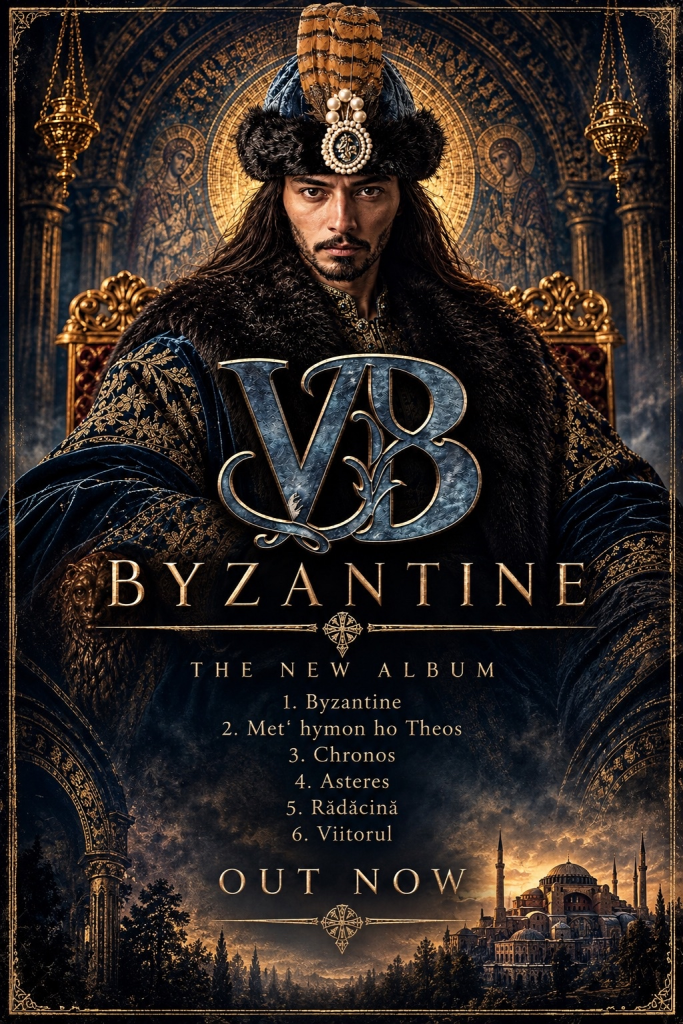

The final movement of Byzantine – a reflection on faith, inheritance and the generations yet to come.
A New Dawn
Every journey through history eventually arrives at a question: what shall be carried forward?
The past may be preserved in chronicles, charters, churches and monuments. Its memory may be sustained through language, music and the traditions of successive generations. Yet heritage becomes truly living only when it is received, understood and entrusted to those who follow.
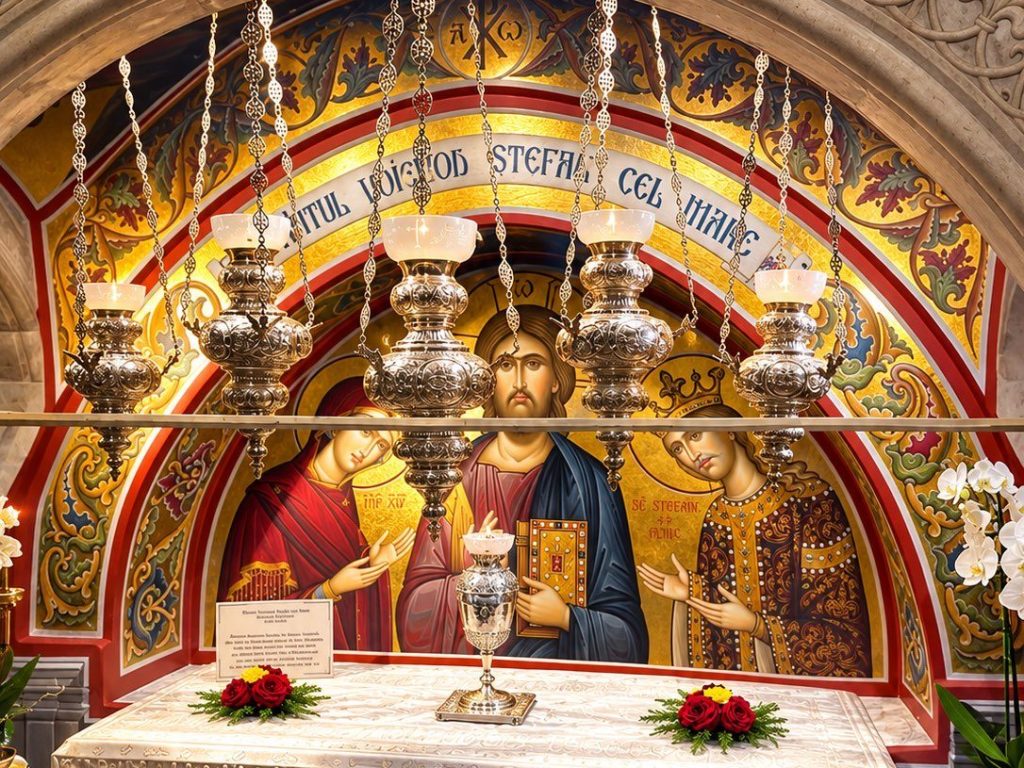
Viitorul – “The Future” – brings Vladislav Carol Nicolae’s album Byzantine to its conclusion. Its opening words announce a new dawn:
Ἀνατέλλει φῶς καινόν,
νέα ἡμέρα ἀνατέλλει.
A new light is rising,
a new day is dawning.
The image is at once simple and profound. Dawn does not erase the night that preceded it; it reveals the landscape anew. In the same way, the future does not begin by rejecting the past. It emerges from what has been received, remembered and prepared.
The song therefore concludes the album not with a retrospective account, but with an invitation to continue. Its central concern is not merely what earlier generations achieved, but what the present generation will leave in the hands of those still to come.
From Memory to Responsibility
The preceding compositions have gradually developed a connected spiritual and historical narrative. They begin with steadfastness in faith and the assurance of God’s presence. They then turn towards the passage of time, the continuity of generations and the promise represented by the stars of heaven. In Rădăcină, the perspective widens further: the history of Wallachia is understood in relation to the wider Byzantine and Orthodox world.
Viitorul takes the next step. Having discovered the inheritance of the past, the listener is now invited to consider its responsibility.
This progression is particularly meaningful when viewed against the historical experience of the Romanian principalities. Their cultural and religious traditions were not formed in isolation. Wallachia and Moldavia maintained connections with the wider Orthodox world through ecclesiastical institutions, monasteries, manuscripts, artistic patronage and diplomatic relations. These connections developed over centuries and were adapted to local circumstances.
The Byzantine inheritance was important, but it was not the only influence upon the emerging Wallachian polity. Its rulers and elites engaged with several political and cultural traditions, including Byzantine, Latin and South-Eastern European models. They did not merely reproduce institutions or customs received from elsewhere; they adapted them to local needs and circumstances, gradually shaping a distinct political and cultural identity. Recent scholarship has accordingly encouraged a more nuanced understanding of the relationship between Wallachia and Byzantium, moving beyond a simple model of influence from an imperial centre to a passive periphery.
The heritage received from Byzantium was therefore never simply an object to be preserved unchanged. It was transmitted, interpreted and given new expression by successive generations. Churches were built and decorated; books were copied and translated; monasteries became centres of worship and learning; princely patrons supported religious institutions both within and beyond their own lands.
The future imagined in the song grows naturally from this historical experience. A tradition remains alive not because it is untouched by time, but because each generation assumes responsibility for carrying it forward.
Hope: More Than an Expectation
The second movement, Speranța – “Hope” – introduces the human dimension of this responsibility.
The Romanian verses acknowledge that the future cannot be fully known:
Nu știm ce zile ne așteaptă,
Nici unde drumul ne va duce,
Dar pășim cu încredere
Spre lumina care ne conduce.
We do not know what days await us, nor where the road will lead us. Nevertheless, we proceed with confidence towards the light that guides us.
This is not a declaration that every undertaking will succeed or that the future can be controlled. Its confidence rests upon a different foundation: faith.
In Christian theology, hope is more than optimism or a favourable expectation about worldly events. It is a virtue directed towards God and grounded in trust in His promises. It enables the believer to act faithfully even when the outcome remains uncertain.
The New Testament expresses this understanding in the Epistle to the Romans, where Saint Paul writes of hope that does not disappoint (Romans 5:5). In the Epistle to the Hebrews, hope is described as an anchor of the soul, firm and secure (Hebrews 6:19). These passages do not promise an absence of difficulty. Rather, they describe the confidence with which a person may continue despite uncertainty.
The song’s hope is therefore active. It calls for steps to be taken, light to be preserved and joy to be sown. The future is not simply awaited; it is approached through the decisions and actions of the present.
The Light of the Future
The third movement gives this confidence its Greek expression:
Τὸ φῶς τοῦ μέλλοντος λάμπει,
ἡ ἐλπὶς ἡμᾶς ὁδηγεῖ.
Οὐ φοβούμεθα τὸ ἄγνωστον,
ὅτι ὁ Θεὸς μεθ’ ἡμῶν ἐστιν.
The light of the future shines; hope guides us. We do not fear the unknown, for God is with us.
The final line recalls one of the album’s recurring theological themes: Μεθ’ ἡμῶν ὁ Θεός – “God is with us.” Its biblical background lies in Isaiah 8:8 and 8:10 in the Septuagint, where the expression appears in the context of a political and military crisis confronting the kingdom of Judah. The prophet’s words originally belong to that particular historical setting. The Christian tradition subsequently reads the promise of Emmanuel in the light of Matthew 1:22-23, where the name is interpreted as “God with us”.
The song does not quote these passages word for word. Rather, it brings their central assurance into a new poetic setting. The unknown future is not made insignificant, nor are its uncertainties denied. What changes is the perspective from which they are faced.
The light is not merely the promise of a better historical period. It is also an image of divine guidance, recalling the biblical association between God’s light and the path of the faithful. The future remains unknown, but it is not approached in solitude.
For Those Who Will Come
The refrain gives the song its particular sense of generational responsibility:
Pentru cei ce vor veni,
Pentru zorii ce-or sosi,
Vom păstra lumina vie,
Și vom semăna bucurie.
“For those who will come, for the dawns yet to arrive, we shall keep the light alive and sow joy.”
Here the perspective moves beyond the individual. The work of the present generation is undertaken not only for its own benefit, but also for those who will inherit its consequences.
The image of sowing has deep biblical associations. In the Gospel according to John, Christ speaks of the grain of wheat which must fall into the earth and die in order to bear much fruit (John 12:24). Saint Paul uses agricultural imagery in his teaching on sowing and reaping (Galatians 6:7-9). These passages give the song’s metaphor a familiar Christian resonance: what is done in the present may bear consequences that become visible only later.
The Romanian verses of Moștenirea – “The Legacy” – develop precisely this thought:
Ce-am semănat cu mâini smerite
Va înflori în alte vremi.
“What we have sown with humble hands will blossom in other times.”
The emphasis on humble hands is important. The future is not presented as the achievement of one extraordinary individual. It is shaped by many acts of care, learning, service and faithfulness. Some may appear modest in their own time, yet become meaningful to people who will never know the circumstances in which they began.
This is also how cultural heritage is transmitted. A manuscript carefully preserved, a church restored, a language taught to children, a historical document made accessible or a musical tradition passed on may all become seeds whose fruits belong to another generation.
A Living Inheritance: The Personal Dimension
The theme of inheritance also carries a contemporary personal resonance for Vladislav Carol Nicolae.
His engagement with Wallachian history has provided a starting point for a wider exploration of the historical and cultural connections between the Romanian principalities and the Byzantine world. More recently, the discovery of relatives within his Byzantine family has added a personal dimension to this interest. It has also opened the possibility of future projects and closer cooperation.
This experience gives Viitorul an additional layer of meaning. The discovery of a historical and cultural connection need not remain an intellectual exercise or a matter of genealogical curiosity. It can become the beginning of new relationships, shared work and projects that bring the past into conversation with the present.
It song reflects the way in which the study of history may lead to encounters in the present, and how those encounters may create possibilities for the future.
The parallel with the song’s imagined journey is clear. A person begins by exploring the history closest to him, discovers connections reaching beyond familiar borders and then considers what may be built upon that discovery. The past becomes a source of relationship rather than merely an object of remembrance.
In this sense, the song’s message is particularly apt: what has been received should not end with the person who receives it. It should become something that can be shared and developed.
Three Languages, One Blessing
As in Rădăcină, the use of Romanian, Greek and Church Slavonic gives the composition a distinctive historical and spiritual dimension. Their functions, however, are not interchangeable.
Romanian carries the personal and collective voice of the song. It speaks of hope, the homeland, the work of the present generation and the legacy entrusted to those who follow.
Greek gives expression to the theological horizon of the composition. Its language recalls the scriptural and liturgical world of Eastern Christianity, in which light, hope, divine presence and the continuity of life are recurring themes.
Church Slavonic enters in the movement entitled ΕΥΛΟΓΙΑ – “Blessing”. Its appearance is especially significant because the words are not an invented prayer, but a recognisable liturgical formulation drawn from the Psalter.
The text reads:
Буди, Господи, милость Твоя на нас,
якоже уповахом на Тя.
It corresponds to Psalm 32:22 in the Septuagint numbering, Psalm 33:22 in the numbering used by most modern English Bibles:
“Let Thy mercy, O Lord, be upon us, according as we have hoped in Thee.”
The verse is a prayer of trust. It does not presume to command the future or claim that human effort alone can secure it. Instead, it asks that divine mercy remain upon those who have placed their hope in God.
The use of Church Slavonic gives this prayer a particular historical resonance in the context of the Romanian principalities. Church Slavonic was an important language of Orthodox worship and written culture in medieval Wallachia and Moldavia. It was also used in princely and administrative documents, particularly in the medieval period. Its role should not be confused with that of Romanian, the language spoken by the population, or Greek, which had its own place in the wider Byzantine ecclesiastical and intellectual world.
The three languages come together not as an attempt to reconstruct a specific medieval service, but as an artistic expression of distinct historical traditions united by a common Christian confession.
The Generations Yet to Come
The final movement gathers the song’s principal images into a common declaration:
Ἡ ἐλπὶς οὐ σβέννυται,
τὸ φῶς οὐ δύει.
Νέαι γενεαὶ ἀνατέλλουσι,
καὶ ἡ ζωὴ συνεχίζεται.
Hope does not fade, the light does not set. New generations arise, and life continues.
The language is poetic rather than a direct quotation from Scripture. Yet its imagery belongs to a long biblical tradition in which light signifies life, guidance and the presence of God. The rising of new generations also recalls the recurring biblical concern with transmitting faith and remembrance from one generation to another.
Psalm 77:3-7 in the Septuagint numbering (Psalm 78:3-7 in most modern English Bibles) speaks of telling the coming generation of the Lord’s works, so that those who follow may place their confidence in God. The point is not simply that the past should be remembered. Its meaning must be communicated, so that the next generation may understand and continue the inheritance entrusted to it.
This is the deeper purpose of the refrain’s repeated invocation:
Ὑπὲρ τῶν ἐρχομένων!
Ὑπὲρ τοῦ φωτὸς τοῦ μέλλοντος!
“For those who will come!
For the light of the future!”
The words turn the song outward. Its final concern is no longer only the singer, the listener or even the present generation. It is directed towards people who have not yet arrived, and towards a future whose shape remains open.
Songtext
The following is the complete text of Viitorul. The translation seeks to preserve the meaning, imagery and solemn character of the original. It is not intended as a strict word-for-word rendering, but as a faithful English version that can be read and understood independently.

Viitorul
Ἡ Ἐλπὶς τοῦ Μέλλοντος • Nădejdea viitorului • The Hope of the Future…
Ι. ΑΝΑΤΟΛΗ
Ἀνατέλλει φῶς καινόν,
νέα ἡμέρα ἀνατέλλει.
Ὁδὸς καινὴ ἀνοίγεται,
καὶ ἡ ἐλπὶς ἀνακαινίζεται.
ΙΙ. SPERANȚA
Din zori se naște-o nouă cale,
Sub cerul limpede și sfânt.
Ce astăzi pare doar speranță,
Mâine va prinde trup și cânt.
Nu știm ce zile ne așteaptă,
Nici unde drumul ne va duce,
Dar pășim cu încredere
Spre lumina care ne conduce.
ΙΙΙ. ΤΟ ΦΩΣ ΤΟΥ ΜΕΛΛΟΝΤΟΣ
Τὸ φῶς τοῦ μέλλοντος λάμπει,
ἡ ἐλπὶς ἡμᾶς ὁδηγεῖ.
Οὐ φοβούμεθα τὸ ἄγνωστον,
ὅτι ὁ Θεὸς μεθ’ ἡμῶν ἐστιν.
IV. NĂDEJDEA VIITORULUI
Pentru cei ce vor veni,
Pentru zorii ce-or sosi,
Vom păstra lumina vie,
Și vom semăna bucurie.
Ἐλπὶς εἰς τὸ μέλλον,
φῶς εἰς τοὺς αἰῶνας.
Ἡ ζωὴ συνεχίζεται,
ἡ ἀγάπη μένει.
V. MOȘTENIREA
Nu doar pentru ieri trăim,
Ci și pentru ce va fi.
Să lăsăm celor ce vin
Lumină-n calea lor senină…
Ce-am semănat cu mâini smerite
Va înflori în alte vremi.
Căci viața merge mai departe
Prin cei ce vin după noi.
VI. ΕΥΛΟΓΙΑ
Буди, Господи, милость Твоя на нас,
якоже уповахом на Тя.
VII. ΤΟ ΦΩΣ ΤΟΥ ΜΕΛΛΟΝΤΟΣ
Un nou răsărit ne cheamă,
Un nou început ne-așteaptă.
Cu credință înainte,
Spre lumina ce ne poartă.
Ἡ ἐλπὶς οὐ σβέννυται,
τὸ φῶς οὐ δύει.
Νέαι γενεαὶ ἀνατέλλουσι,
καὶ ἡ ζωὴ συνεχίζεται.
Pentru cei ce vor veni!
Ὑπὲρ τῶν ἐρχομένων!
Pentru lumina ce va fi!
Ὑπὲρ τοῦ φωτὸς τοῦ μέλλοντος!
Буди, Господи, милость Твоя на нас,
якоже уповахом на Тя.
Ἡ Ἐλπὶς τοῦ Μέλλοντος…
Nădejdea viitorului…
I. THE DAWN
A new light is rising,
A new day is dawning.
A new path is opening,
And hope is renewed.
II. HOPE
From the dawn a new path is born,
Beneath the clear and holy sky.
What today appears to be only hope,
Tomorrow will take form and song.
We do not know what days await us,
Nor where the road will lead us,
But we walk forward with confidence
Towards the light that guides us.
III. THE LIGHT OF THE FUTURE
The light of the future shines,
Hope guides us.
We do not fear the unknown,
For God is with us.
IV. THE HOPE OF THE FUTURE
For those who will come,
For the dawns that will arrive,
We shall keep the light alive,
And we shall sow joy.
Hope for the future,
Light unto the ages.
Life continues,
Love remains.
V. THE LEGACY
We do not live only for yesterday,
But also for what is yet to be.
Let us leave for those who come after us
A light upon their peaceful way.
What we have sown with humble hands
Will blossom in other times.
For life goes on
Through those who come after us.
VI. THE BLESSING
Let Thy mercy, O Lord, be upon us,
According as we have hoped in Thee.
VII. THE LIGHT OF THE FUTURE
A new dawn calls us,
A new beginning awaits us.
With faith, we move forward,
Towards the light that carries us.
Hope does not fade,
The light does not set.
New generations arise,
And life continues.
For those who will come!
For those who are to come!
For the light that will be!
For the light of the future!
Let Thy mercy, O Lord, be upon us,
According as we have hoped in Thee.
The Hope of the Future…
The Hope of the Future…
Listen to the Song
The Conclusion of a Journey – and Its Continuation
With Viitorul, the album Byzantine reaches its conclusion, but the narrative it has developed does not come to an end.
Its journey has moved through the endurance of faith, the assurance of God’s presence, the passage of time, the promise extending across generations and the discovery of a spiritual inheritance shared beyond political borders. The final composition gathers these themes and gives them a direction: forward.
The historical experience of Wallachia and the wider Orthodox world offers a fitting background to this conclusion. Empires have disappeared, political frontiers have changed, dynasties have ended and languages have evolved. Yet many traditions have survived because successive generations found ways to preserve, reinterpret and transmit them.
The future, in this sense, is neither a rejection of the past nor its mere repetition. It is the responsibility to carry forward what remains worthy of remembrance, while allowing it to bear fruit in circumstances that earlier generations could not have foreseen.
The final blessing returns the listener to prayer. After the declarations of hope and the promises made for those who will come, the song entrusts the future to divine mercy.
Its closing words are therefore not an ending in the ordinary sense:
Ἡ Ἐλπὶς τοῦ Μέλλοντος…
Nădejdea viitorului…
The Hope of the Future…
The final thought is both humble and resolute. We cannot know all that lies ahead, nor can we determine what form the future will take. But we can preserve the light we have received, sow what may bear fruit in other times, and entrust those who follow to the mercy of God.
The past gives us roots. Faith gives us direction. Hope calls us towards the generations yet to come.
Basarab Heritage
— A.C.