
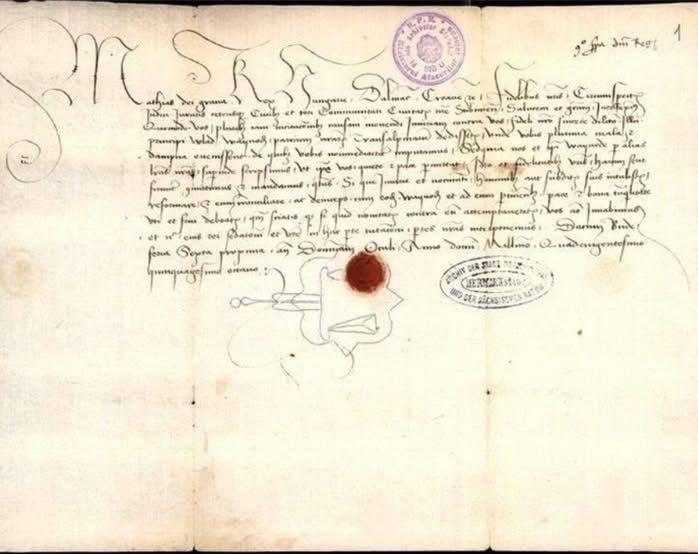
On 3 March 1458, Matthias Corvinus, the newly elected King of Hungary, addressed the civic authorities and community of Sibiu, calling on them to maintain peaceful relations with Vlad III Țepeș, Voivode of Wallachia. Written at a time of political tension between the Wallachian ruler and the Transylvanian Saxon towns, the letter offers a glimpse into the diplomacy that connected the Kingdom of Hungary, Transylvania and Wallachia in the fifteenth century.

Rather than presenting a complete account of the dispute, the document records the king’s position and the instructions he issued to the community of Sibiu. Its wording reveals how royal authority was used to discourage further hostilities and encourage reconciliation.
A Document from a Time of Political Tension
The letter is addressed to the judge, sworn officials, other citizens and the entire community of Sibiu, known in German as Hermannstadt. Matthias refers to Vlad as his trusted and distinguished voivode of the lands beyond the Carpathians – a reference to Wallachia.
According to the king’s account, the people of Sibiu had repeatedly provoked the Wallachian ruler and were consequently suffering harm and losses. Matthias reproaches the community, instructing its members to make amends for any wrongs committed against Vlad’s men or subjects and to restore peaceful relations.
The king also states that he has written separately to Vlad, asking him to leave the people of Sibiu in peace. His message to the town is nevertheless firm: should its inhabitants undertake further hostile action against the voivode, they should not expect royal assistance or intervention on their behalf.
The letter therefore communicates a clear political objective: to prevent the dispute from escalating and to secure a more stable relationship between the Wallachian ruler and the community of Sibiu.
The Latin Text
The following transcription reproduces the Latin text supplied for this article. Its spelling and punctuation should be collated with the published documentary edition before the text is treated as a definitive diplomatic transcription.
Mathias dei gratia rex Hungariae, Dalmaciae, Croaciae et cetera fidelibus nostris circumspectis iudici, iuratis ceterisque civibus et toti communitati civitatis nostrae Scibiniensis salutem et gratiam. Intelleximus, quomodo vos pluribus iam incitationibus causam movendi iniuriam contra vos fideli nostro sincere dilecto illustri principi Wlad waywodae partium nostrarum Transalpinarum dedissetis, unde vobis plurima mala et damna evenissent, de quibus vobis non mediocriter imputamus. Sed quia nos et ipsi waywodae per alias literas nostras superinde scripsimus, ut ipse vos quiete et pace permittat, ideo et fidelitatibus vestris harum serie firmiter committimus et mandamus, quatenus si quae iniuriae et nocumenti hominibus aut subditis suis intulistis, reformare et eum reconciliare ac deinceps cum eodem waywoda et ad eum pertinentibus pace et bona tranquillitate uti et frui debeatis. Quoniam sciatis, quod si quid novitatis contra eum attemptaveritis, vos non iuvabimus et nec eius rei sedationi et vestrae in hac parte tutationi partes nostras interponemus. Datum Budae feria sexta proxima ante dominicam Oculi, anno domini millesimo quadringentesimo quinquagesimo octavo.
The Letter in English
The following is an English translation prepared for this article. It is intended to convey the meaning of the Latin text rather than to serve as a critical or scholarly edition.
Matthias, by the grace of God King of Hungary, Dalmatia, Croatia, and so forth, sends greetings and favour to our faithful and prudent judge, sworn officials, other citizens, and the entire community of our city of Sibiu.
We have learned that, through repeated provocations, you gave our faithful, sincerely beloved and illustrious prince Vlad, voivode of our lands beyond the Carpathians, cause to act against you. As a result, you have suffered considerable harm and losses, for which we hold you substantially responsible.
However, since we have also written separately to the voivode on this matter, instructing him to leave you in peace and tranquillity, we now firmly charge and command you by these presents that, if you have inflicted any wrong or injury upon his men or subjects, you must make amends and be reconciled with him. From now on, you are to maintain and enjoy peace and good relations with the said voivode and those belonging to his authority.
You should therefore know that, if you undertake any further hostile action against him, we will not assist you, nor will we intervene to bring such a conflict to an end or to protect you in this matter.
Given at Buda, on the Friday immediately preceding Oculi Sunday, in the year of Our Lord 1458.
What Does the Letter Tell Us?
The document is valuable for several reasons.
First, it shows Vlad III as a recognised political counterpart in royal correspondence. Matthias addresses him in terms of trust and distinction and refers to him by his office as voivode of Wallachia. This language reflects the position the king assigns to Vlad within the political order of the region.
Second, it reveals tensions between Wallachia and Sibiu. The king’s instructions indicate that relations between the Wallachian ruler and the town had become strained enough to require royal intervention. The letter refers to provocations, damage and the need for reconciliation, although it does not provide a full account of the incidents behind the dispute.
Third, the letter illustrates the practical exercise of royal authority. Matthias does not simply appeal for goodwill. He gives instructions, demands that wrongs be put right and warns that the community will lose his support if it renews hostilities.
These points must, however, be read with care. The letter presents the king’s account of the dispute, not a neutral record of every action taken by the parties. It does not independently establish precisely what happened before it was written, nor does it preserve the responses of the people of Sibiu or Vlad himself.
A Glimpse into Vlad III’s Political World
The date is significant. Matthias Corvinus had been elected King of Hungary on 24 January 1458, only a few weeks before this letter was issued. The document thus belongs to the opening phase of his reign, when royal authority and relationships with regional political actors were being established.
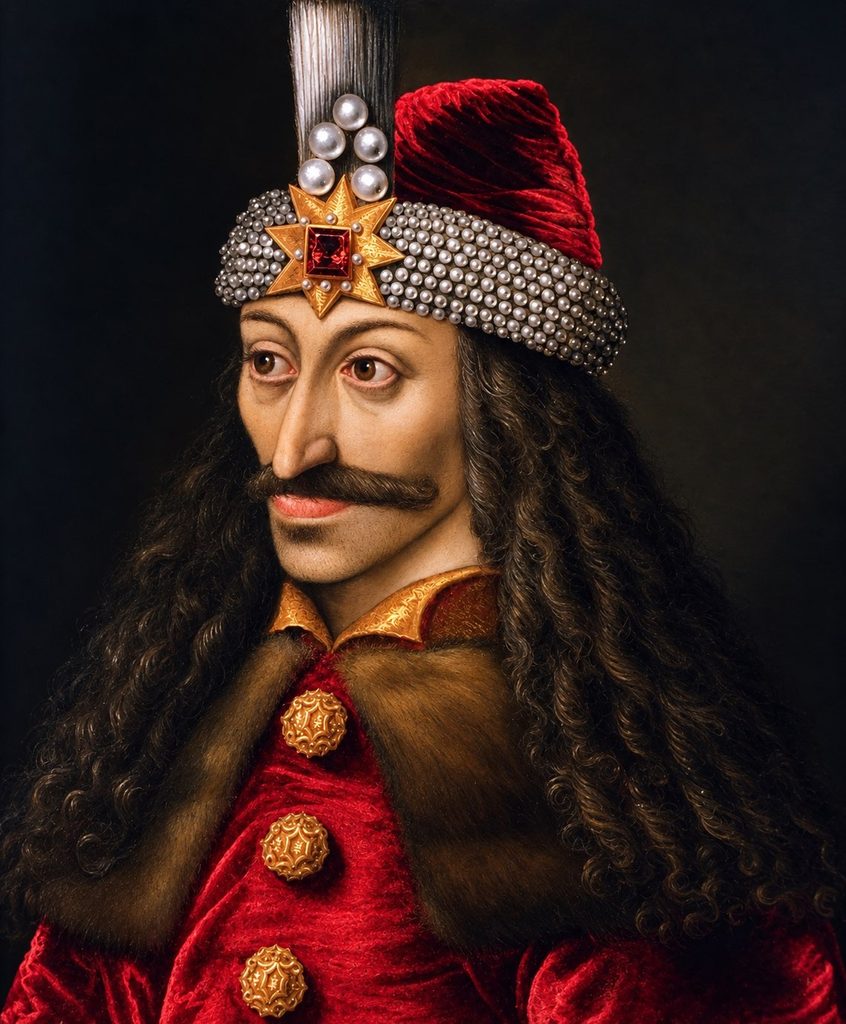
Wallachia and the Transylvanian Saxon towns were connected by more than their geographical proximity. Their relationships involved trade, border interests, political alliances and competing claims of authority. Disagreements between a Wallachian ruler and a Saxon town could therefore become matters of concern for the Hungarian Crown.
In this instance, Matthias sought to restrain the community of Sibiu while also asking Vlad to maintain peace. His intervention demonstrates that the relationship between the Crown, the Transylvanian towns and Wallachia was shaped by negotiation as well as conflict.
A single letter cannot tell the entire story of Vlad III’s relations with Sibiu. It does, however, preserve a direct expression of royal policy at a particular moment: a demand for reconciliation, backed by a warning that the king would not support renewed hostilities.
Basarab Heritage
— A.C.
⸻
Sources and Further Reading
Primary source
Hurmuzaki, Eudoxiu de, and Nicolae Iorga, ed. Documente privitoare la istoria românilor culese de Eudoxiu de Hurmuzaki. Vol. XV, Part I: Acte și scrisori din arhivele orașelor ardelene (Bistrița, Brașov, Sibiu). Bucharest, 1911, pp. 48–49.
This documentary collection is cited in modern scholarship in connection with the royal correspondence of March 1458 concerning the tensions between Vlad III and Sibiu. The Latin transcription above should be checked against the relevant passage in this edition before publication.
Secondary reading
Stoicescu, Nicolae. Vlad Țepeș. Bucharest: Editura Academiei Republicii Socialiste România, 1976.
A historical monograph on Vlad III, including discussion of his political relations with Transylvania and the Kingdom of Hungary.
Editorial note
The Latin text is presented here as a transcription for historical reading, while the English translation has been prepared for Basarab Heritage. The translation is interpretative in places and should not be cited as a published scholarly translation. The letter is best read as evidence of Matthias Corvinus’s stated position and instructions, rather than as an impartial account of the dispute.