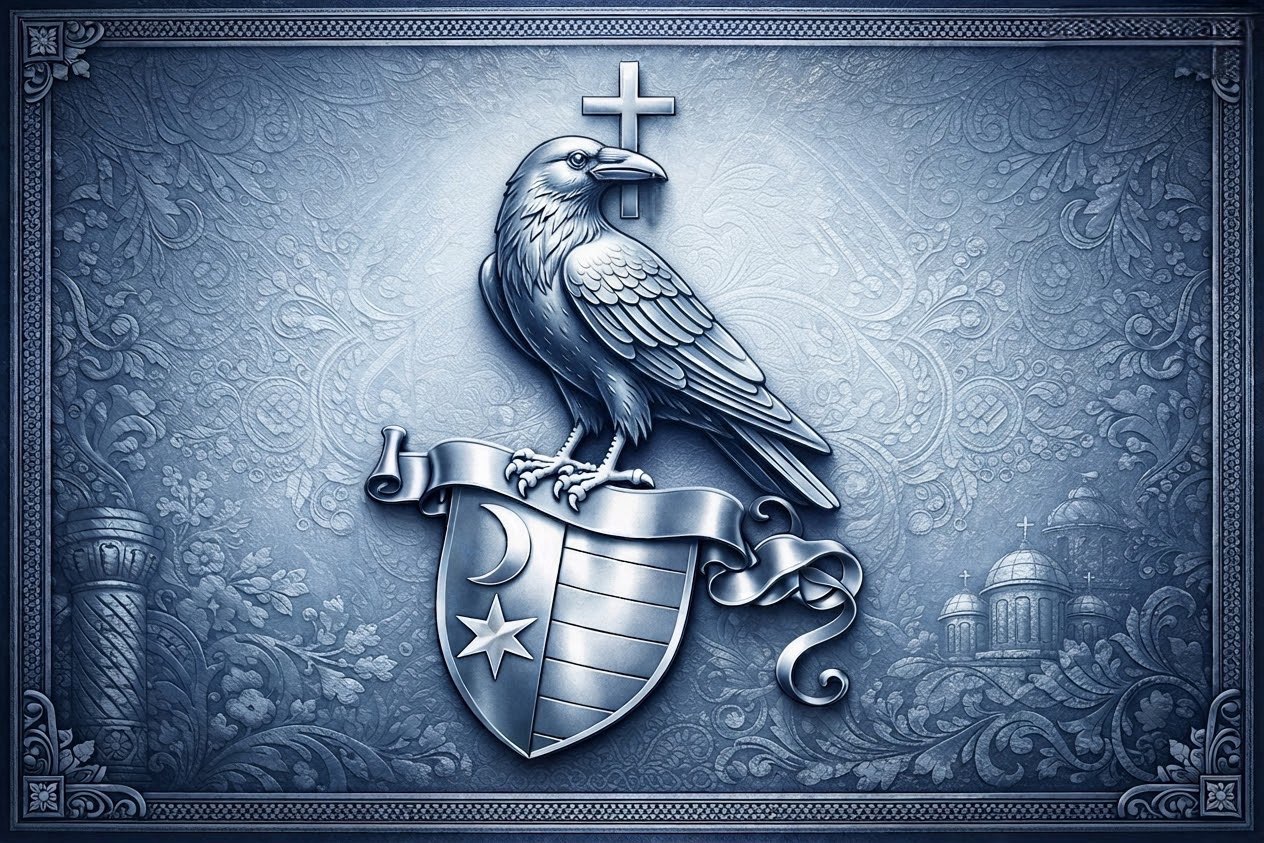
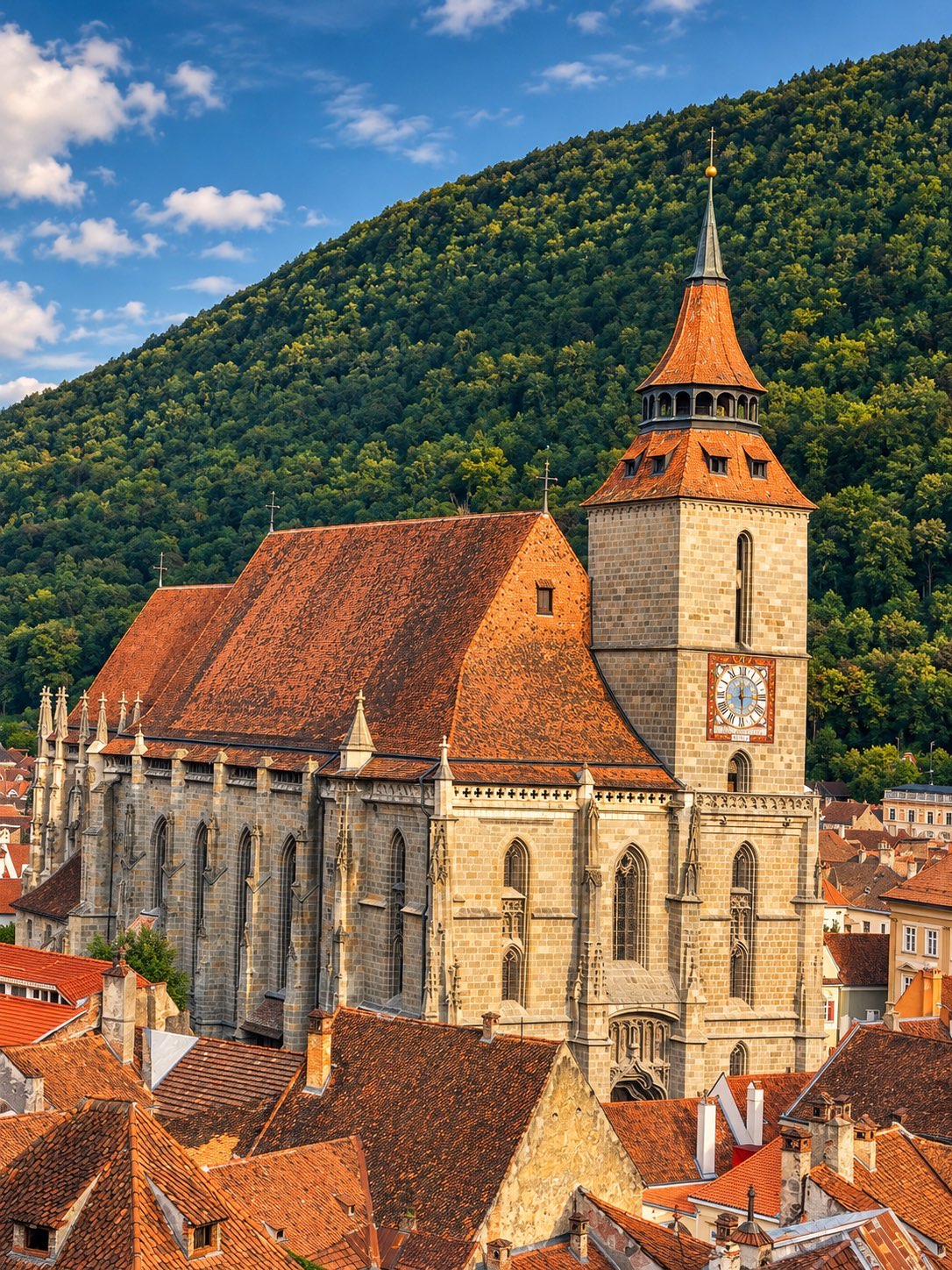
Rising above the historic centre of Brașov, the Black Church stands as one of the most remarkable monuments of medieval Transylvania. Its imposing Gothic architecture, substantial dimensions and richly layered interior reflect centuries of religious devotion, civic ambition, commercial prosperity and cultural exchange.
Yet the history of the church is not simply the history of a great medieval building. It is also the history of the community that raised it, worshipped within its walls, experienced the upheavals of the Reformation and rebuilt it after one of the most destructive fires in the history of the town.
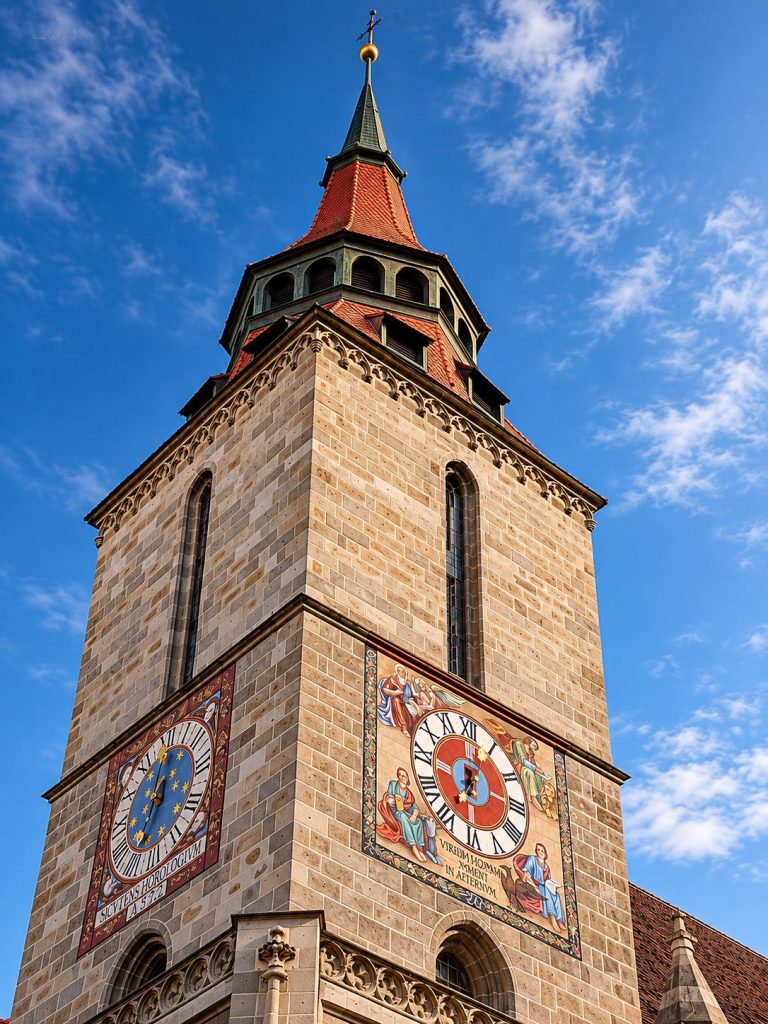
Known today as the Biserica Neagră in Romanian and Die Schwarze Kirche in German, the church remains the principal place of worship of Brașov’s Evangelical Lutheran community. Its original dedication was to the Virgin Mary, and it was formerly known as the Marienkirche, or Church of Saint Mary. The familiar name by which it is now recognised arose from the darkened appearance of its walls following the great fire of 1689. The building thus preserves, in its very name, the memory of a catastrophe that transformed both the church and the town around it.
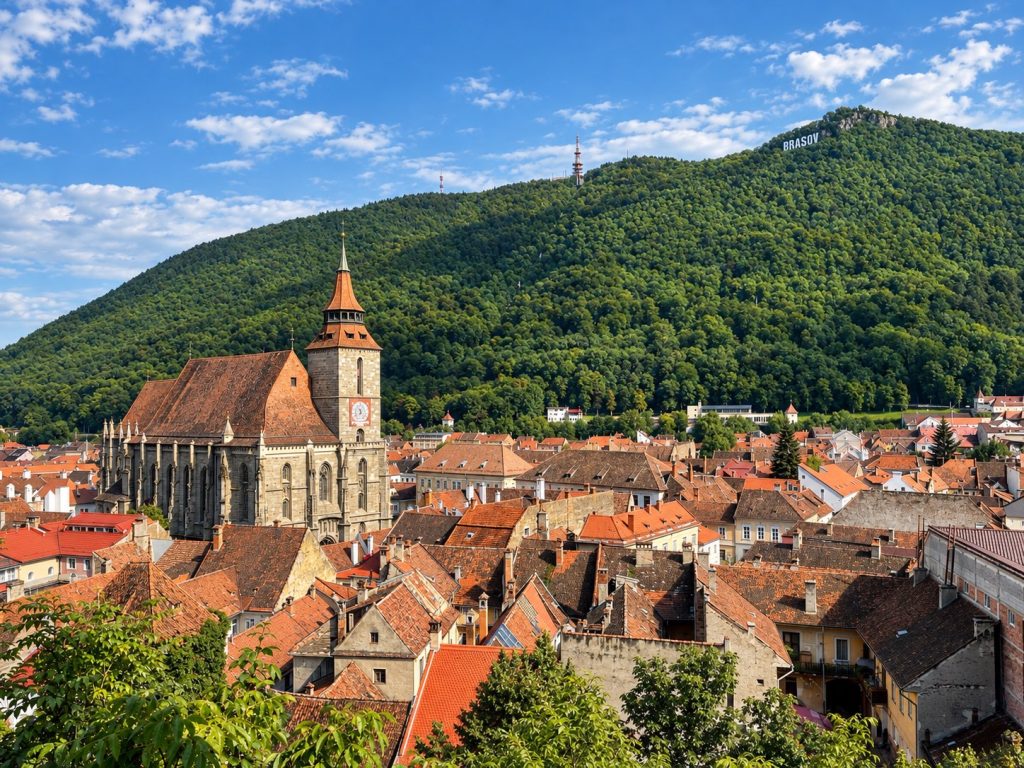
The Black Church rising above the historic centre of Brașov, framed by the slopes of Mount Tâmpa, illustrating its prominent place in the urban landscape.
A Medieval Church for a Prosperous Town
The origins of the Black Church are closely connected with the development of medieval Brașov, one of the principal commercial and craft centres of southeastern Transylvania. Situated along important routes linking the Kingdom of Hungary with the lands beyond the Carpathians, the town benefited from trade, royal privileges and the activities of its German-speaking burgher community. Its prosperity found expression not only in its fortifications and civic institutions but also in the ambition to erect a church worthy of its growing importance.
The present building was raised on the site of an earlier place of worship. Although some accounts associate this predecessor with a Romanesque church, the surviving evidence does not allow its appearance or precise history to be reconstructed with certainty.
The construction of the Gothic church is conventionally dated to 1383, although other historical accounts place the beginning of the project a few years earlier, around 1377 or 1380. The undertaking was therefore not the result of a single building campaign, but a project extending across several generations.
The church received ecclesiastical support during its construction. Indulgences granted in the late fourteenth and fifteenth centuries encouraged contributions towards the work, while donations from prominent individuals helped sustain the undertaking. An inscription discovered within the fabric of the church identifies Thomas, who died in 1410, as an early founder or principal benefactor. Such evidence offers a glimpse of the people whose resources and standing contributed to a project of considerable architectural and financial ambition.
The building was conceived on a monumental scale. Its Gothic design reflected the architectural aspirations of Central Europe, while its position within the town expressed the importance of the parish church in the religious and civic life of the community. Brașov’s commercial connections brought the town into contact with artistic and architectural traditions from beyond Transylvania. The church is often discussed in relation to major Gothic buildings in the German-speaking lands, particularly the tradition of the large hall church. Such comparisons help establish its wider architectural context, although they should not be taken to imply that it was a direct copy of any single model.
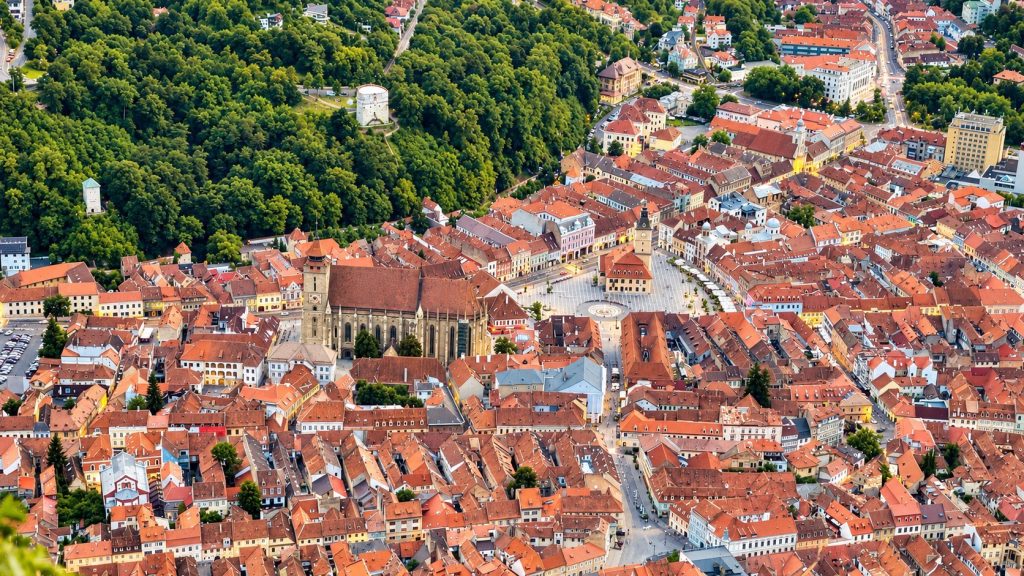
Panoramic view across the old town of Brașov as seen from the summit of Mount Tâmpa.
Construction, Conflict and the Gothic Hall Church
The construction of the church was interrupted by the Ottoman incursion of 1421, which brought devastation to Brașov and its surroundings. The town’s immediate priorities shifted towards the repair and strengthening of its defensive system. Building work on the parish church consequently suffered delays, and the original architectural ambitions appear to have been modified during the subsequent phases.
The later fifteenth century nevertheless saw the gradual completion of the principal structure. The year 1477 is conventionally regarded as marking the conclusion of the main medieval building campaign, although alterations and additions continued thereafter. A major earthquake in 1471 also affected the project: the southern tower was not completed to the height originally envisaged. The church therefore emerged from a long and interrupted process, shaped by both the aspirations of its builders and the political and natural circumstances of the age.
Architecturally, the Black Church belongs to the tradition of the Gothic hall church. Its three principal naves rise to approximately the same height, creating an interior in which the space is experienced as a broad and unified whole rather than as a central nave clearly dominating lower side aisles. This arrangement was particularly characteristic of late medieval ecclesiastical architecture in parts of Central Europe.
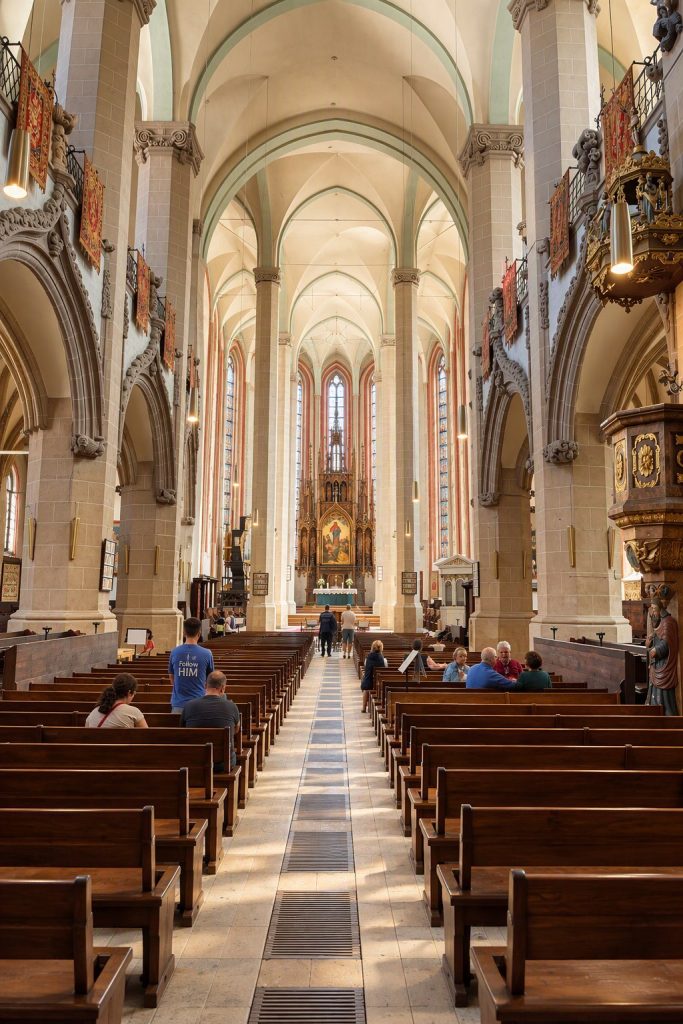
The building measures approximately 90 metres in length and is among the largest Gothic churches in southeastern Europe. Its scale is impressive, but its significance lies equally in the quality of its architectural composition. Pointed arches, ribbed vaulting, substantial piers and carefully articulated stonework establish the vertical rhythm characteristic of Gothic design. The exterior is strengthened by buttresses, while the portals and sculptural details reveal the skill of the workshops involved in its construction.
The church’s medieval appearance, however, should not be confused with the building as it stands today. Although much of its Gothic structure survives, later disasters, repairs and architectural interventions substantially altered its interior. The Black Church is therefore best understood as a historical monument in which several distinct periods remain visible.
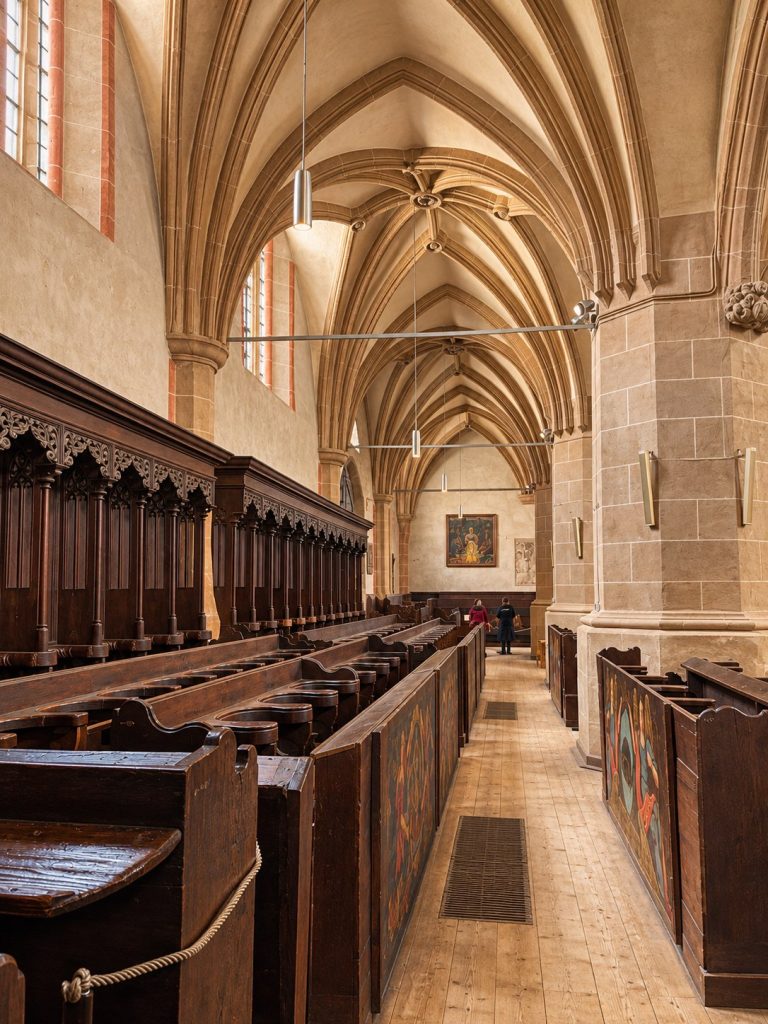
Side aisle interior showcasing the reconstructed vaults and historic guild seating, illustrating the spatial and social organization of the church.
The Reformation and Johannes Honterus
One of the most consequential transformations in the history of the church occurred not through war or fire, but through religious reform.
During the sixteenth century, the ideas of the Protestant Reformation spread through the towns of Transylvania. Brașov became one of the principal centres of this movement, largely through the work of Johannes Honterus (1498-1549), the humanist, educator, printer and religious reformer whose influence extended far beyond his native town.
Honterus had studied and worked in Central Europe before returning to Brașov. He brought with him a wide intellectual outlook and a commitment to education, printing and religious renewal. His activities were not confined to theological debate. He helped establish institutions that strengthened the intellectual and cultural life of the town, including a school and a printing press, and played a decisive role in the adoption of Lutheran ideas among the Transylvanian Saxons.
The transition was closely connected with the civic authorities. Brașov’s town council supported the reform movement, and Honterus prepared the text commonly known as the Reformation Book, which set out principles for the organisation of the new religious order. The parish church of Saint Mary consequently became an important centre of the Lutheran Reformation in Transylvania.
The first Lutheran service in the church is traditionally dated to October 1542. In 1544, Honterus became its parish priest. The change in confession was accompanied by a transformation in the religious life and furnishing of the building. The medieval Catholic church, with its altars and devotional arrangements, became an Evangelical parish church shaped by the liturgical and theological priorities of the Reformation.
This transition did not erase the building’s medieval origins. Rather, it gave the church a new institutional and spiritual identity. The same walls that had once enclosed the worship of a Catholic community now became the centre of Lutheran religious life in Brașov. The church thus offers a tangible account of the religious transformation of a major Transylvanian town.
Honterus’s legacy is commemorated outside the church by the monument erected in 1898, the work of the sculptor Harro Magnussen. It stands as a reminder of the close relationship between the church, the Reformation and the development of education and humanist culture among the Transylvanian Saxons.
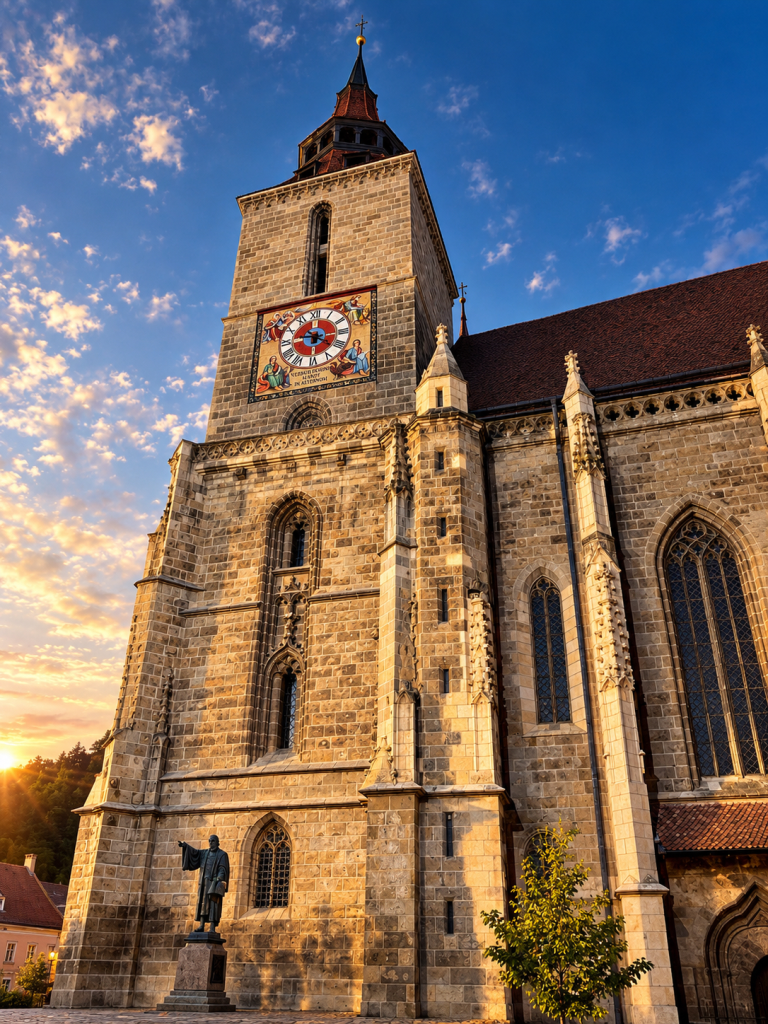
Exterior view of the Black Church tower and facade, with the 1898 monument to Johannes Honterus commemorating the humanist reformer’s pivotal role in Transylvanian history.
The Great Fire of 1689
On 21 April 1689, a devastating fire swept through Brașov. The catastrophe destroyed or severely damaged large parts of the town, and the parish church was among the buildings most seriously affected.
The church’s roof and interior furnishings were destroyed, and the damage to its vaulting was extensive. The walls remained darkened by smoke and flames, while the building could no longer be used in its former condition. The disaster gave rise to the name by which the church is now universally known. The designation Black Church developed from the visible consequences of the fire; it was initially a popular name and only gradually became established as the official designation of the monument.
The reconstruction was a major undertaking and required the resources and participation of the wider community. The work extended over several decades and involved craftsmen from outside Transylvania. Historical accounts record the contribution of builders from the Hanseatic city of Danzig, whose expertise was sought for the reconstruction of the great vaults.
The rebuilding did not simply restore the medieval church to its former state. The new vaults were executed in the Baroque manner rather than according to the original Gothic design. The roof was renewed, the interior was reorganised, and new furnishings were introduced. Galleries were constructed in the side aisles to accommodate the congregation, while new seating arrangements reflected the social and institutional structure of the town.
The pulpit, donated by the master butcher Laurenz Bömches in the late seventeenth century, became an important focal point of the interior. The seating reserved for the town council, teachers and guild masters expressed the continuing relationship between religious worship and civic life. The church was not merely a place for private devotion; it remained a central institution of the urban community.
The reconstruction proceeded in stages. The roof and other essential elements were repaired during the years immediately following the fire, while galleries and other interior features were added in subsequent decades. Major work on the vaults continued well into the eighteenth century. The resulting interior therefore reflects a prolonged process of restoration and adaptation rather than a single rebuilding campaign.
The Black Church’s present appearance is consequently the result of destruction, renewal and successive architectural interventions. Its medieval Gothic structure remains fundamental to the building, but the Baroque vaults and later furnishings are equally important to understanding its historical development.
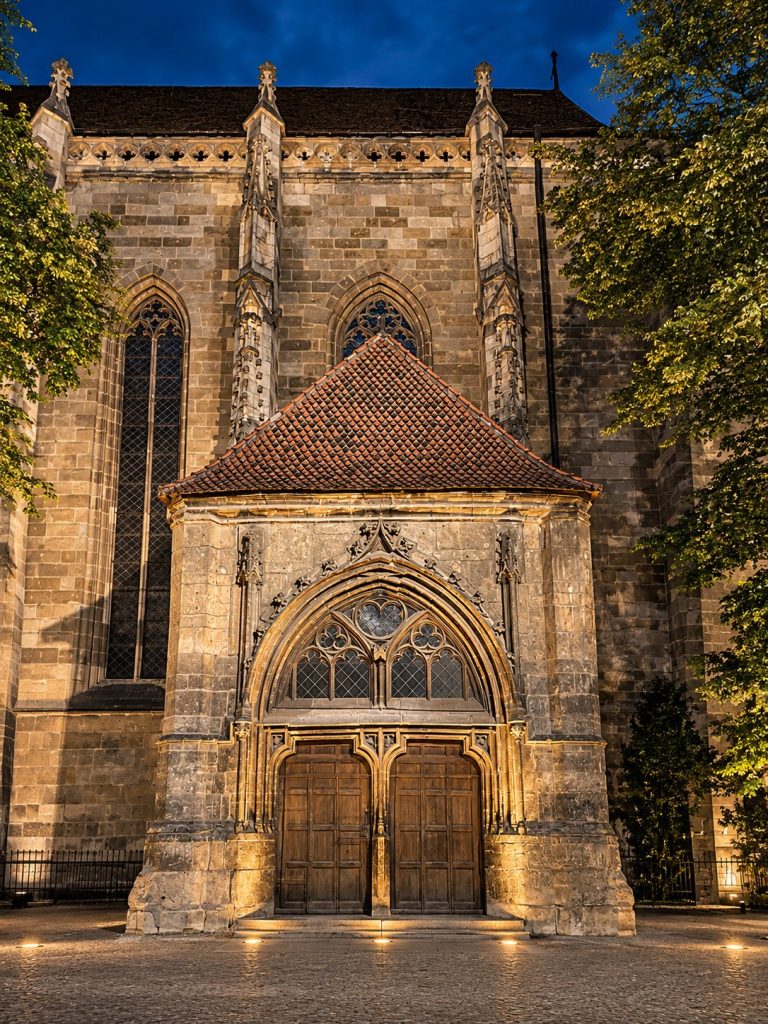
Detail of the Gothic portal and porch, showing the darkened stonework that still bears witness to the catastrophic fire of 1689.
The Treasures of the Interior
The interior of the Black Church preserves an exceptional collection of objects accumulated over several centuries. These works of art and craftsmanship reveal the religious practices, commercial connections and social organisation of Brașov’s inhabitants.
Among the oldest and most significant objects is the bronze baptismal font, dated to 1472. Its Gothic form is richly ornamented and recalls the shape of a monumental chalice. It remains in use, linking contemporary worship with the religious life of the late medieval parish. Its survival through the Reformation, the fire of 1689 and subsequent centuries of change is particularly noteworthy.
The collection of Ottoman carpets is another distinctive feature of the church. These textiles, many produced in Anatolia, reached Brașov through the commercial networks that connected Transylvania with the Ottoman world. They were donated by prosperous parishioners, merchants and guild members, particularly during the seventeenth and eighteenth centuries, and were used to adorn the interior.
Their presence is a striking reminder that the cultural world of medieval and early modern Transylvania was not confined by religious or political boundaries. Brașov’s merchants and craftsmen participated in trade routes that brought goods and artistic traditions from distant regions into the town. The carpets are therefore not simply decorative objects: they bear witness to the commercial relationships and cultural encounters that helped shape the city.
The church preserves one of the most important collections of historic Ottoman carpets in Europe outside Turkey. The collection includes textiles of different origins, designs and dates, and its significance lies not only in its size but also in the evidence it provides of the commercial and cultural life of the town.
The church also possesses an impressive collection of liturgical furnishings, sculptures and historical objects. Among these, the monumental altar constructed in 1866 deserves particular attention. Standing approximately seventeen metres high, it belongs to the nineteenth-century phase of the church’s development and reflects the artistic language of German Romanticism. Its central painting depicts Christ preaching, while the surrounding figures include the four Evangelists and the Apostles Peter and Paul.
The pulpit and guild seating, meanwhile, preserve the memory of the social structure of the early modern town. The guilds were central to Brașov’s economic prosperity, and their representatives occupied a recognised place within the life of the parish. The arrangement of the interior thus offers insight into the relationship between faith, civic authority and the institutions of urban society.
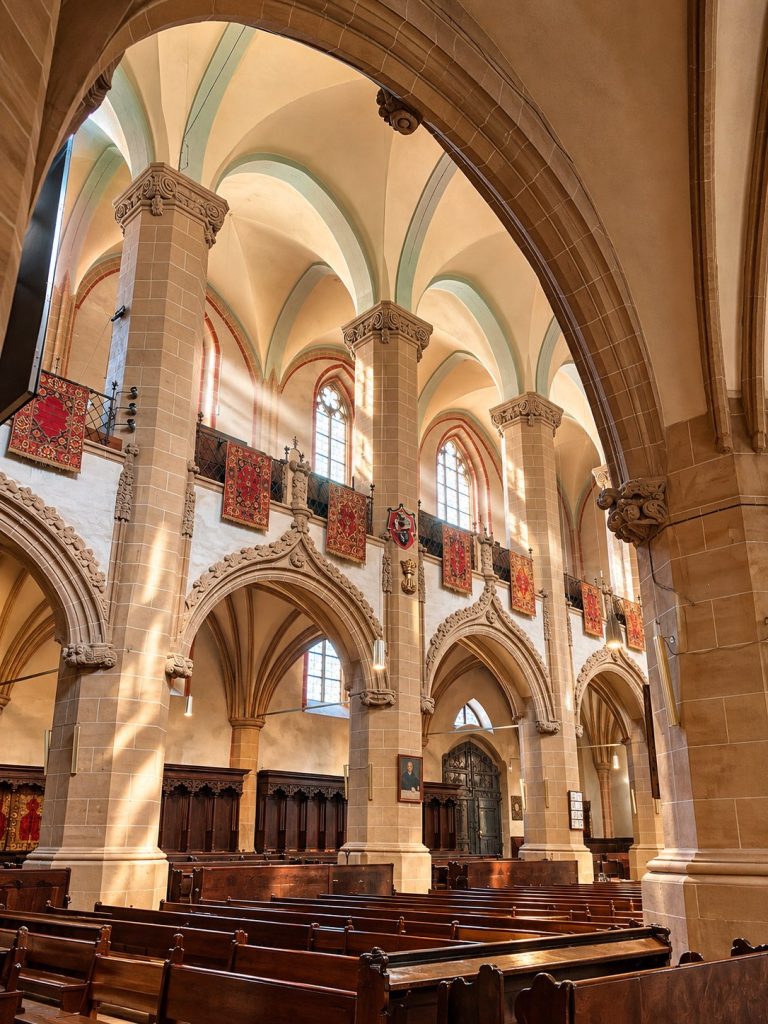
Interior view towards the side galleries, adorned with Anatolian carpets that attest to Brașov’s early modern commercial networks.
The Buchholz Organ and the Musical Tradition
Music has long held an important place in the worship of the Black Church. An organ is documented in the church as early as 1499, although the instrument from that period did not survive the later history of the building.
Following the reconstruction after the great fire, the congregation continued to maintain an organ for liturgical use. In time, however, the existing instrument proved inadequate for the scale of the church and the musical requirements of its community. A new instrument was therefore commissioned from Carl August Buchholz, an organ builder from Berlin.
Constructed and installed between 1836 and 1839, the Buchholz organ remains one of the most important nineteenth-century mechanical organs in the region. It contains 3,993 pipes, four manuals and a pedalboard. Its monumental dimensions and carefully developed sound make it particularly suited to the church’s vast interior.
The instrument underwent restoration in the twentieth century, including a major campaign completed in 2001. Its continued use preserves a musical tradition that has accompanied the religious life of the parish for generations.
The organ is more than an exceptional work of craftsmanship. Its presence reflects the importance attached to music in the Lutheran tradition and the cultural ambitions of the nineteenth-century congregation. Concerts and musical events held in the church continue to make use of the building’s remarkable acoustics, allowing the instrument to remain part of the living heritage of Brașov.
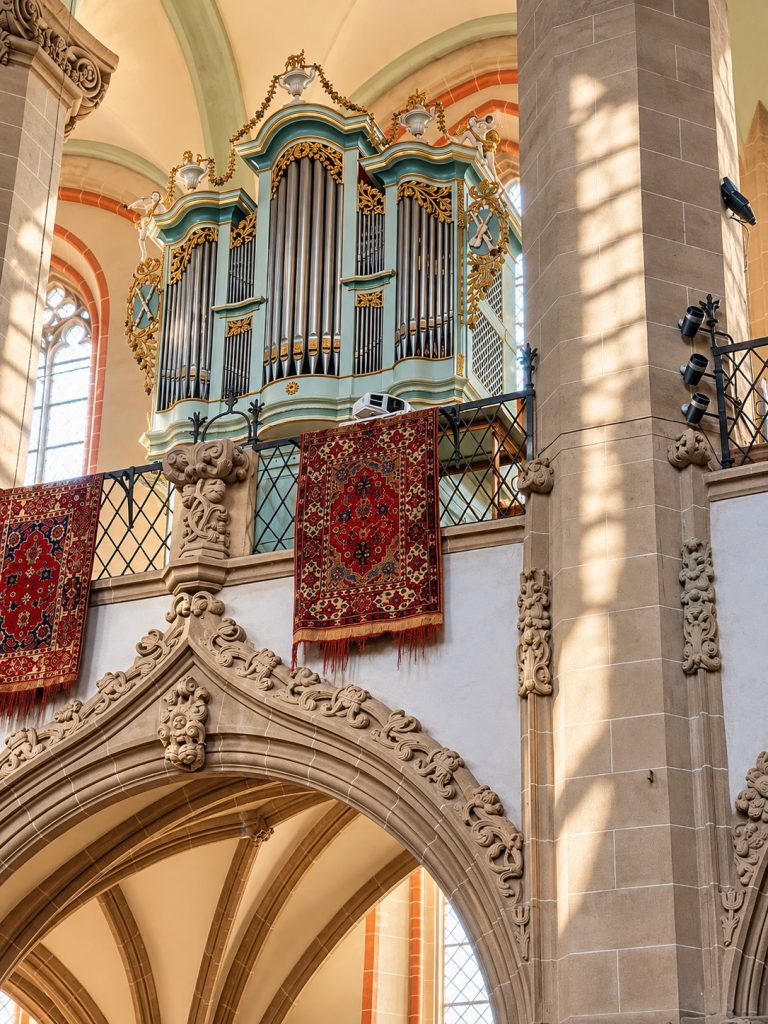
The monumental Buchholz organ of 1836-1839 positioned on the gallery, uniting the church’s rich musical tradition with historical interior furnishings.
The Church and the Saxon Community
The history of the Black Church cannot be separated from that of the Transylvanian Saxons, the German-speaking community whose institutions and cultural traditions played a formative role in the development of Brașov.
For centuries, the parish church served as a central point of religious and communal life. Its relationship with the town council, guilds, schools and charitable institutions reflected the close connection between civic organisation and religious identity in the urban society of early modern Transylvania.
The church’s importance did not end with the decline of the medieval town or the political transformations of the modern period. It continued to serve as the principal church of the Evangelical Lutheran community, preserving traditions of worship, education, music and historical memory.
The twentieth century brought profound changes to the Saxon population of Romania. War, political upheaval, the establishment of communist rule and subsequent emigration resulted in a substantial reduction of the community. The Black Church nevertheless remained an important centre of its religious and cultural heritage.
The parish has also assumed responsibility for preserving objects from other Saxon communities whose churches could no longer maintain them. Historic organs from former Protestant churches in Saxon villages have been transferred to Brașov, restored and brought back into use. The church likewise cares for Ottoman carpets entrusted to it by communities unable to provide for their conservation.
This work gives the Black Church a role extending beyond the preservation of its own collections. It has become a place in which important elements of the wider Transylvanian Saxon heritage are safeguarded.
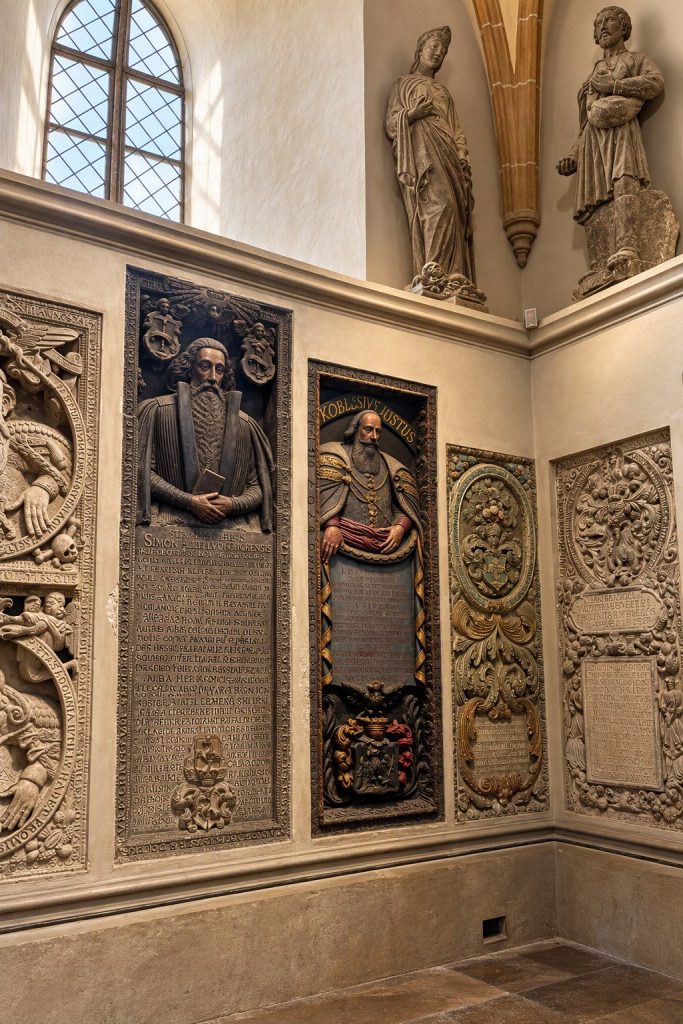
Historic stone epitaphs and memorial plaques adorning the interior walls, commemorating prominent figures of Brașov’s early modern urban community.
Restoration and the Preservation of a Living Monument
A building that has endured more than six centuries of use, fire, structural damage and changing liturgical requirements demands continuous care. The Black Church has therefore been the subject of several major restoration campaigns, particularly during the twentieth century.
Extensive works were undertaken in the early decades of that century. Further conservation and restoration took place during the later twentieth century, including a major programme affecting the interior between 1981 and 1991. The restoration of the Buchholz organ, completed in 2001, formed another important part of the effort to preserve the church’s historic fabric and furnishings.
These interventions have sought to protect the building while allowing it to continue fulfilling its religious and cultural functions. The challenge is considerable: the church must be preserved not as a static architectural exhibit, but as a place of worship, music and communal life.
The distinction between original medieval fabric and later restoration is essential to understanding the monument. Its Gothic structure remains the foundation of the building, but the Baroque vaults, early modern furnishings, nineteenth-century altar and organ, and modern conservation works all form part of its historical development. Each period has left its mark, and together they give the church its particular character.
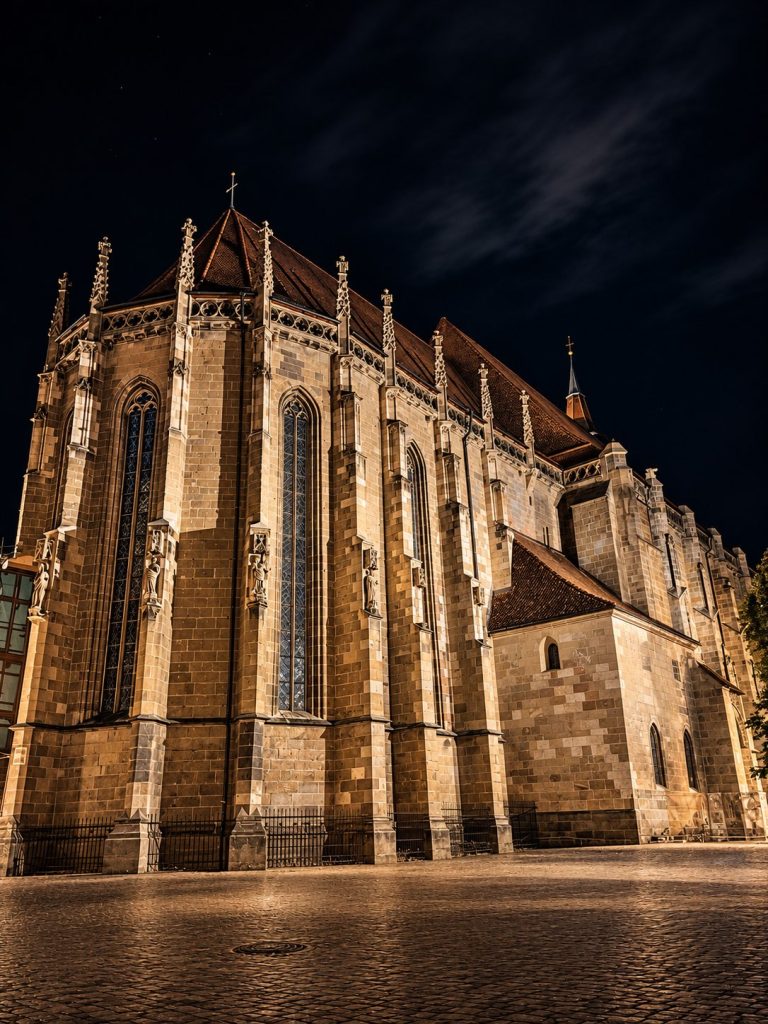
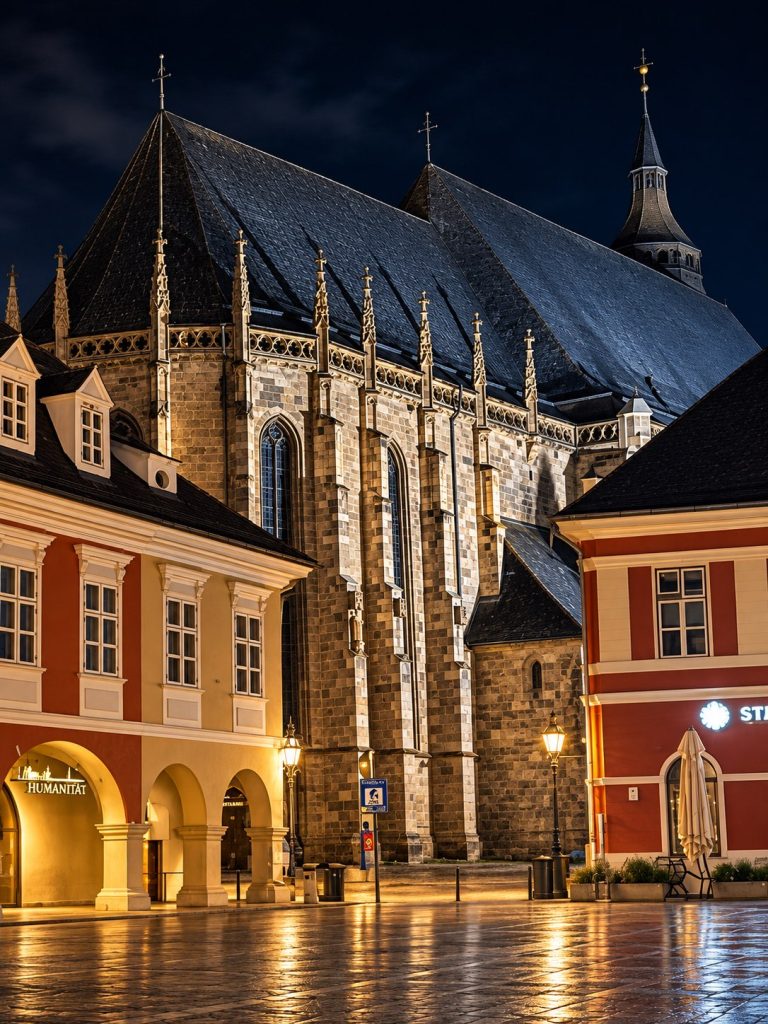
Night view of the choir exterior, highlighting the massive buttresses, soaring Gothic windows, and the fire-blackened stonework that preserves the memory of the 1689 catastrophe.
The Black Church Today
Today, the Black Church remains one of the defining landmarks of Brașov. Its position beside the historic town centre places it within the wider setting of the former Saxon town, where churches, civic buildings, guild houses and fortifications together preserve the memory of a distinctive urban culture.
Yet its significance extends beyond architectural scale or historical fame. The church embodies the continuity of a community through periods of prosperity, conflict, religious transformation and demographic change. It bears witness to the medieval ambition of Brașov’s burghers, the intellectual and spiritual influence of Johannes Honterus, the destruction of 1689 and the generations who contributed to its reconstruction.
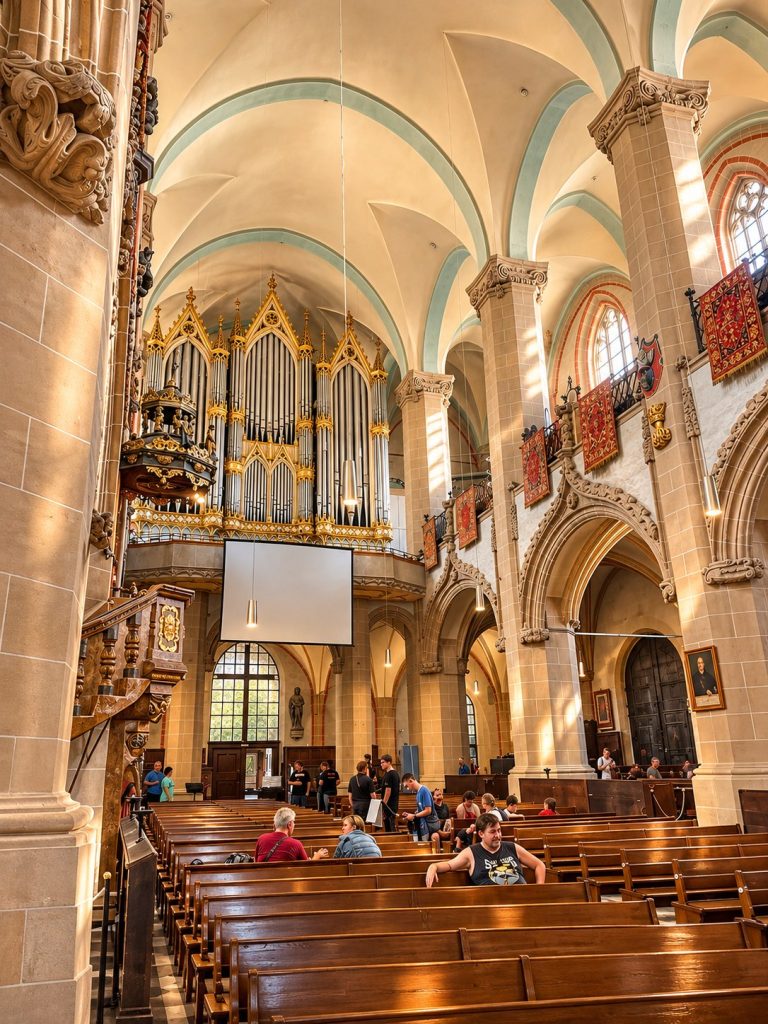
Its interior brings together objects from different worlds: a medieval baptismal font, Ottoman textiles acquired through trade, Baroque furnishings, a nineteenth-century altar and the great Buchholz organ. These are not unrelated treasures gathered under one roof. They are material evidence of the successive communities and historical circumstances that shaped the church.
The Black Church is therefore best understood not simply as a monument of Gothic architecture, but as a living historical record of Brașov and the Transylvanian Saxons. Its stones preserve the memory of the Middle Ages; its furnishings reveal the transformations of the early modern period; and its continuing religious and musical life connects that heritage with the present.
More than six centuries after its construction began, the church remains a place where architecture, faith, art and civic memory meet. Its history is not one of uninterrupted survival, but of repeated adaptation and renewal – a history that has made the Black Church one of the most enduring witnesses to the cultural heritage of Transylvania.
Basarab Heritage
— A.C.
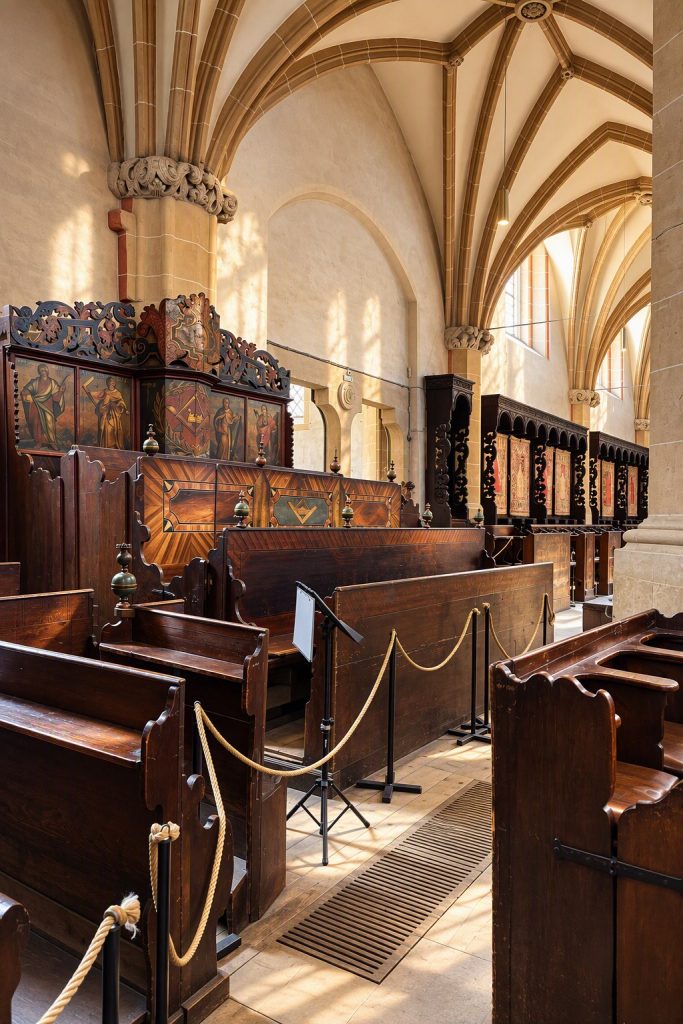
Detail of the historic wooden pews and guild seating within the interior, reflecting the social order and craftsmanship of Brașov’s early modern urban community.